



This article is the second in a two-part series about the mysterious and controversial death of Ellen Rae Greenberg

Suicide or Staged?
A few weeks before her death, Ellen Greenberg spoke with a longtime friend, Erica Hamilton, who was studying psychology to become a school counselor. Ellen expressed her concerns about the confidentiality of the information she shared with her new psychiatrist.
Erica explained that unless Ellen were to express homicidal or suicidal ideation, her psychiatrist is legally bound to keep everything confidential. In Erica’s own words, she then point-blank asked Ellen if she was suicidal, and Ellen responded with a resolute no. Dr. Berman had taken notes in her appointments with Ellen, and she had clearly indicated that Ellen was not suicidal
In the week leading up to Ellen’s death, she had just finished mailing out the save-the-date cards for her upcoming wedding. Only four days before she died, Ellen had gone bridesmaid dress shopping with friend and fellow bride-to-be, Alyson Stern.
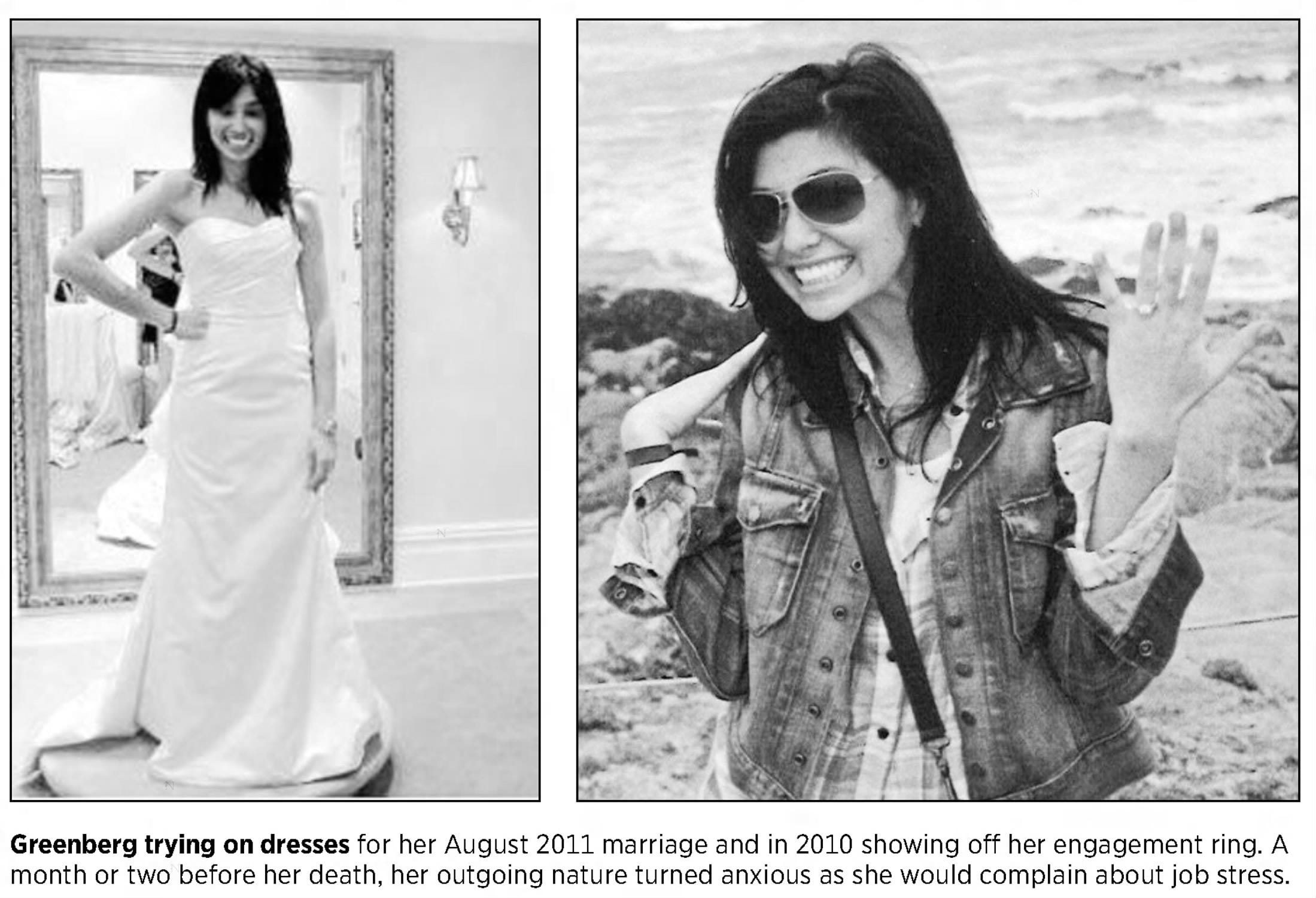
After arriving home on January 26th, Ellen had been working on student grades. Her friends and family believe these facts all paint the picture of a woman who was not preparing to end her own life.
Additionally, multiple sources confirmed the absence of any suicide note, as well as the lack of any concerning evidence on any of Ellen’s devices. The ME Investigation Report noted there was “No note found or anything indicative of suicide on the computers or in the rest of the apartment.” The final autopsy report, in the Findings section, stated, “Analysis of the decedent’s laptop provided no additional information.”
After the devices were returned to the PPD, all three laptops and Ellen’s cell phone were sent to the Philadelphia Regional Computer Forensics Laboratory (RCFL) to be analyzed. Following this analysis, a police report summarizing the findings stated, “Keyword searches were done on every computer searching for suicide information, and the examination did not reveal anything remarkable.”
Per an FBI report from the DOJ, which the Greenbergs’ attorney received in the fall of 2020, there was “a notation in PPD’s records [which] indicated that no findings were made following the FBI’s review.”
Ellen’s search history was not part of the conversation until the Attorney General’s office took over the case from the local District Attorney in 2018. In March 2019, Inquirer columnist Stephanie Farr reached out to the AG’s office regarding Ellen’s case and her manner of death.
In an email response, the AG’s office representative mentioned “additional evidence” reviewed by the office since 2018, which included web searches for “methods of committing suicide,” “quick death,” and “depression” made by Ellen in the weeks prior to her death.
The AG upheld the suicide ruling, and seven months after they reported this new evidence of Ellen’s alleged search history, Josh and Sandee Greenberg filed a civil suit against the ME’s office to have Ellen’s manner of death changed.
2019 Civil Lawsuit
In preparation for their civil lawsuit, the Greenbergs retained a technology expert to examine the alleged search history. Per the Greenberg’s attorney Joseph Podraza Jr., “Our expert states that the ‘searches’ identified by OAG were not direct searches but instead phantom searches which appear because of analytics.”
The expert, along with many other technology experts, has confirmed that search histories can be fabricated easily and searches can be added retroactively. Podraza has maintained that he has made numerous requests to the AG for a copy of the digital forensic report, but none have ever been provided.
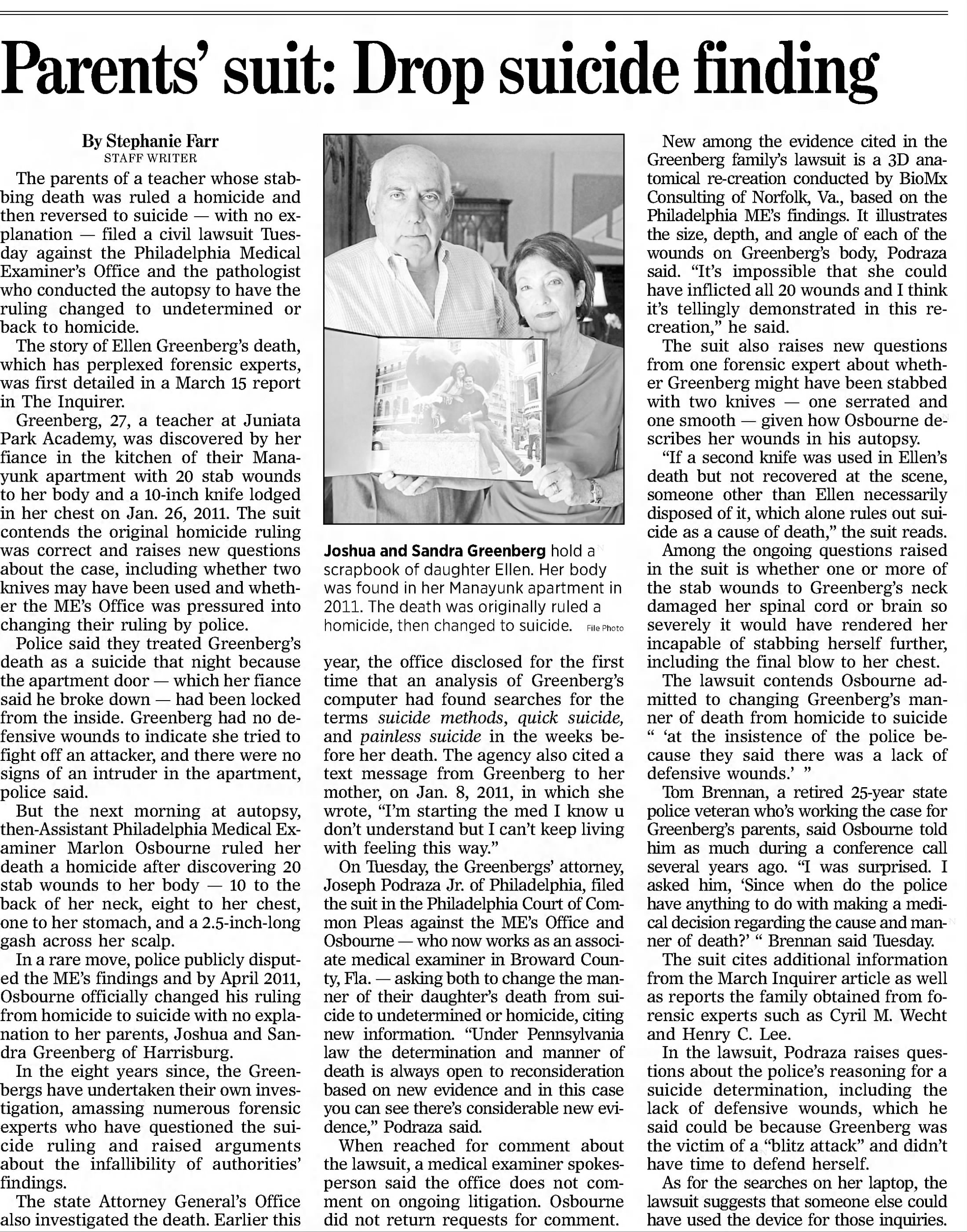
The Greenbergs’ first civil suit was filed in 2019 against the city of Philadelphia’s MEO and Dr. Marlon Osbourne, seeking to have Ellen’s death reinvestigated impartially and her manner of death changed to something other than suicide.
In the autopsy report, Dr. Osbourne claimed that Dr. Lucy Rorke-Adams, a renowned neuropathologist who, after leaving the ME’s office, later agreed to provide neuropathology consults on a contract basis, had examined Ellen’s spinal cord. In 2018, the Inquirer’s Stephanie Farr reached out to Dr. Rorke-Adams regarding this examination, for which no official report had ever been found.
In their email exchange, Dr. Rorke-Adams explained that every consultative service she provided to the Philadelphia MEO was performed under contract, with the cost determined by the extent of the examination (i.e., physical vs. microscopic). She stated that for each report, a detailed invoice was created, which included the OME case number, the decedent's name, the date of the completed exam, and the associated charges.

Regarding Ellen’s case, Dr. Rorke-Adams then stated, “If there is no neuropathology report in the case file and no record that I charged for an examination, I would conclude that I did not see the specimen in question, although there is a remote possibility that it was shown to me. However, I have no recollection of such a case.”
