


*Warning: This Article Contains Sensitive Subject Matter*
Background
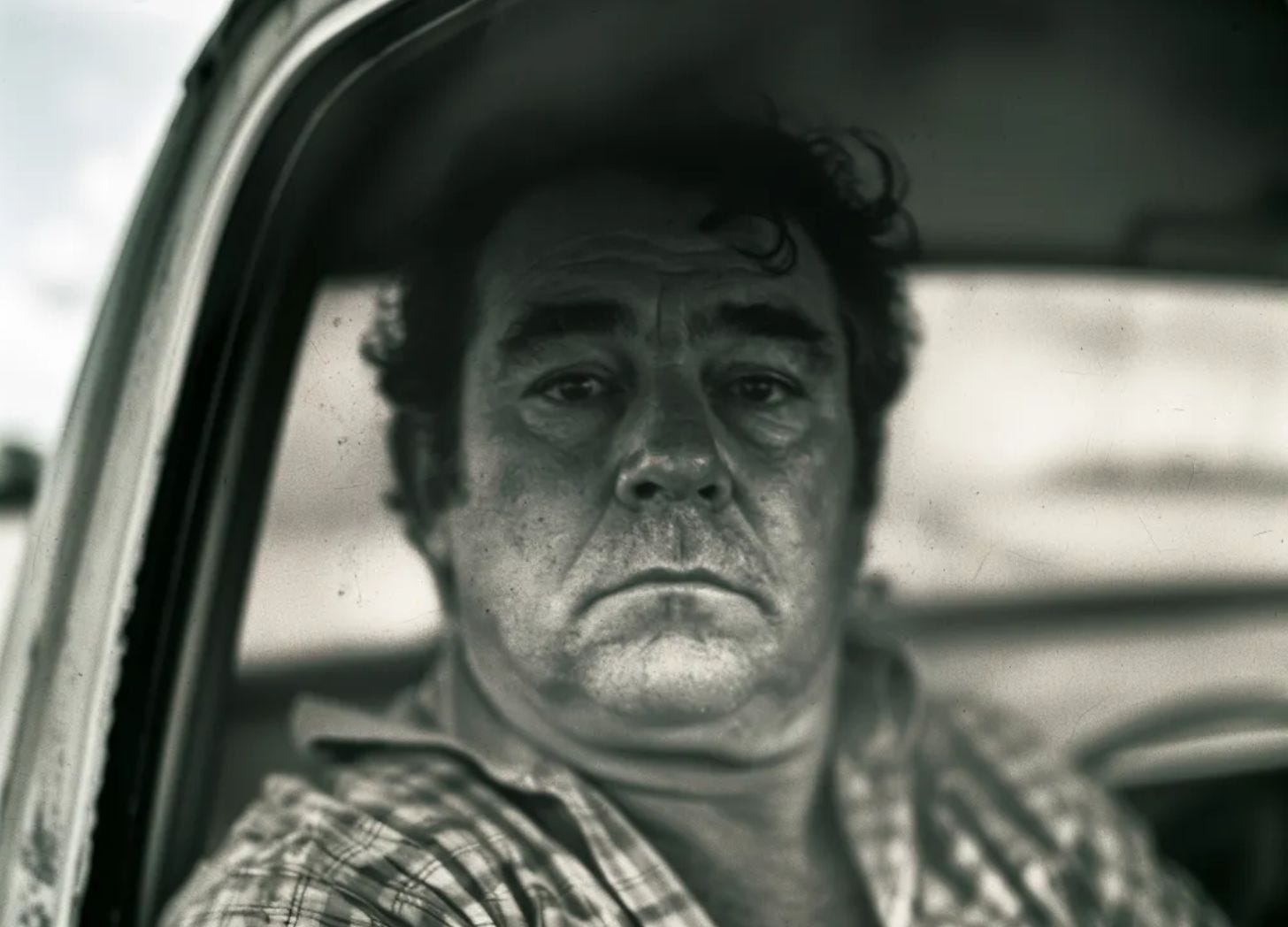
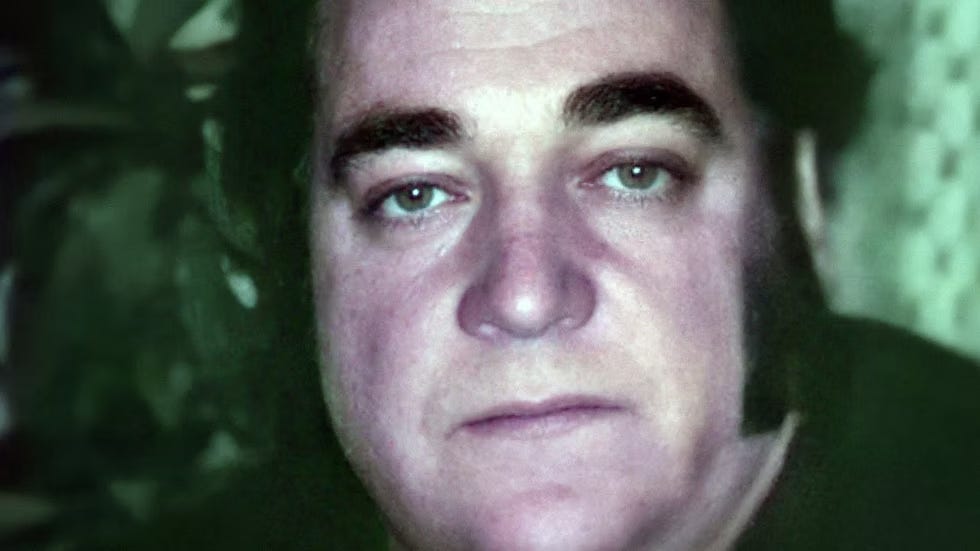
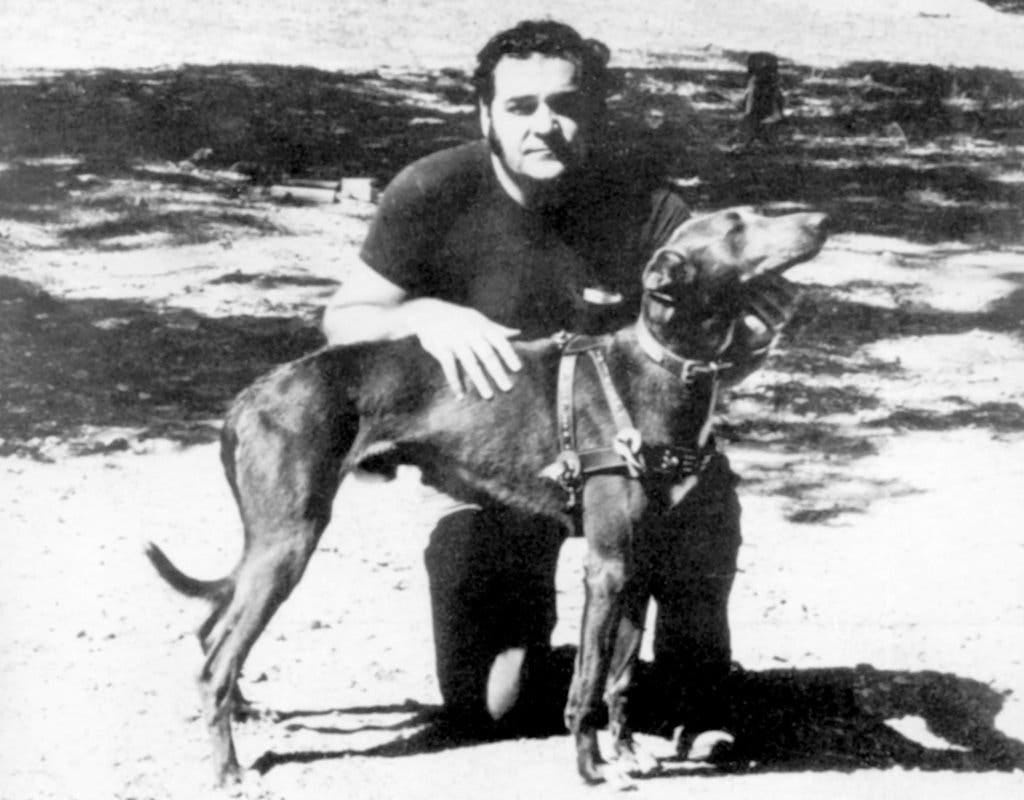
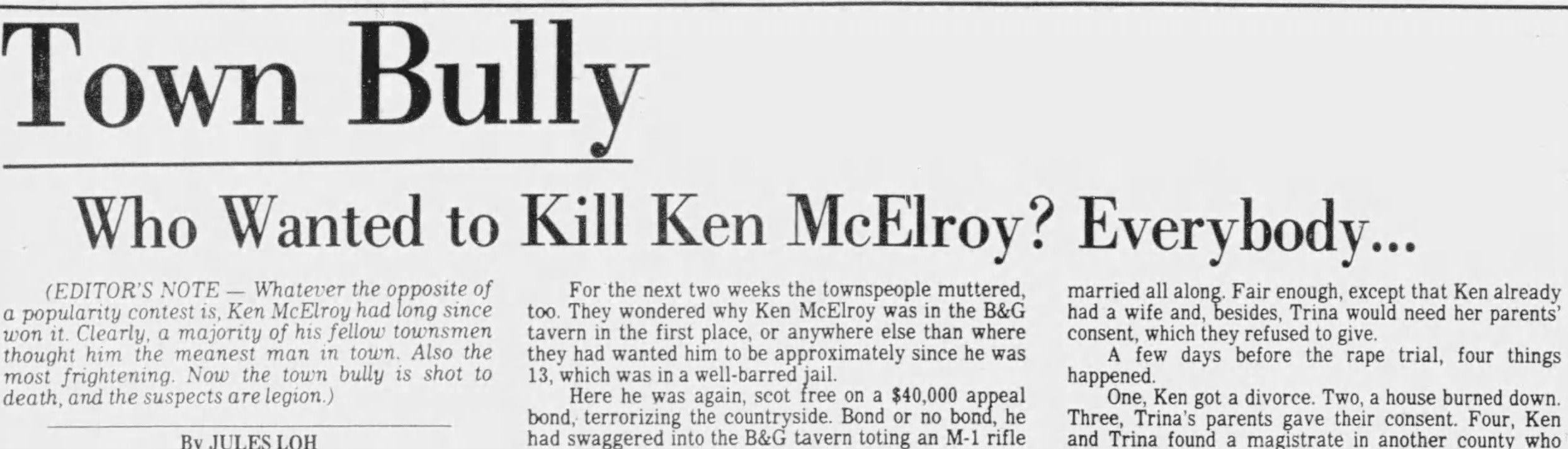
For years, the shadow of Ken McElroy loomed large over the tiny town of Skidmore, located in northwest Missouri. McElroy was a violent bully and criminal who had been indicted more than 20 times over the years for various crimes, yet somehow he always managed to go free.
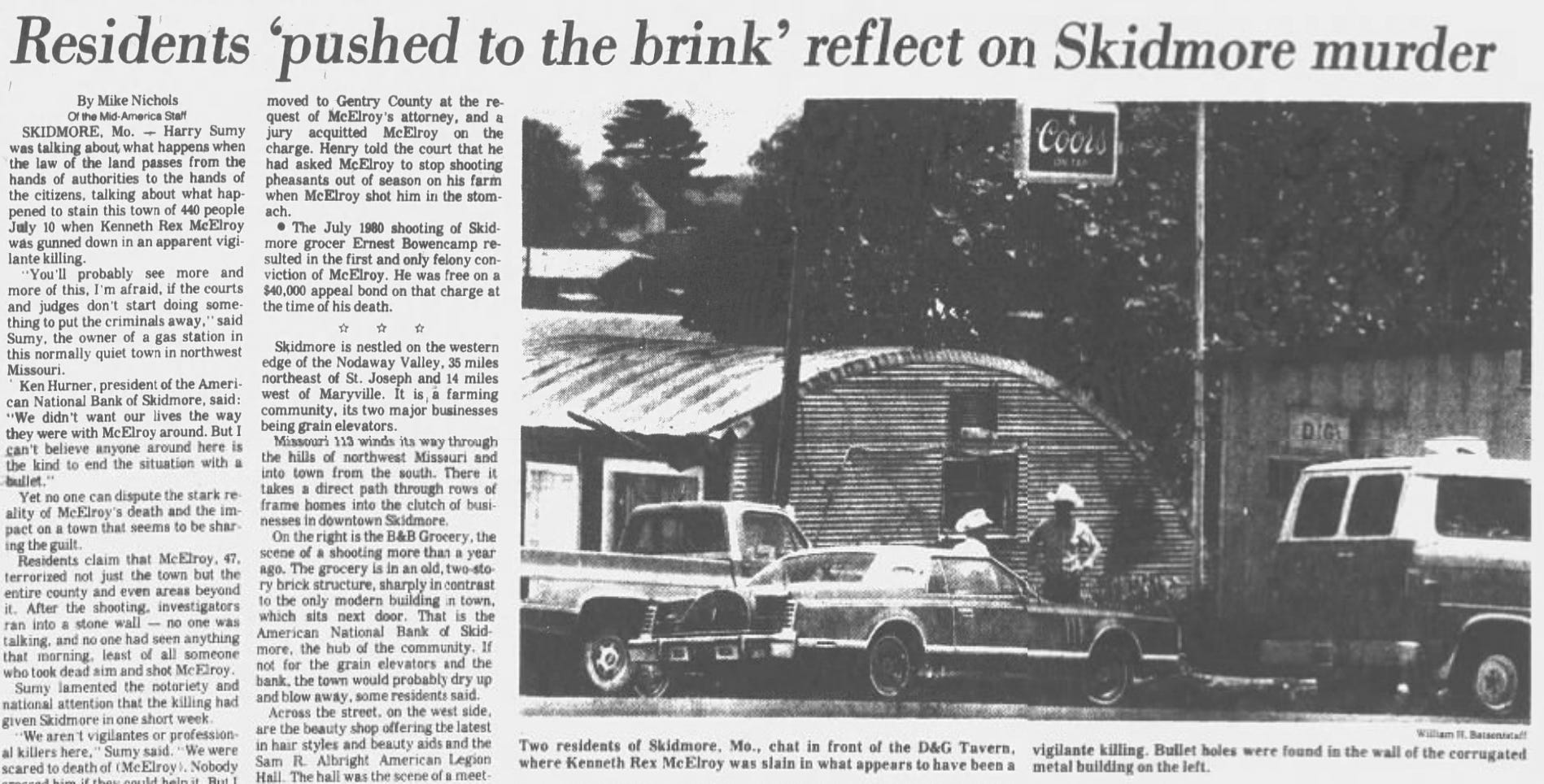
Then one hot July day in 1981, McElroy’s long campaign of fear and intimidation came to a violent end as he was gunned down while sitting in his pickup truck. The shooting happened in front of dozens of people, and yet, no one claimed to have seen anything. Not one of the witnesses would identify the shooters. Today, the murder of Ken McElroy remains unsolved.
The Town Bully
Ken Rex McElroy was born on June 16, 1934, the fifteenth of sixteen children. His parents, Tony and Mabel, were poor tenant farmers who moved from place to place between Kansas and the Ozarks before eventually settling outside Skidmore, Missouri. The town is located in the northwest corner of Missouri and, at the time, had a population of fewer than 500 residents.
By the time Ken was a teenager, he had already developed a nasty reputation that would follow him for the rest of his life. He dropped out of school at age 15, while in the eighth grade, and quickly became known in the area as a cattle rustler, thief, and troublemaker.
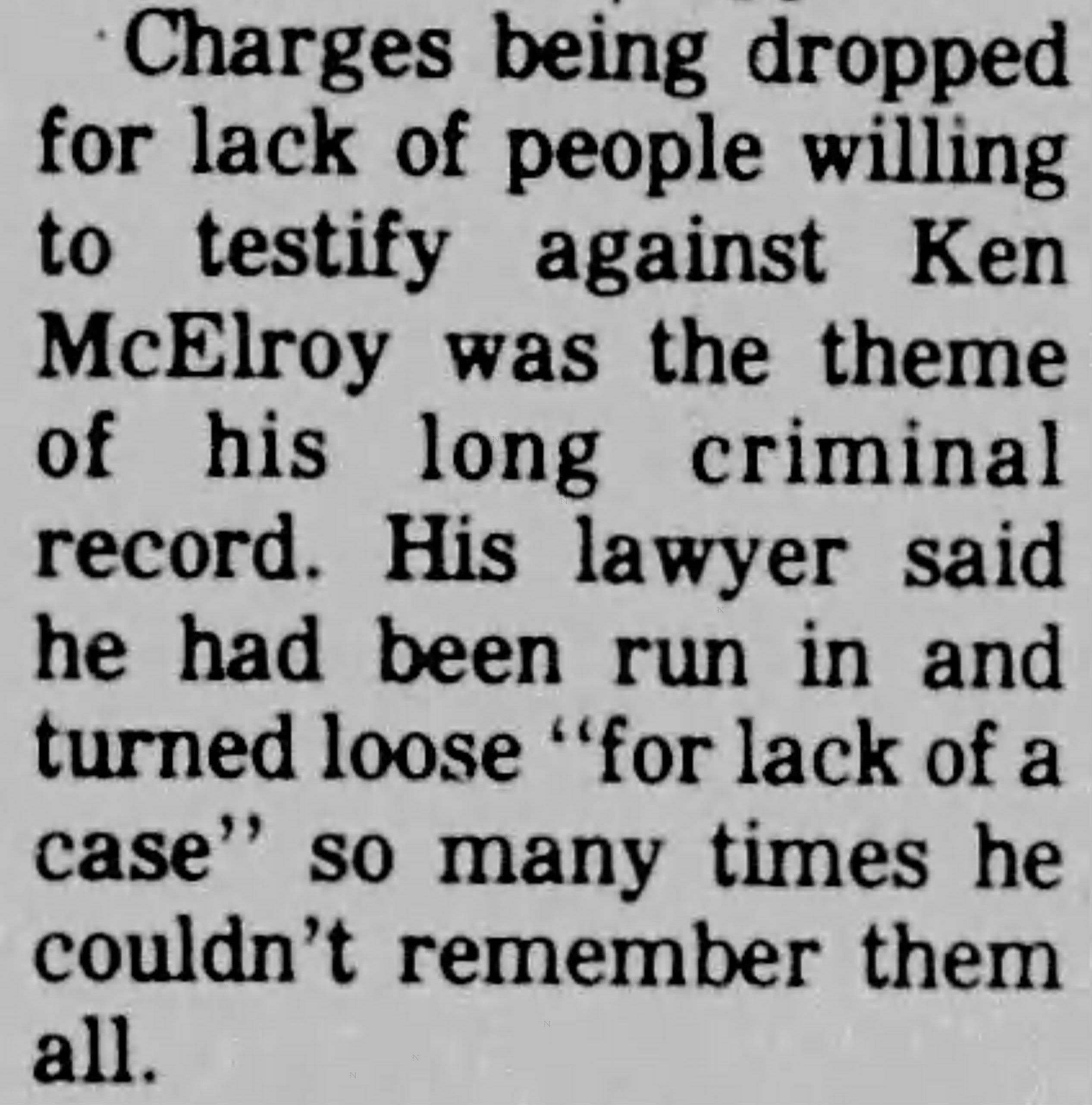
Throughout his life, McElroy was accused of dozens of serious crimes. These accusations included assault, child molestation, statutory rape, arson, animal cruelty, hog and cattle rustling, burglary, and theft involving grain, gasoline, alcohol, antiques, and livestock. Over the years, McElroy was indicted 21 times. Yet he escaped conviction every time but the last.
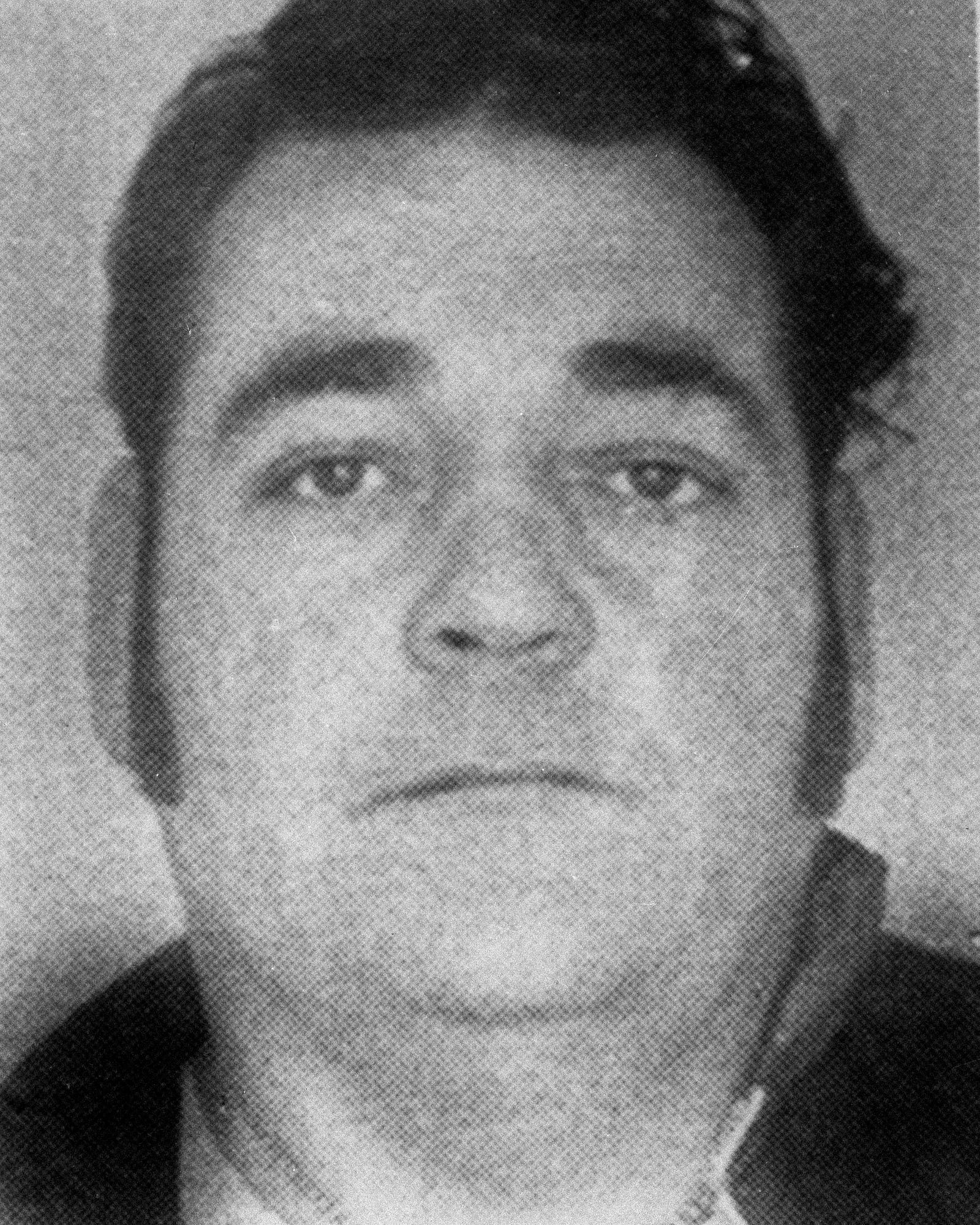
This became a major part of his legend in Skidmore. It was not just that McElroy was accused of crime after crime. It was that, no matter how serious the accusation, he always seemed to walk away free.
Witnesses became afraid. Victims hesitated. People changed their stories. Some refused to testify altogether. Many said this was because McElroy intimidated them. He was known to follow people, park outside their homes, and watch them for hours. To the people of Skidmore, the message was clear: if you crossed Ken McElroy, he would not forget it.
Reign of Fear
By the 1970s, McElroy’s name had become synonymous with fear in Nodaway County. He was often armed, openly confrontational, and quick to make threats. If someone accused him, he intimidated them. If someone testified, he followed them. If the law came after him, the case somehow collapsed.
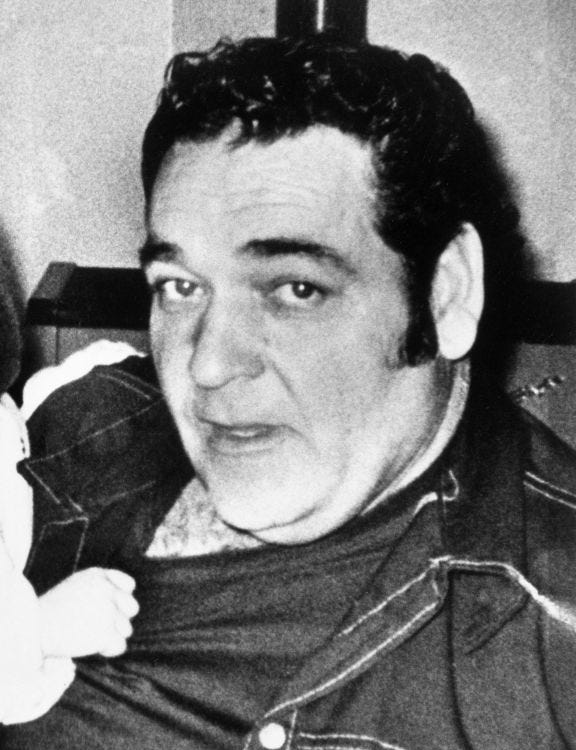
McElroy had at least 17 children by multiple wives and other young women and girls, but the sheer number of children was less important than the pattern that surrounded his life. His relationships, his disputes, and his criminal accusations all seemed to carry the same theme: power through fear. And for more than two decades, that fear worked. Many Skidmore residents believed the courts had become useless against him.
One of the darkest parts of McElroy’s life involved Trena McCloud, who would later become his last wife. McElroy met Trena when she was only 12 years old and in the eighth grade. He was 35. What followed was a deeply disturbing pattern of abuse, coercion, and intimidation.
According to accounts of the case, McElroy raped Trena repeatedly. When her parents opposed the relationship, McElroy allegedly terrorized the family into submission. The McCloud family’s home was burned down, and their dog was shot.
Trena became pregnant at 14. After leaving school in the ninth grade, she moved into the home McElroy shared with his third wife, Alice. McElroy later divorced Alice and married Trena. Many believed the marriage was a way for him to avoid statutory rape charges, since Trena was the key witness in the case against him.
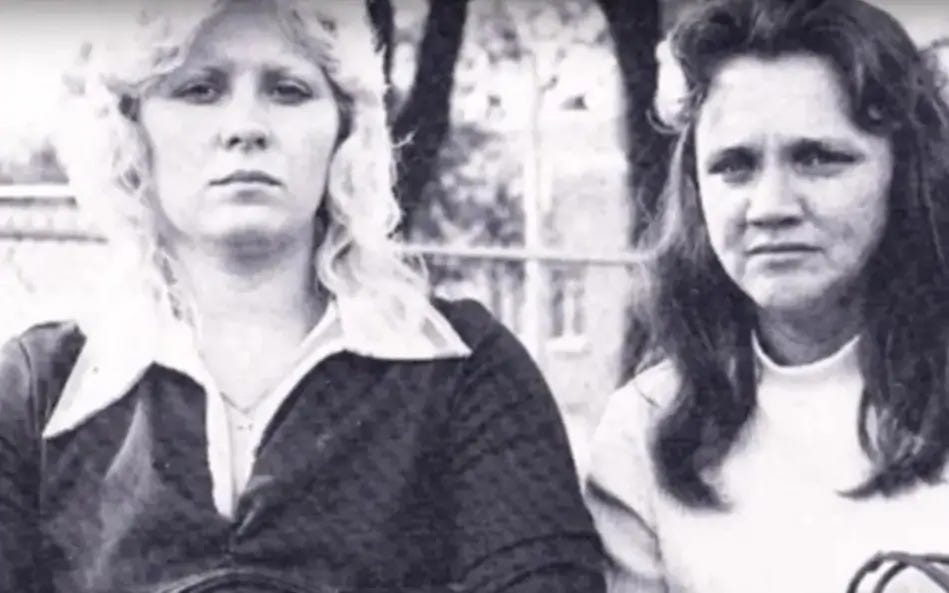
In June 1973, McElroy was indicted on charges of arson, assault, and statutory rape. He was arrested, booked, arraigned, and then released on $2,500 bail. For Trena and her baby, however, freedom from McElroy was still out of reach. They were placed in foster care at a home in Maryville, Missouri, but McElroy soon found them.
He reportedly sat outside the foster home for hours, staring at the house and making his presence impossible to ignore. Then came one of the most chilling threats connected to the entire case: McElroy allegedly told the foster family he would trade “girl for girl” to get his child back, because he knew where their biological daughter went to school and which bus route she took.
Additional charges were filed against him, but once again, this did little to slow McElroy’s threats and intimidation. Even after Trena gave birth, McElroy’s control over her did not stop. Just sixteen days after the baby was born, Trena and Alice ran to Trena’s parents’ home, hoping to get away from him. But according to court records, McElroy tracked them down and brought them back. Later, while the McClouds were away, their home was allegedly set on fire again, and their new dog was shot.
For many in Skidmore, the McCloud family’s suffering was another reminder of what happened when anyone tried to stand up to Ken McElroy.
A Pattern of Violence
On July 27, 1976, Romaine Henry, a farmer from Skidmore, claimed McElroy shot him twice with a shotgun after Henry confronted him for firing weapons on his property. McElroy was later charged with assault with intent to kill. The accusation was serious. Henry had been shot, and he named McElroy as the person responsible.
As the case dragged on, Henry said McElroy parked outside his home at least 100 times before trial. It was the kind of intimidation people in Skidmore had come to expect.
At trial, McElroy denied being at the scene. Two raccoon hunters testified that they were with him away from Henry’s property on the day of the shooting. McElroy’s attorney, Richard Gene McFadin, focused heavily on Henry’s credibility. Under questioning, Henry was forced to admit that he had concealed a petty criminal conviction from more than three decades earlier. In the end, McElroy walked free.
Reports later claimed that McElroy had stalked and intimidated members of the jury before the trial. It was also reported that a barn owned by the judge was burned down. Whether every rumor was true or not, the effect was the same. The people of Skidmore believed that McElroy had once again escaped accountability, and that belief made him seem even more untouchable.
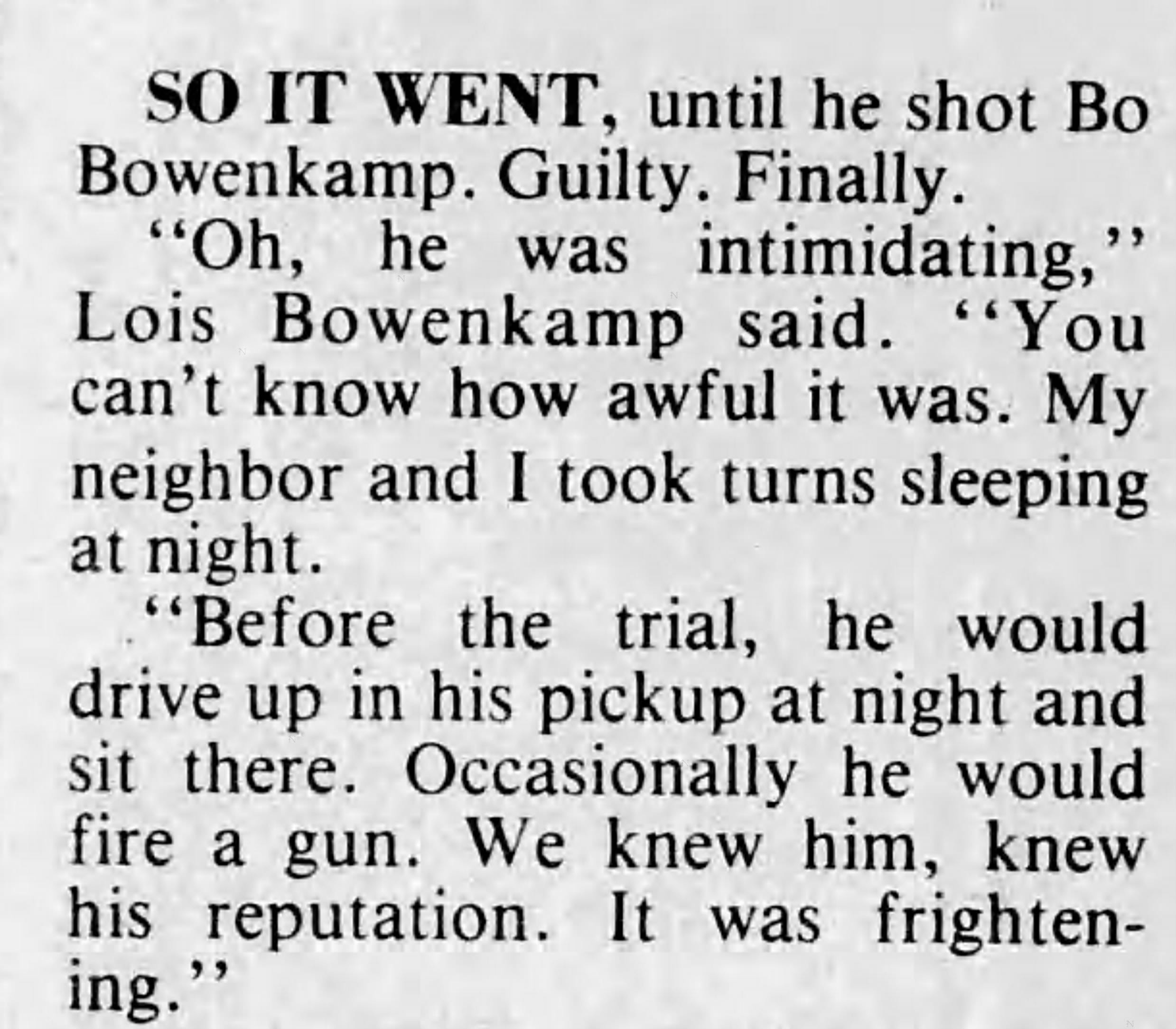
The incident that finally brought Skidmore to its breaking point began in 1980 at a local grocery store owned by Ernest “Bo” Bowenkamp and his wife, Lois. Bo Bowenkamp was 70 years old. He and Lois were ordinary small-town business owners, the kind of people who should have been able to spend their later years running their store in peace. Instead, they became the center of the conflict that would eventually lead to McElroy’s death.
The trouble reportedly began when one of McElroy’s daughters got into an argument with a store clerk named Evelyn Sumy. The girl was allegedly accused of trying to steal candy. It was a small incident, the kind of thing that might have ended with a warning in any other town. But with Ken McElroy, small disputes rarely stayed small.
McElroy began stalking and harassing the Bowenkamp family. Eventually, he confronted Bo Bowenkamp in the back of the store while holding a shotgun. During the confrontation, McElroy shot Bowenkamp in the neck. Miraculously, Bo survived. This time, it seemed that McElroy had finally gone too far.
He was arrested and charged with first-degree assault, a charge that could have carried a life sentence. For a town that had watched him escape serious punishment again and again, the Bowenkamp case looked like the moment the system might finally work.
In June 1981, McElroy was convicted of second-degree assault. He was sentenced to two years in prison. For Skidmore, the conviction should have brought relief. Instead, it brought fear. McElroy was released on bond pending appeal.
Despite the conviction, McElroy did not fade into the background. If anything, he carried himself as though nothing had changed — as though he still believed no one had the power to stop him. On June 30, 1981, McElroy appeared at the D&G Tavern, a local bar in Skidmore. He was armed with an M1 Garand rifle with a bayonet attached. While there, he reportedly threatened Bo Bowenkamp.
To the people in town, this was not just another ugly scene. It was a warning. McElroy had been convicted of shooting a 70-year-old grocer in the neck, had been released on bond, and was now allegedly threatening the same man again. The question hanging over Skidmore was no longer whether McElroy was dangerous. That had long been answered.
The question now was whether anyone would stop him before someone else was hurt or killed.
Town Meeting
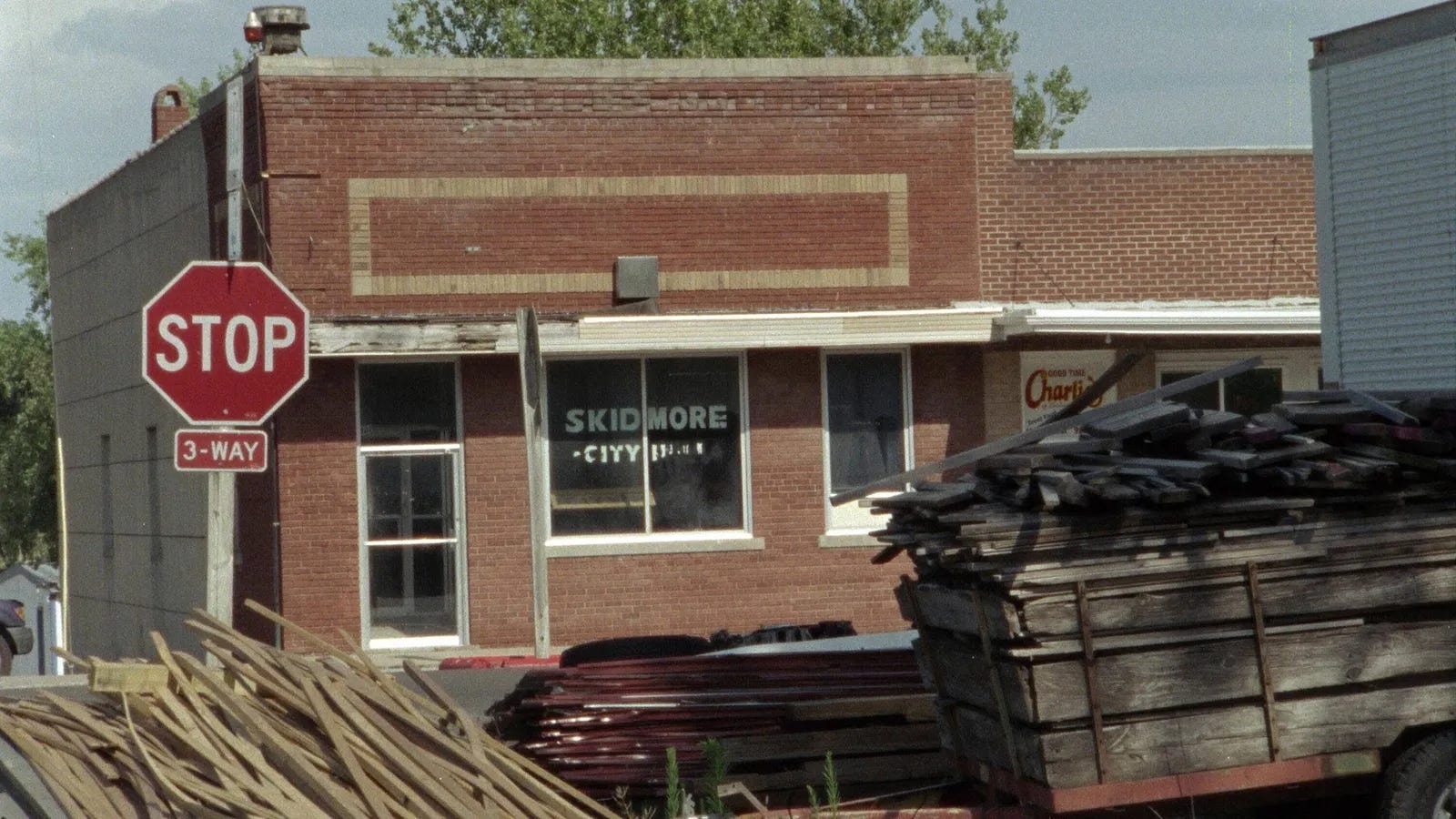
On July 10, 1981, many Skidmore residents were expecting McElroy to appear in court again — this time for a hearing to revoke the bond that had kept him free since the D&G Tavern incident. But when the court date arrived, they learned that McElroy’s attorney had won a continuance, and the hearing had been rescheduled. For a town already exhausted by years of threats, delays, and failed prosecutions, the news felt like yet another setback. Frustrated and frightened, residents gathered at the Legion Hall to discuss what could be done.
Nodaway County Sheriff Danny Estes attended the meeting and reportedly advised the citizens not to confront McElroy directly. He suggested they consider forming a neighborhood watch. But for many people in Skidmore, that answer must have felt painfully hollow. They had already seen the courts fail them. They had seen witnesses grow too afraid to speak.
Soon word spread that McElroy and his wife, Trena, were at the D&G Tavern. Many of the people at the meeting began making their way toward the tavern. The place filled with townspeople. McElroy sat inside drinking. Eventually, he bought a six-pack of beer, left the bar, and climbed into his red pickup truck with Trena beside him.
What happened next would forever be remembered in Skidmore.
The Killing of Ken McElroy
As McElroy sat in his truck, shots rang out. McElroy was hit twice by two different-sized bullets. The use of different types of ammunition suggested that at least two firearms were involved. Some accounts described gunfire coming from different directions. Trena was sitting beside him when the shooting began. She scrambled from the truck, screaming, covered in blood. A man helped her away from the vehicle.
When it was over, Ken McElroy was dead. There were dozens of people present. Estimates place the number of potential witnesses somewhere between 30 and 46. It was broad daylight. This was not a hidden murder in a dark alley. It happened on the main street of a small town where everyone knew everyone.
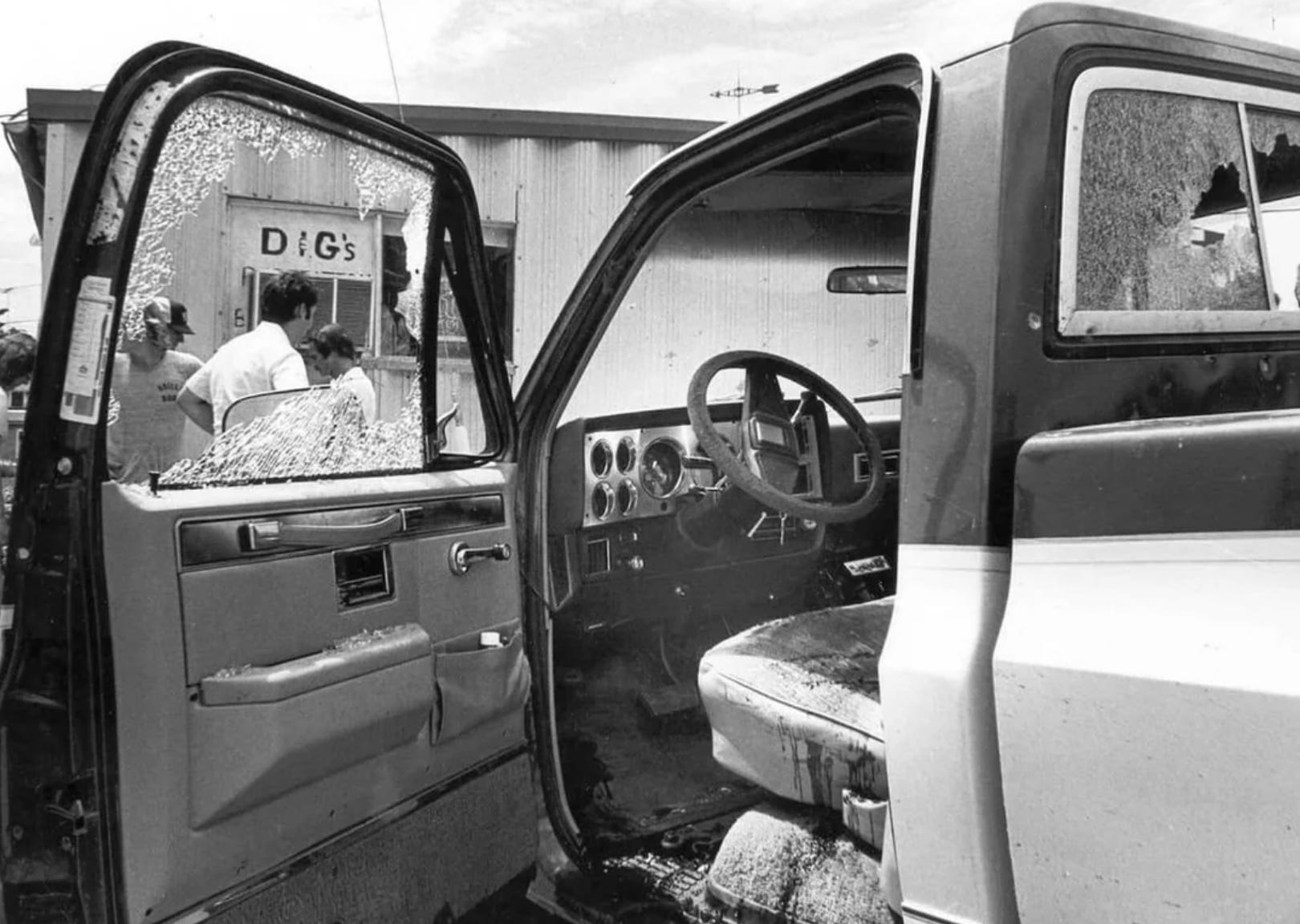
And yet, when investigators began to ask questions, the answer was silence. Nobody saw the shooter. Nobody could identify the gunmen. Nobody admitted knowing anything. And nobody had bothered to call for help.
After years of living under McElroy’s shadow, Skidmore had closed ranks. Whether out of fear, loyalty, relief, or a shared belief that justice had already been served, the town refused to turn in his killers.
Wall of Silence
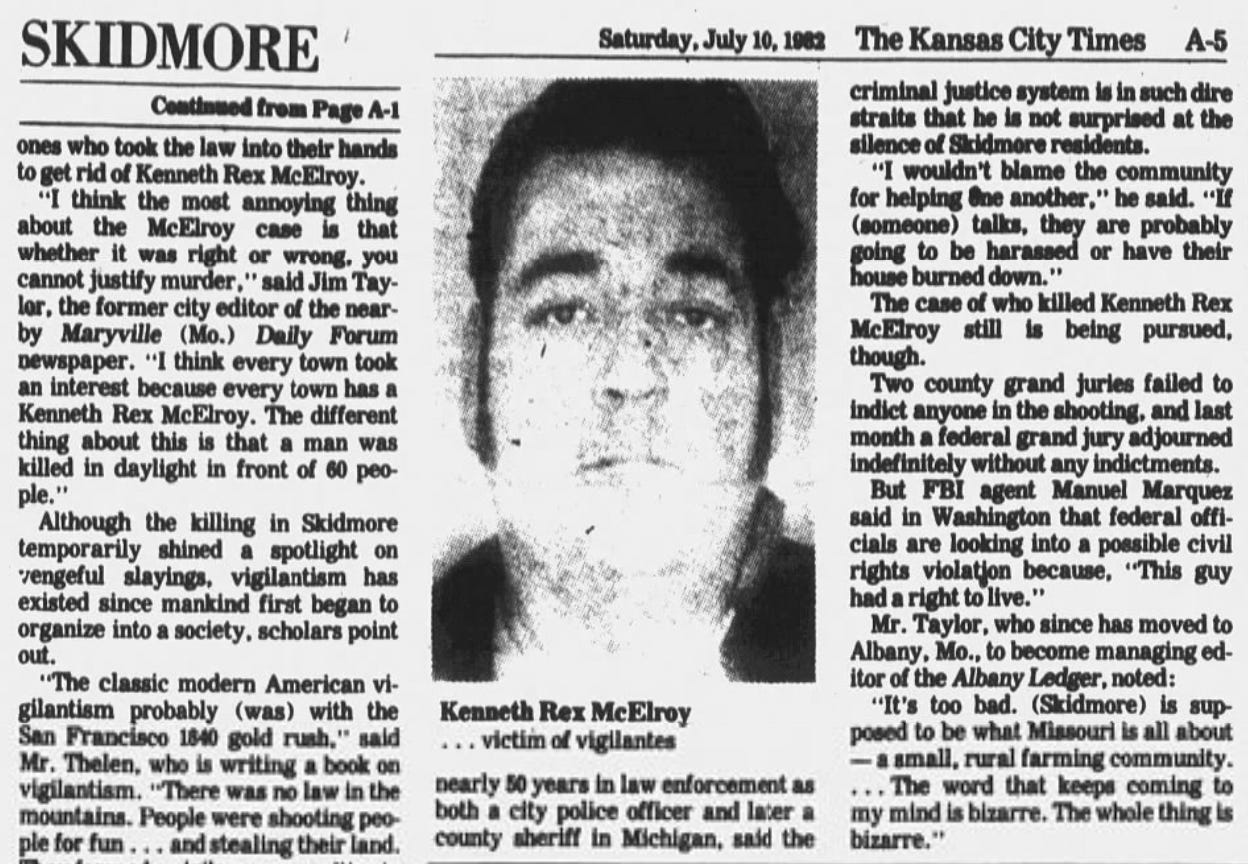
Despite the number of witnesses present at the time of the shooting, the case remained unsolved. It was confirmation that the residents of Skidmore both feared and detested McElroy, and that he had finally gotten what was coming to him.
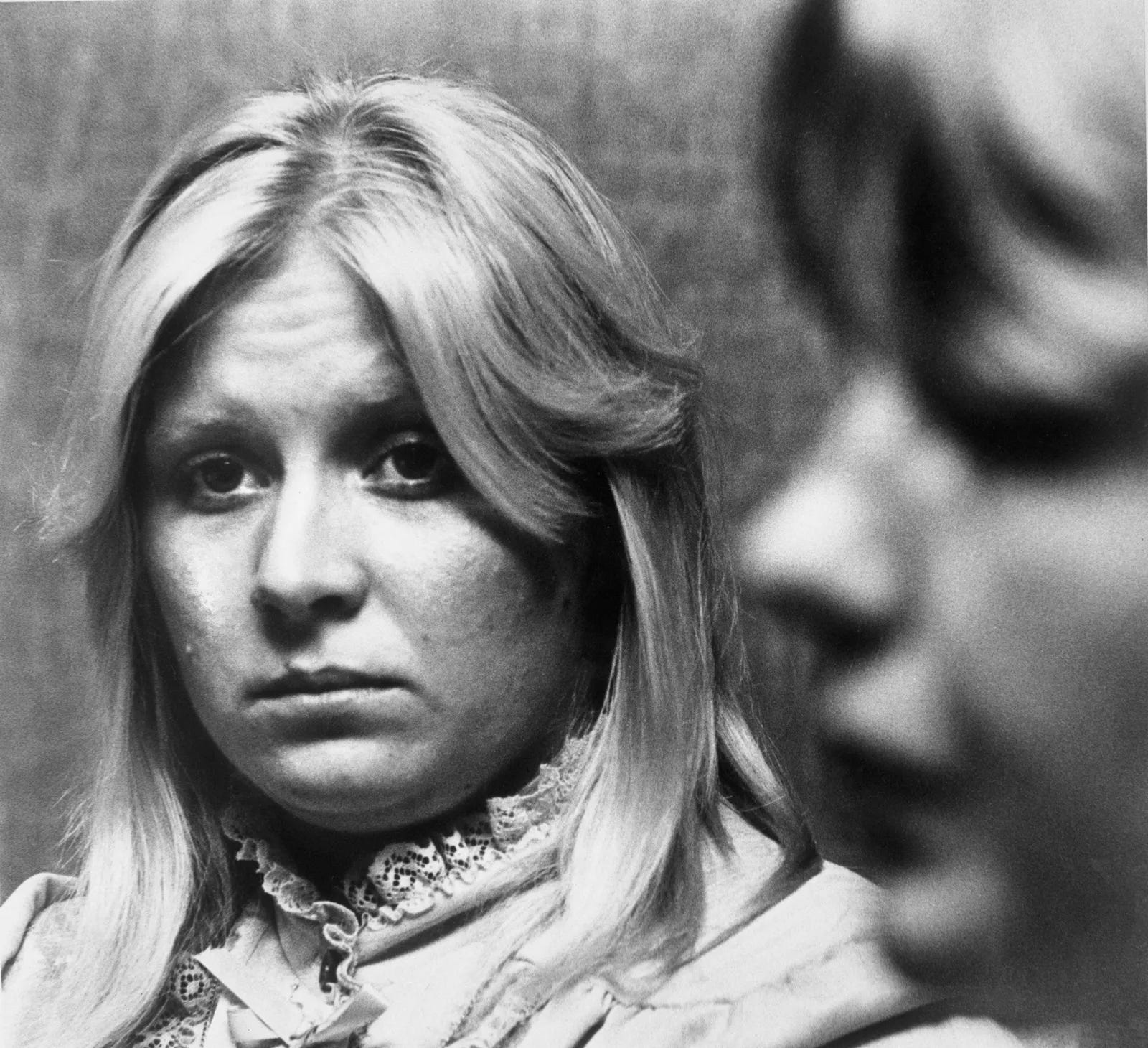
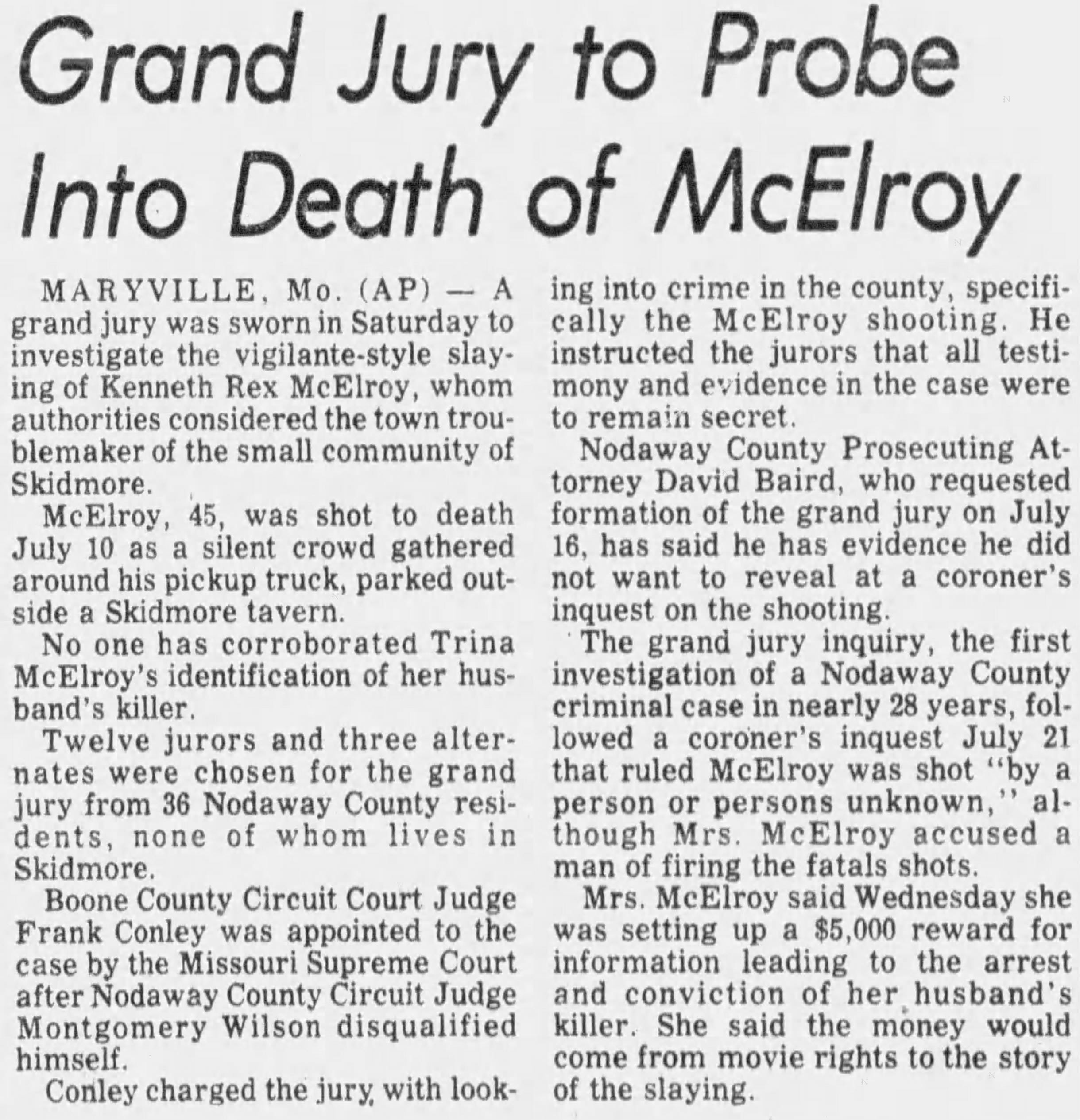
Trena McElroy later accused Del Clement of being one of the shooters. However, Clement was never charged, and he denied any involvement until his death in 2009. Prosecutors declined to press charges, and an extensive federal investigation also failed to produce an indictment.
Many believed the residents had simply decided that the system had failed them for too long, and that it was up to them to finally put an end to McElroy’s reign of terror. Missouri-based journalist Steve Booher later described the sentiment of many townspeople in a simple phrase: “He needed killing.”
Aftermath
Ken McElroy was buried at Memorial Park Cemetery in St. Joseph, Missouri. But his death did not end the controversy.
On July 9, 1984, Trena McElroy filed a $5 million wrongful death lawsuit. The lawsuit named the Town of Skidmore, Nodaway County, Sheriff Danny Estes, Skidmore Mayor Steve Peters, and Del Clement, the man Trena accused of being involved in the shooting.
The suit was settled out of court for $17,600. No one admitted guilt. The settlement was reportedly made to avoid the cost of continued legal fees. Trena later remarried and moved to Lebanon, Missouri. She died of cancer on January 24, 2012.
As for Skidmore, the town would never fully escape the shadow of the McElroy case. The story has been revisited again and again: in Harry N. MacLean’s Edgar Award-winning 1988 book In Broad Daylight and the 1991 television film it inspired, in the 2019 documentary series No One Saw a Thing, and most recently in KENREX, the Olivier Award-winning one-man play that opened in New York in April 2026. But what continues to fascinate people is not just the killing itself — it is what the case reveals about fear, justice, silence, and what can happen when a community feels the law has failed them.
More than four decades later, the death of Ken McElroy remains one of the most infamous alleged acts of vigilante justice in American history.
His story has been told and retold because it does not fit neatly into a simple moral category. McElroy was not an innocent man randomly gunned down. He was a convicted assailant and a man accused of a long history of violence, intimidation, and abuse. At the same time, he was also a murder victim, killed in public by people who were never brought before a court.
That is what makes the case so unsettling.
It is not just a story about a criminal. It is not just a story about a killing. It is a story about a town pushed so far that violence became its final answer. Ken McElroy was known as “the town bully,” but by the end, that title no longer belonged only to him. The real bully in Skidmore may have been fear itself. Fear of McElroy. Fear of retaliation. Fear that the courts would fail again. Fear that speaking up would only bring more violence.
To this day, no one has been charged with the killing of Ken Rex McElroy.
Last updated: July 2026 — forty-five years on, the case remains unsolved.
Sources:
UPI Archives — Trena McElroy's $5 Million Wrongful Death Lawsuit. https://www.upi.com/Archives/1984/07/10/The-widow-of-the-town-bully-in-Skidmore-Mo/9407458280000
Harry N. MacLean — Ken McElroy's intimidation of Skidmore and the Bo Bowenkamp store incident. https://www.harrymaclean.com/in-broad-daylight
Missouri Life — Skidmore Revisited Part 1: The Death of Ken McElroy. https://missourilife.com/skidmore-revisited-part-1-death-ken-mcelroy-2
Wikipedia — “Ken McElroy.” https://en.wikipedia.org/wiki/Ken_McElroy
A&E — “A Missouri Town Goes Quiet After Bully Is Shot.” https://www.aetv.com/articles/ken-rex-mcelroy-vigilante-murder-skidmore-unsolved
Inside Edition — “The Unsolved Murder of Missouri Town Bully Ken Rex McElroy.” https://www.insideedition.com/the-unsolved-murder-of-missouri-town-bully-ken-rex-mcelroy-no-one-saw-a-thing-54856
Find a Grave — Trena Louise McElroy Williams (1957–2012). https://www.findagrave.com/memorial/84375228/trena_louise-mcelroy_williams

Actually I think it fits neatly into a simple moral category: when the State fails the People may act. A State which collects taxes and does not uphold the civil order is just committing theft.
Good read. Ken McElroy was one of the world's all-time, championship dirtbags.