


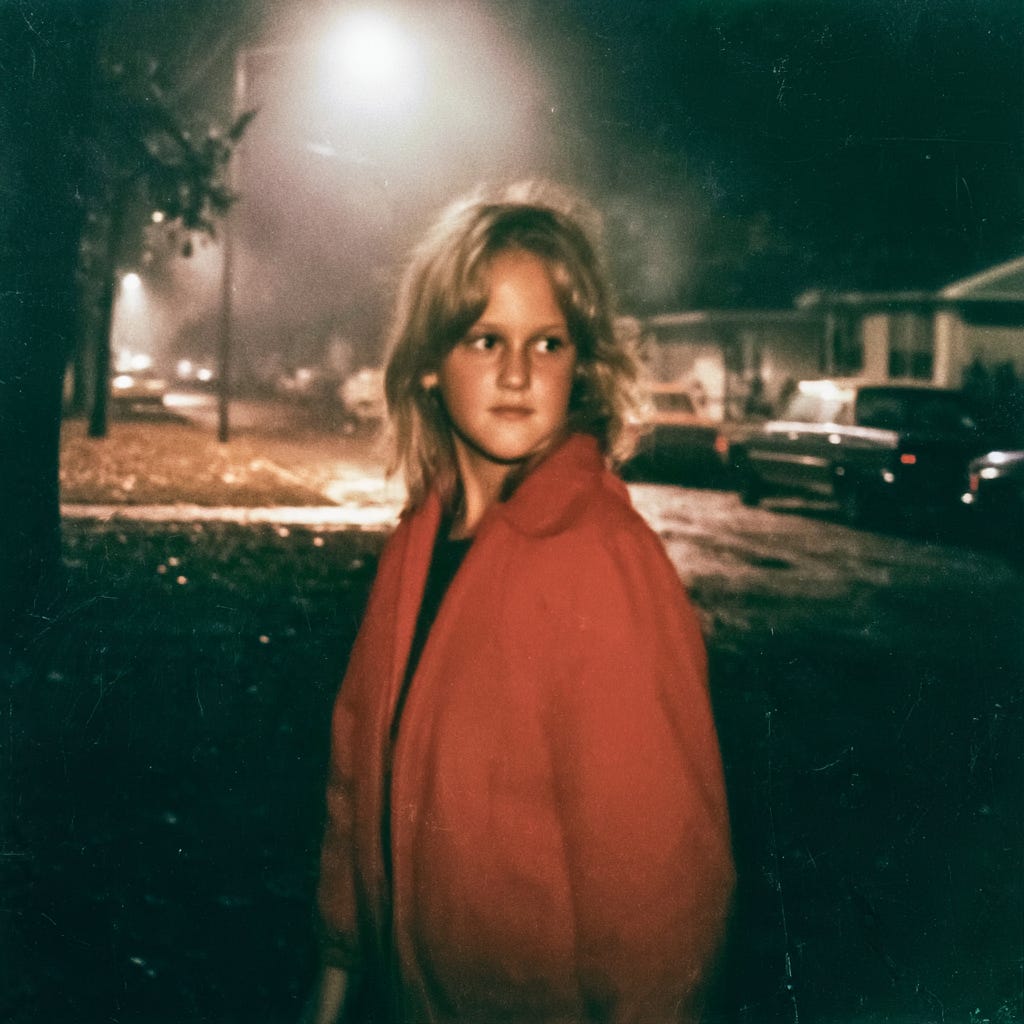
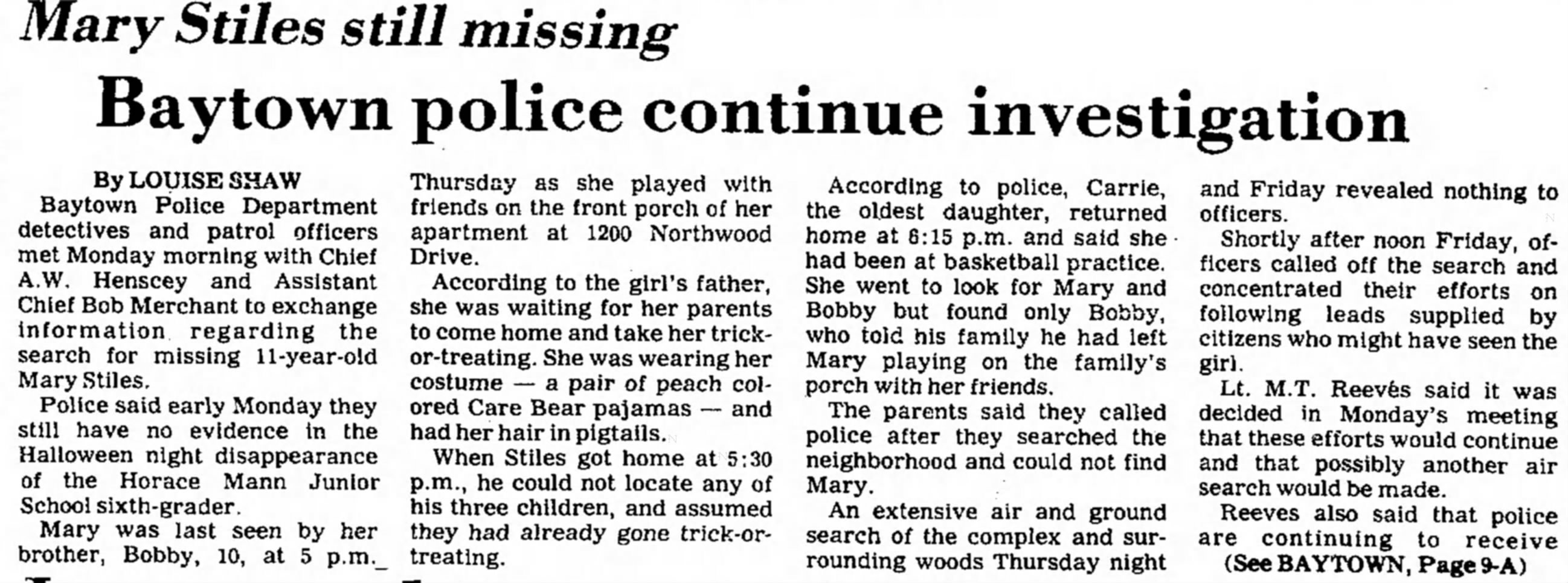
On October 31, 1985, 11-year-old Mary Stiles disappeared from her family’s apartment complex in Baytown, Texas, after leaving to go trick-or-treating with her friends. When she didn't return home for dinner that evening, Mary’s family grew worried. After several hours of searching, they contacted the police, and a large-scale search began.
Authorities attempted to retrace Mary’s steps as well as investigate and rule out all potential suspects. Despite these efforts, the investigation turned up nothing. Then, nine days later, a mysterious note arrived at the Baytown Police Department. The letter would change the nature of the case and put investigators on the trail of a cold-blooded child killer.
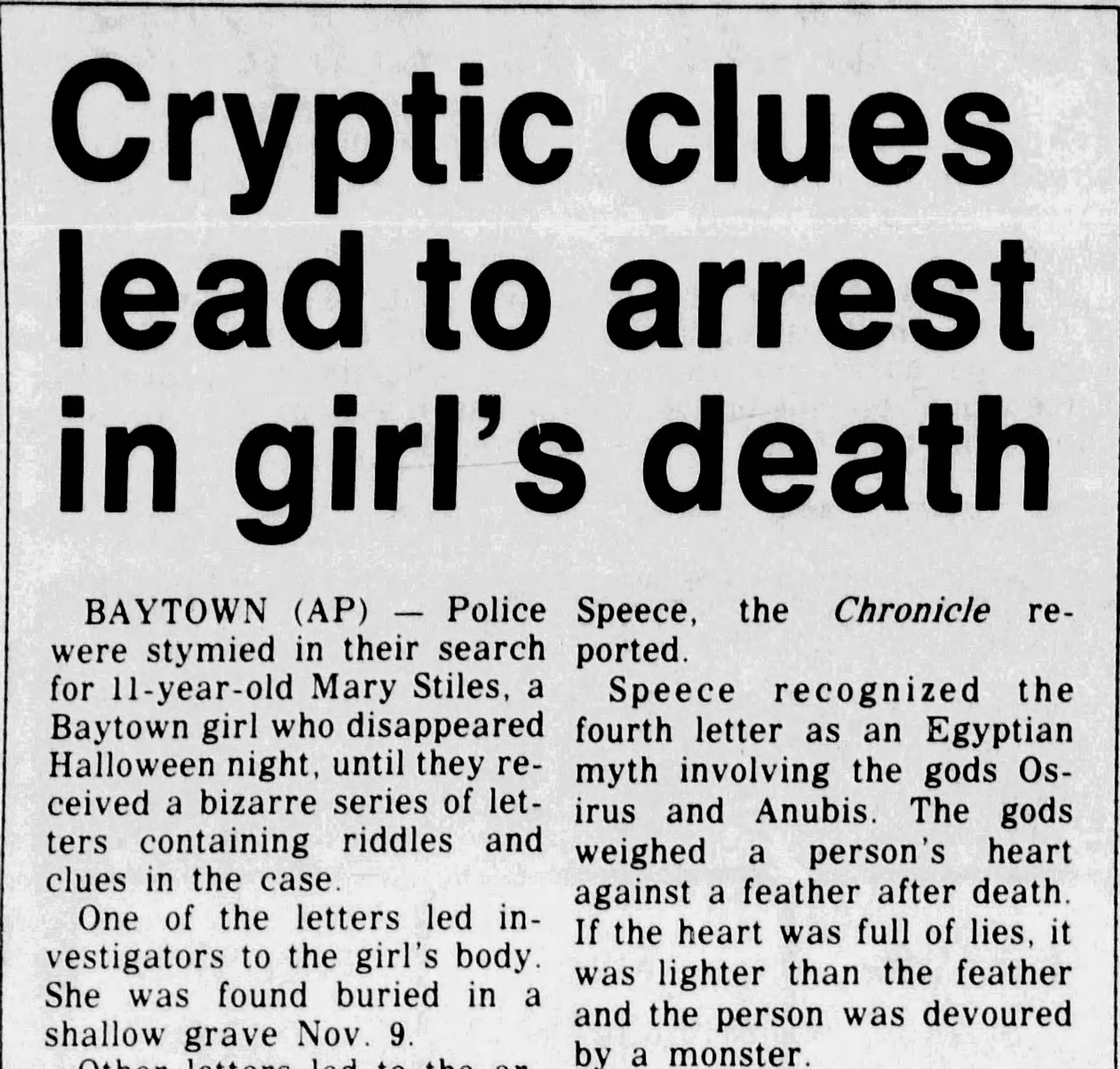
Who was Mary Stiles?
Mary Lorene Stiles was born on November 14, 1973.1 In the fall of 1985, Mary was an 11-year-old girl living with her family at the Woodhollow Apartments in Baytown, Texas. Her family included her father, Gary Stiles; her stepmother, Mary Stuart; her older sister, Carrie; and her brother.
Mary was a sixth-grade student at Horace Mann Junior School. Mary had a good friend who also lived at the Woodhollow Apartments. Her friend had an older stepbrother, 16-year-old Joseph Lee Fordham, who would occasionally walk Mary home from school.
Halloween 1985
That year, Halloween fell on a Thursday. For her costume, Mary dressed as a baby in peach-colored Care Bear pajamas and carried a large plastic baby bottle, with her hair in pigtails, making her easy to spot among the children moving around the complex. Around 4 p.m. that afternoon, Mary went to the Apartment Complex’s main office, where they were handing out candy. She then joined some friends as they began trick-or-treating. 2
As evening approached, an uneasy worry began to grow as no one in the family had heard from Mary for several hours. As dinnertime came and went with no word from her, panic began to set in. Her family began searching the area for any sign of her. They asked friends and neighbors if anyone had seen Mary or knew where she was, but nobody seemed to know anything.
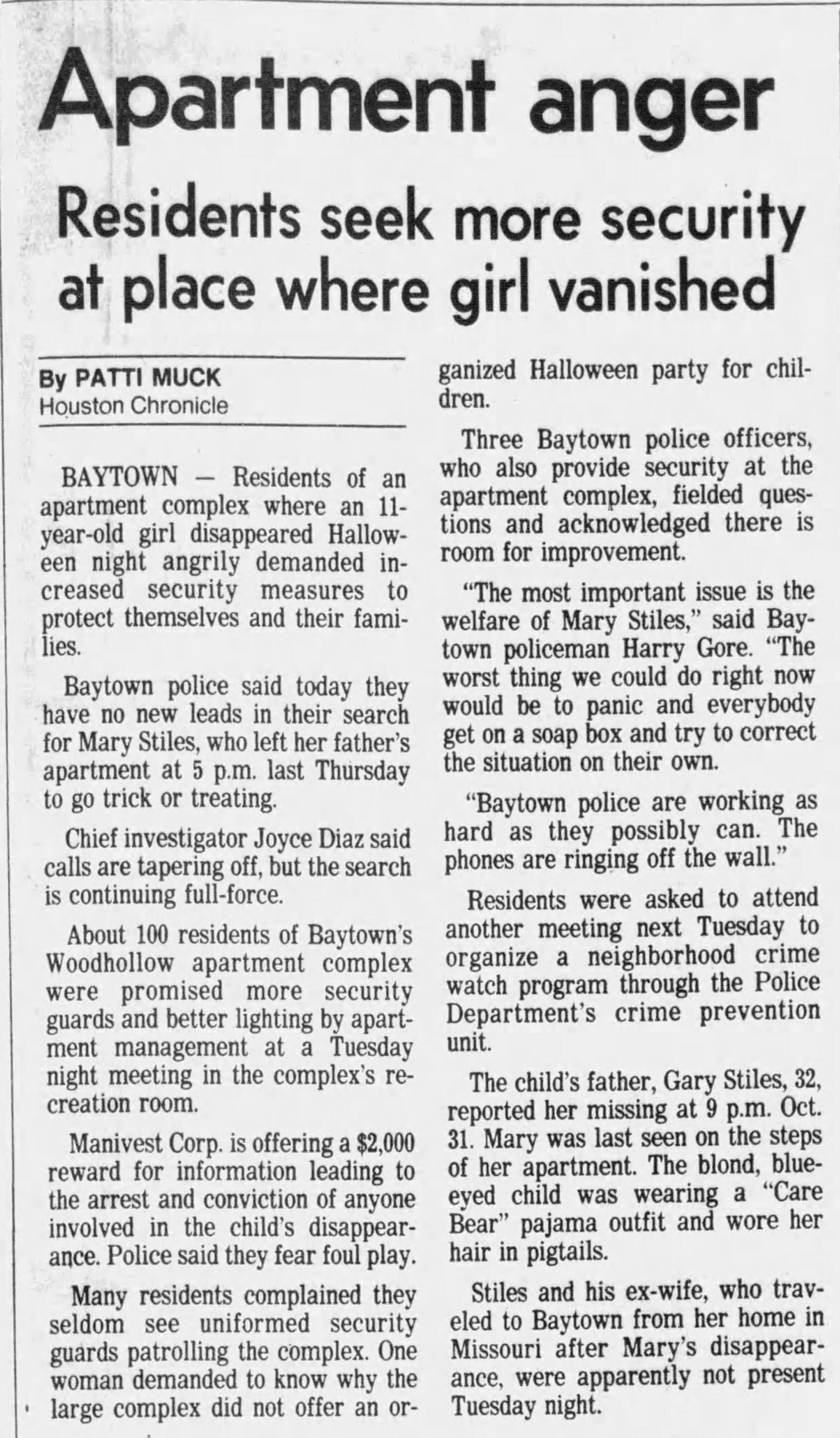
Around 9 p.m., the family called the Baytown Police Department, and the official search began that night. Investigators had limited information, so they began their search at the Woodhollow Apartments and the surrounding area, trying to retrace where she might have gone after she was last seen.
Initial Search
The search continued the following day. Officers searched the grounds around the complex and the wooded lot behind it, near a pond about 150 yards from the apartments. They found nothing. At that point, there was still hope that she might be somewhere else and would return home safely.
However, there was also reason to fear, as Baytown was still dealing with the memory of a tragic child murder that had happened only weeks earlier. On September 10, 1985, 11-year-old Carolyn Hahn had been killed in nearby Mont Belvieu. The recent nature of the crime, as well as the close proximity, raised concerns that the cases could be connected.
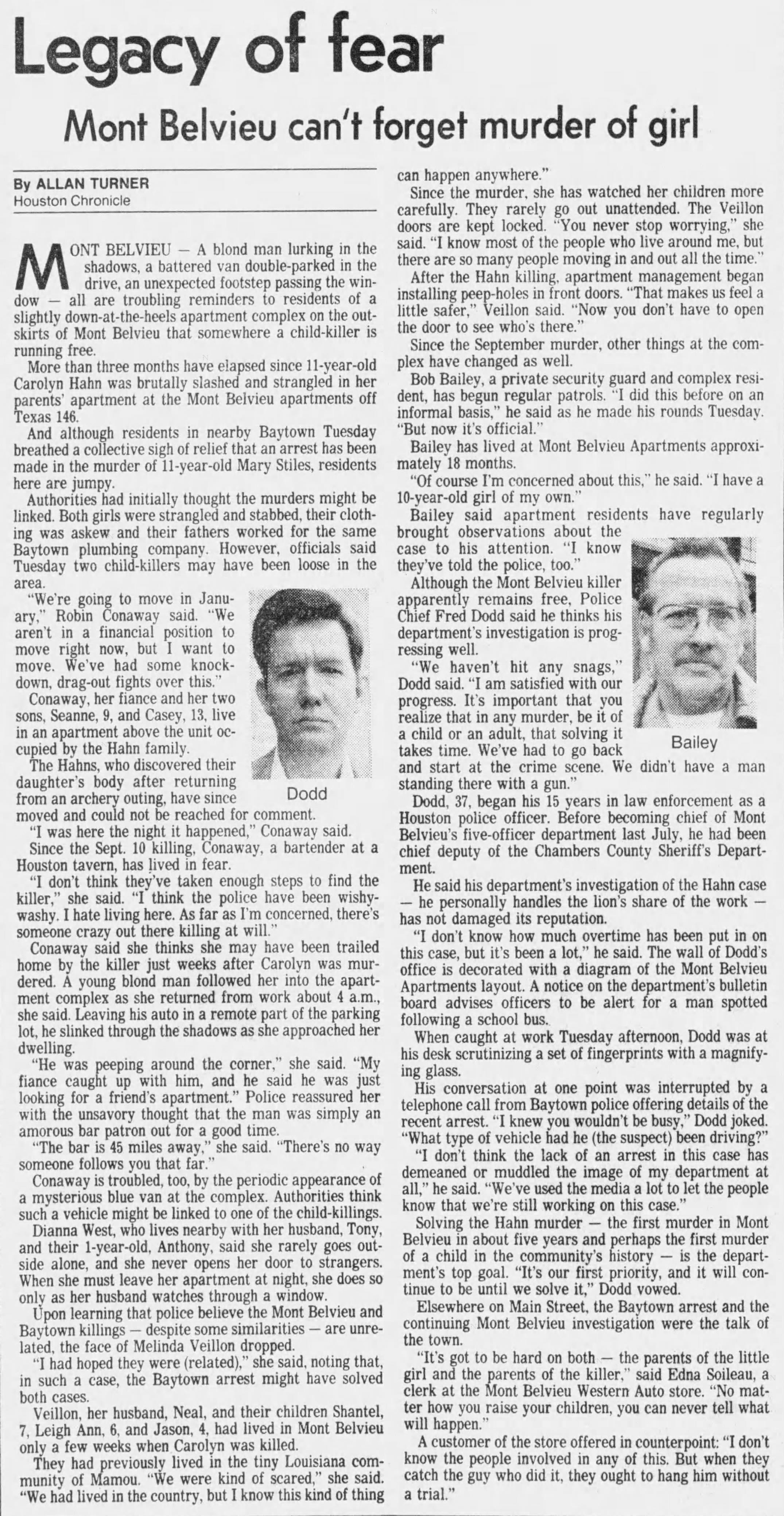
Both girls were 11-year-old sixth-graders and lived in apartment complexes in the same general area. Their fathers also worked for the same Baytown plumbing company. It would later be determined that the two cases were unrelated, with a family friend of the Hahns confessing to Carolyn's murder in 1988.
By Thursday, November 7, a week after Mary vanished, the Baytown Sun reported that police still had "no definite leads." The town pooled money for information, and rewards were posted: $10,000 from a local restaurant, $2,000 from the company that owned the apartment complex, and $1,000 from Crime Stoppers.
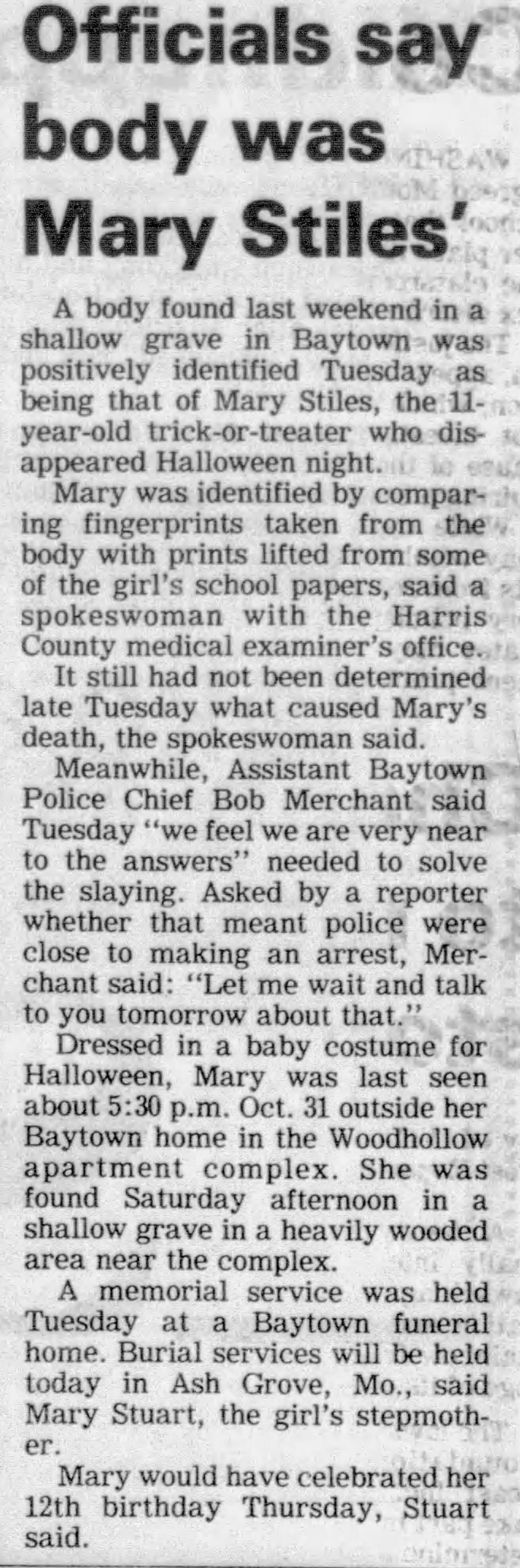
Mary’s Body Found
On November 9, an envelope arrived at the Baytown Police Department marked "Urgent-Mary Stiles." Inside was a Baytown Sun news clipping about her disappearance and a rough, hand-drawn map of the land behind the Woodhollow Apartments. According to later reporting, the note began with the words "I killed her," and went on to describe where she had been attacked and gave directions to where her body had been left.
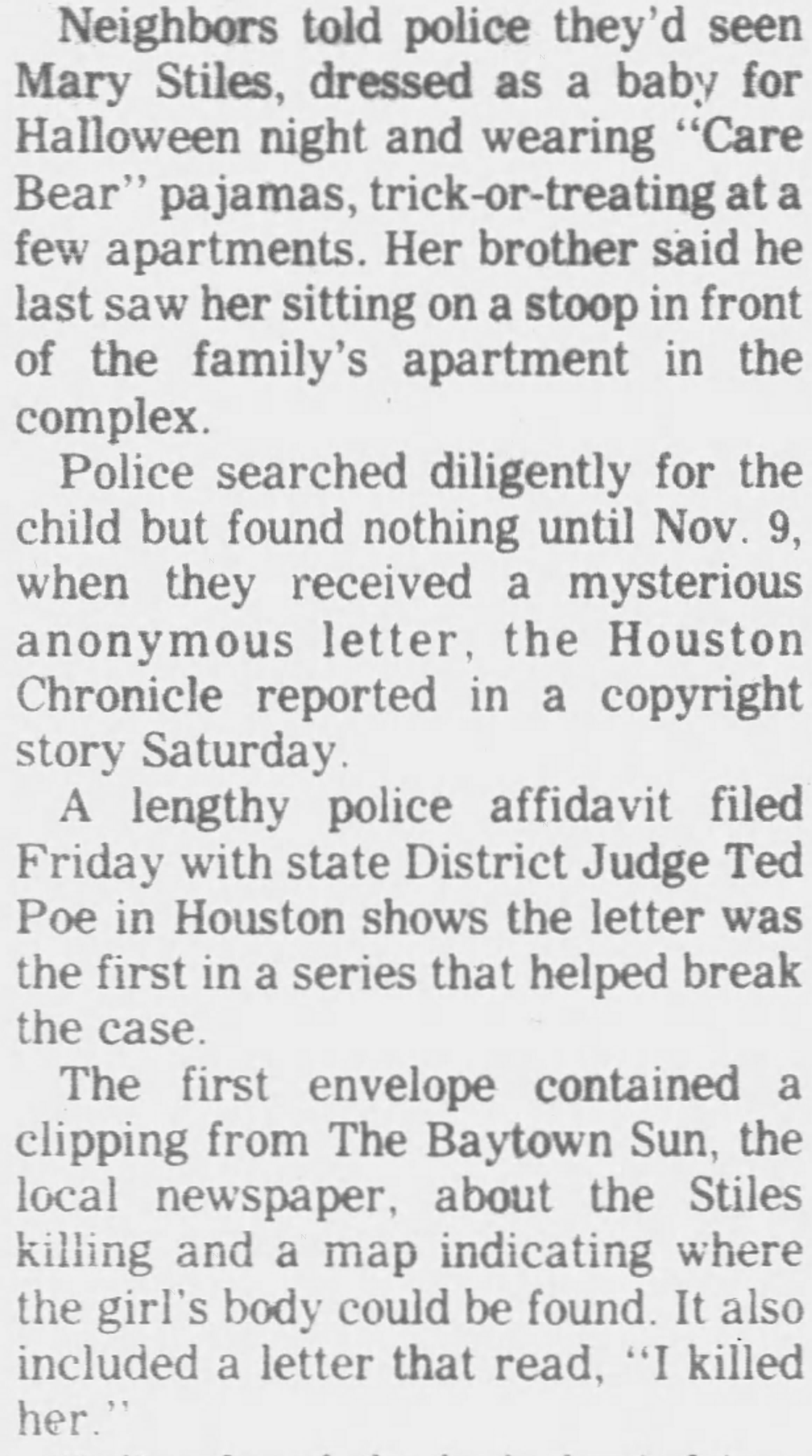
The message was disturbing because it seemed to contain information only someone closely connected to the crime would know. The letter was cryptically signed “The Madman who wishes he never was.” For reasons unknown, it appeared that Mary’s killer wanted police to find her body.
Officers followed the map into the woods behind the apartment complex. The location was near a mosquito-filled pond, about 150 yards from the Woodhollow Apartments, where they had searched earlier and found nothing. There they found Mary's body hidden under leaves and tree limbs, still wearing her Care Bear pajamas. The discovery brought a terrible end to the nine-day search.
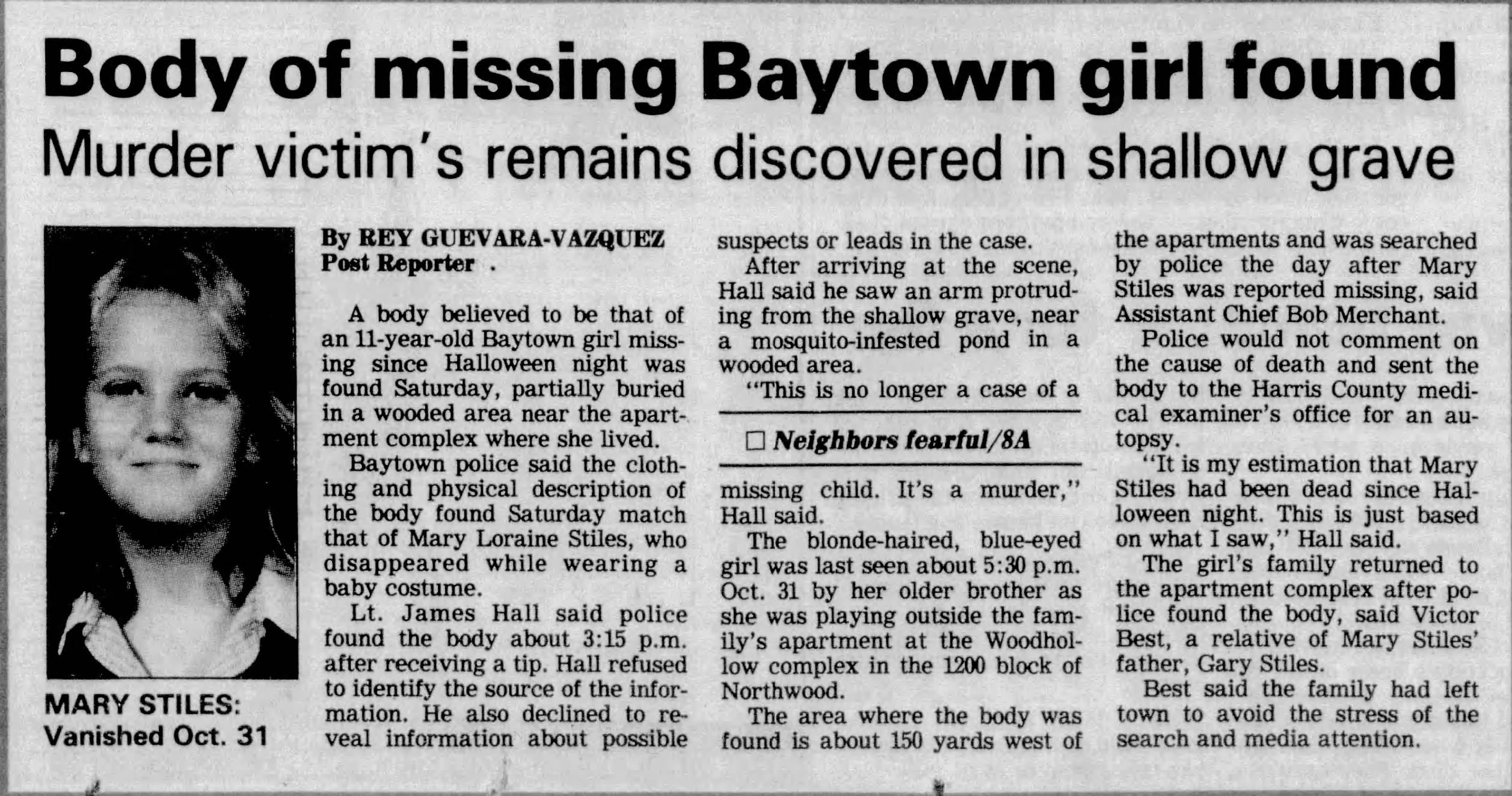
Mary's body had been partially buried and had remained outdoors for several days, so the body was badly decomposed, and police had to use her fingerprints to confirm who she was. On November 10, the Harris County Medical Examiner's Office in Houston completed an autopsy.
The autopsy revealed that Mary had been stabbed, strangled, and asphyxiated. Investigators found that she had been stabbed four times in the neck and a thick blue-and-white sock had been forced down her throat. The sock was later identified as one Mary had been wearing.3 There were also reportedly defensive injuries to her hand, which showed that Mary had tried to fight back.
For Mary's family, the discovery was devastating. For nine days they had lived with uncertainty, hoping that every knock on the door or telephone call might bring good news. Instead, the search ended with the confirmation that their daughter and sister was dead. The family now had to face not only their grief but also the knowledge that Mary's killer was still out there.
Mysterious Letters
On December 3, Baytown police received another mysterious letter. In it, the writer seemed to express regret and hinted that he was struggling with what he had done. It arrived with another Baytown Sun clipping, indicating that he was following the news coverage.
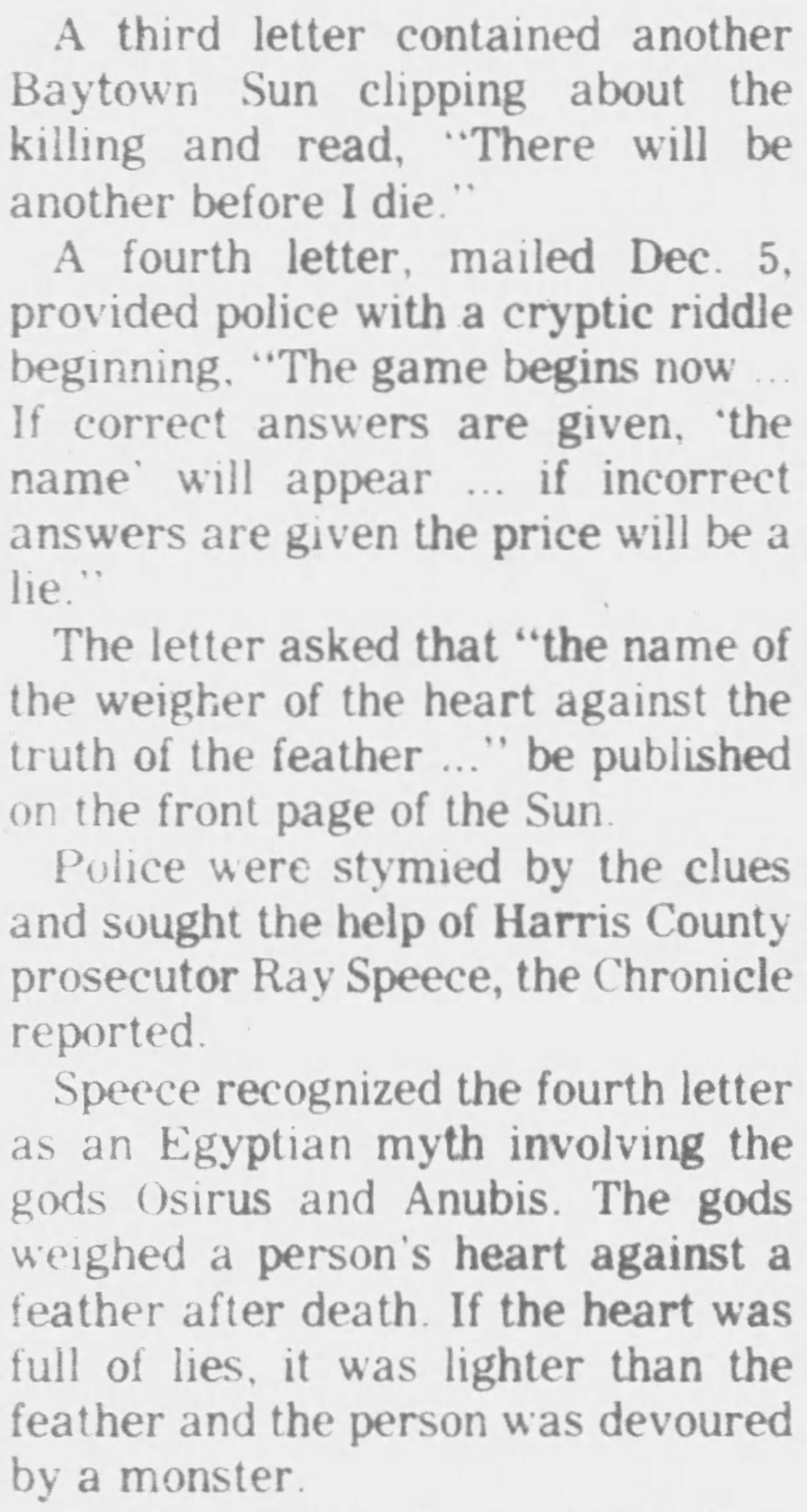
The following day, December 4, another letter arrived. This one was much more alarming because it contained a direct threat. The letter said, “There will be another before I die,” and once again, a Baytown Sun clipping was included, referring to a $10,000 reward for information about Mary's murder. It was as if the killer had decided that the investigation itself had become part of a game.
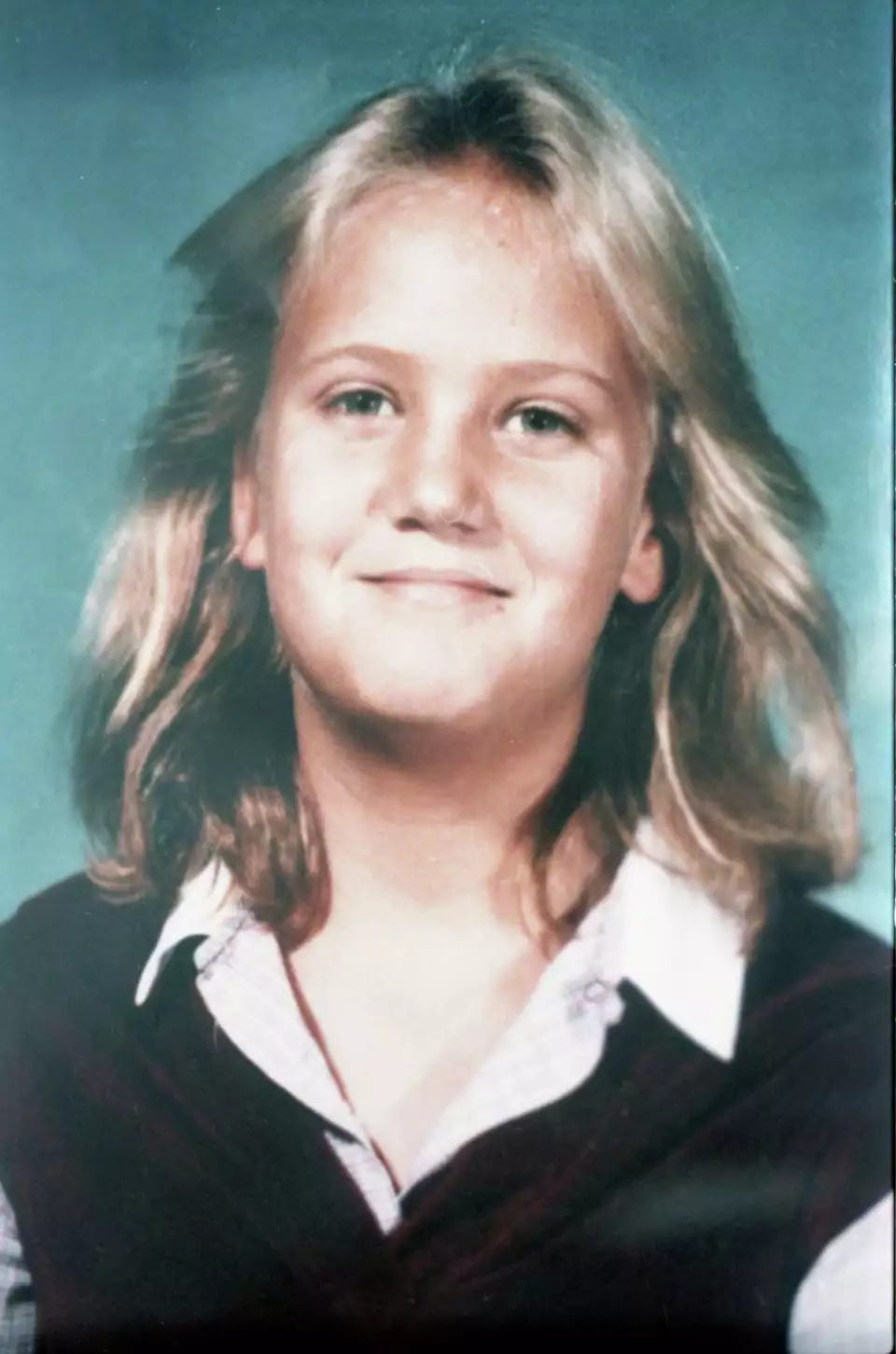
Then, on December 5, the fourth letter arrived, announcing that “the game begins now” and telling investigators they needed to solve a series of clues. The writer suggested that correct answers would reveal a name, while wrong answers could cost someone a life. The letter also told investigators to look beyond the obvious words and sentences for the answers.
The messages contained references to mythology, riddles, and hidden meanings that investigators believed were designed to lead them toward the writer's identity. The writer demanded that the answers be printed in the Baytown Sun, and police began planting replies in the paper to keep him talking.
Investigation
The FBI became involved in the case as experts examined the correspondence, studying what the writing might reveal about the person behind it. They carefully preserved the envelopes and letters and began examining them for fingerprints, handwriting, and other clues that might reveal who had handled them.
They also studied the language and subject matter of the messages, hoping the strange mythological references and the writer's word choice would reveal his age, education, and personality.
As detectives studied the correspondence, they also began building a list of possible suspects. The behavioral assessment suggested that the writer might be younger than investigators had first expected, possibly a juvenile. Investigators believed the writer had shown signs of guilt or regret and might be someone whose behavior had changed after Mary's murder.
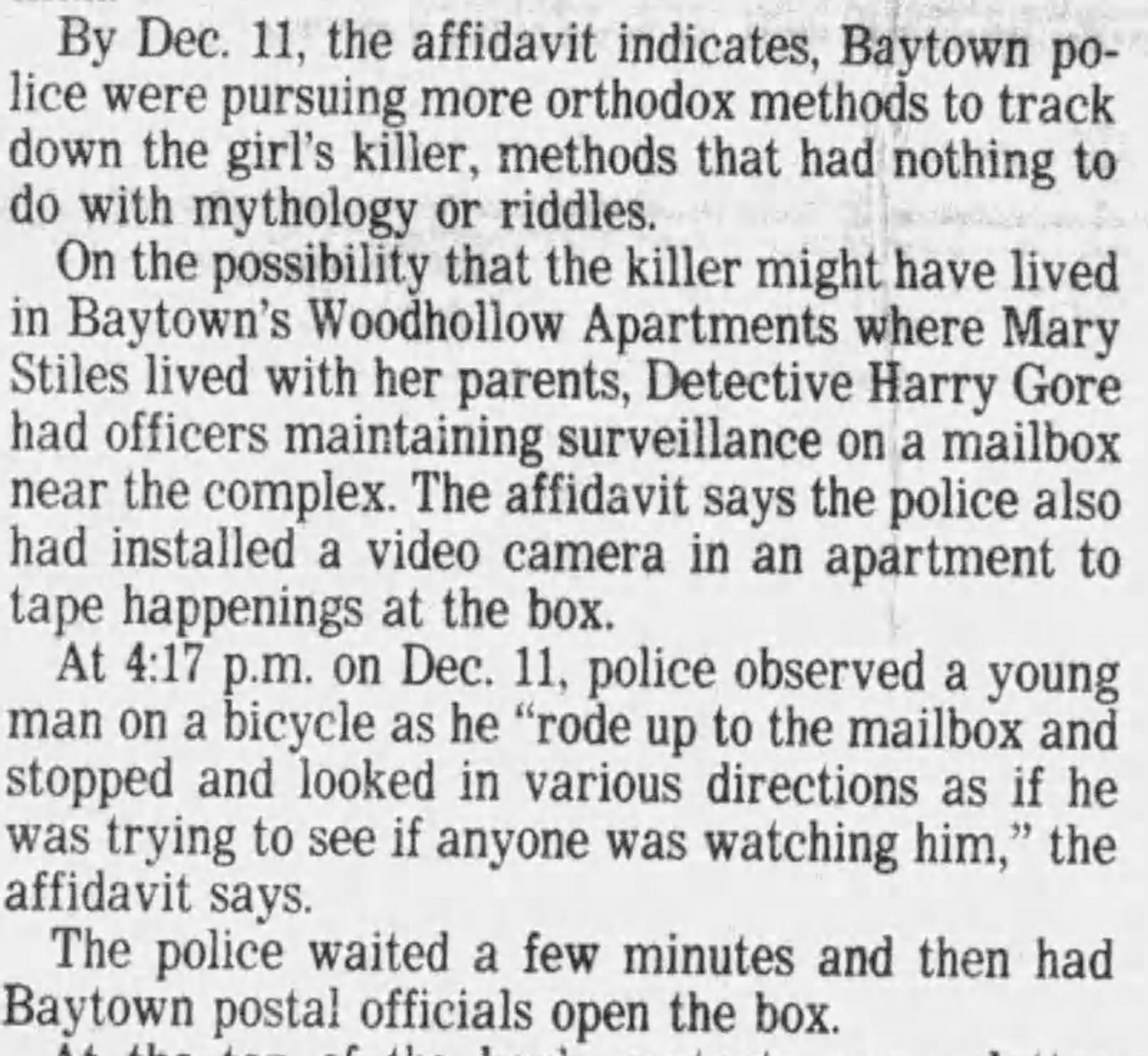
In response, Detective Harry Gore began paying closer attention to young men who lived around Woodhollow Apartments and attended Ross S. Sterling High School. At the same time, detectives began watching mailboxes around the apartment complex. They wanted to catch the writer in the act of sending another message.
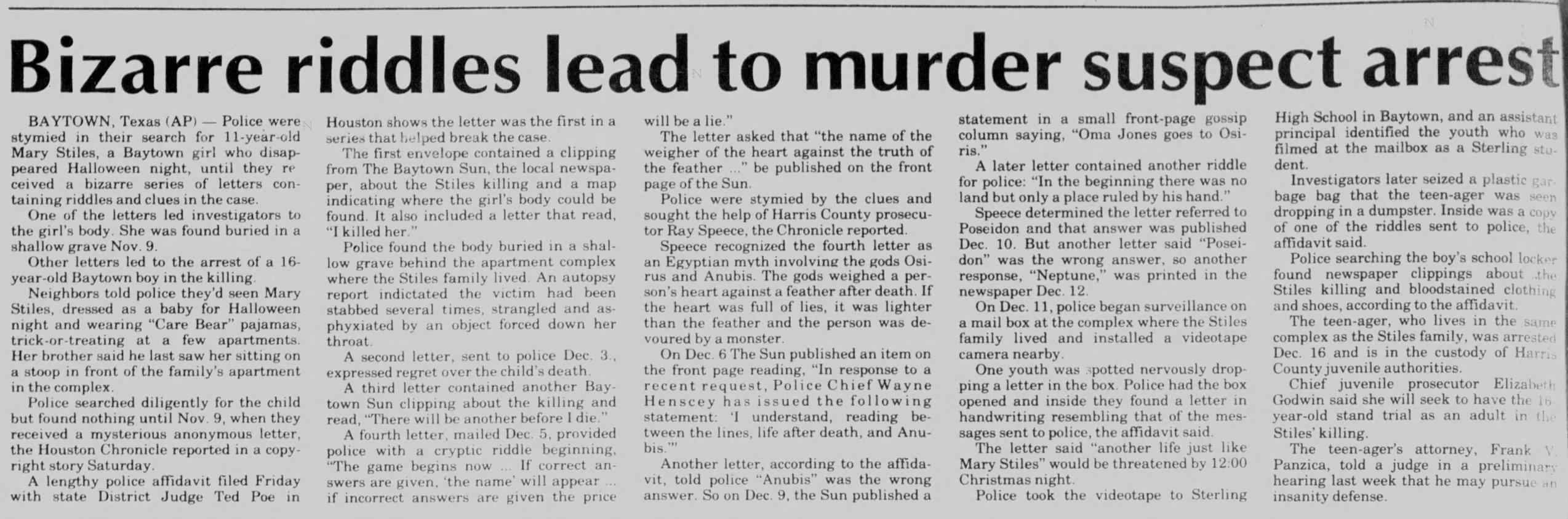
Eventually, the surveillance produced the breakthrough investigators needed. In December 1985, a camera recorded a teenager quietly dropping a letter into one of them. An assistant principal at Ross S. Sterling High School identified him as 16-year-old sophomore Joseph Lee Fordham. It was later learned that Fordham lived in the same apartment complex as the Stiles family and that his younger stepsister had been friends with Mary.
While the surveillance footage did not prove that Fordham had killed Mary, it gave investigators a strong reason to take a closer look at him. In the following days, authorities observed Fordham throw away a garbage bag, and after looking inside, they found riddles and other material connected to the letters. Fordham’s palm and fingerprints also matched the letters.
Arrest and Confession
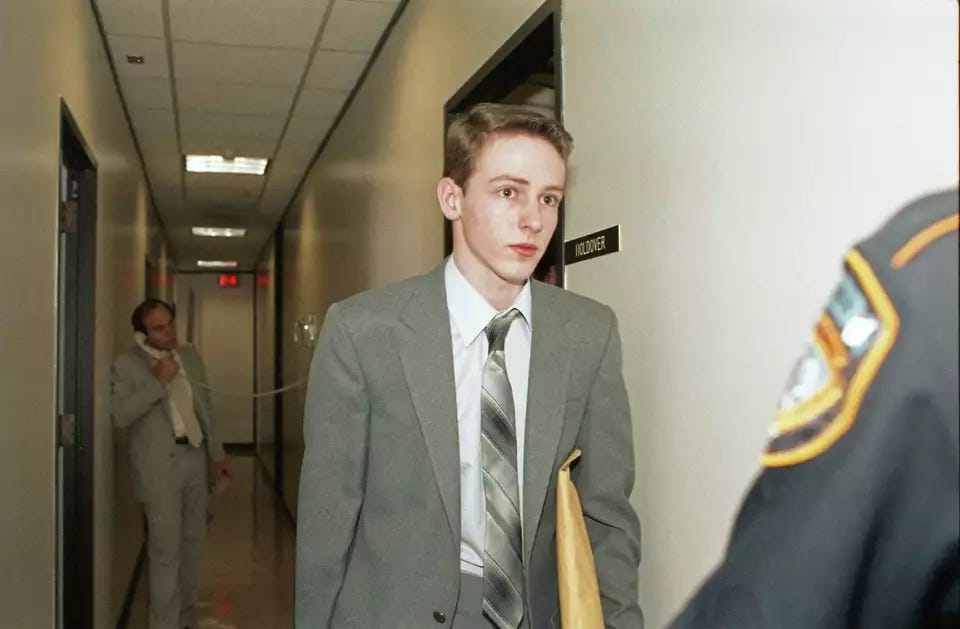
By mid-December, authorities felt that they had enough evidence to charge Joseph Fordham. With search and arrest warrants in hand, police arrested Fordham as he stepped off his school bus at Woodhollow. In the Fordham family apartment, they found newspaper clippings about the killing, books on mythology, bloodstained clothes and shoes, and a pocketknife that police believed was the murder weapon.
After his arrest, Fordham confessed to killing Mary Stiles, but the confession never answered the key question— why? Reports said he had developed an infatuation with her. The resulting trial never produced a motive for what happened behind the Woodhollow Apartments that Halloween night.
Fordham was charged with Mary's murder. Because his lawyers planned to argue that he was mentally ill, doctors examined him before trial.
Trial and Sentencing
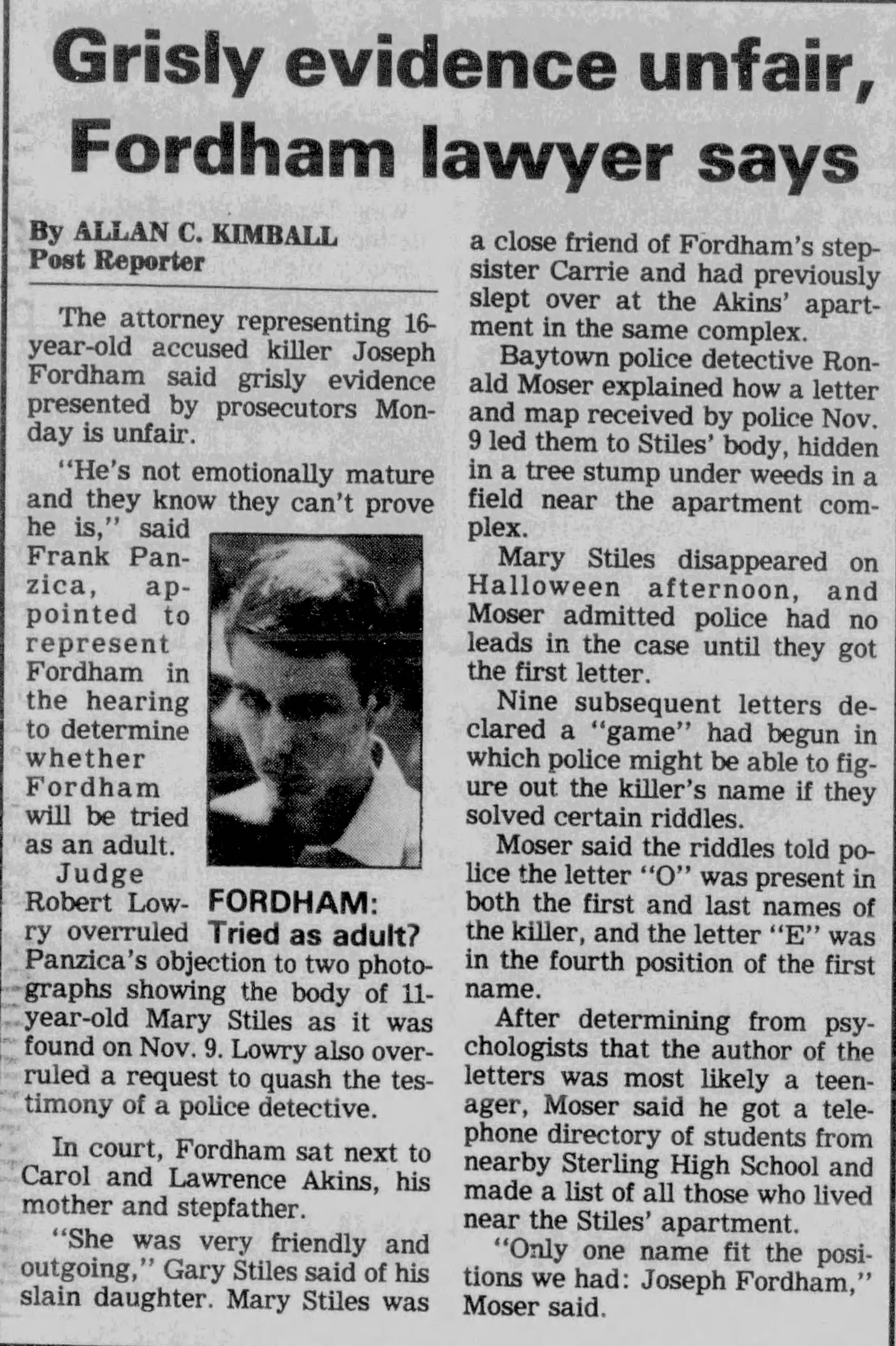
Joseph Fordham’s trial began in late April 1987, before Judge Joseph Guarino. Though he had been 16 at the time of his arrest, Fordham, who was 17 at the opening of his murder trial, was charged as an adult.
The prosecution’s evidence included the letters sent to police, the surveillance of Fordham at the mailbox, fingerprint analysis, testimony from law-enforcement officers and FBI agents, and other evidence gathered during the investigation. The letters were especially important because they had helped police locate Mary's body and eventually led them to Fordham.
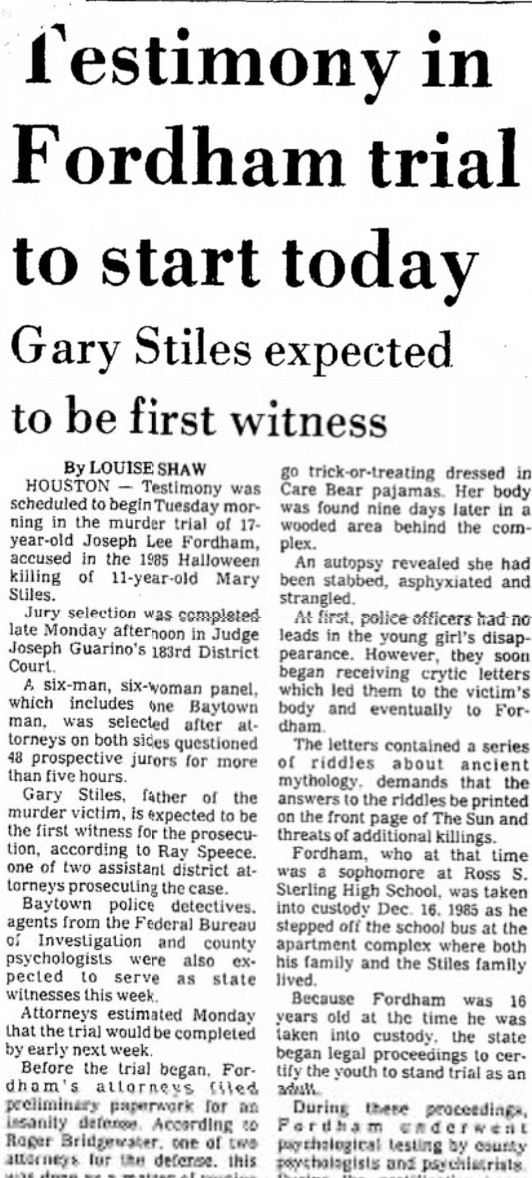
The defense didn't dispute the evidence; rather, they argued about Fordham’s state of mind. According to the Baytown Sun, Fordham had described strange feelings and hearing voices around the time of the killing. Defense psychologist Jerome Sherman testified that Fordham was legally insane when Mary was killed, basing his opinion in part on what Fordham had told him about his thoughts at the time.
The prosecution challenged that interpretation with testimony from other mental-health professionals. Psychiatrist Dr. Ninfa Cavazos told the court that although Fordham had mental problems, she believed he was sane at the time of the killing and was sane when she evaluated him.
Another clinical psychologist, Jerome Brown, also testified that Fordham was not legally insane and understood the difference between right and wrong. The conflicting opinions left the jury with two very different accounts of what had been happening inside the teenager's mind.
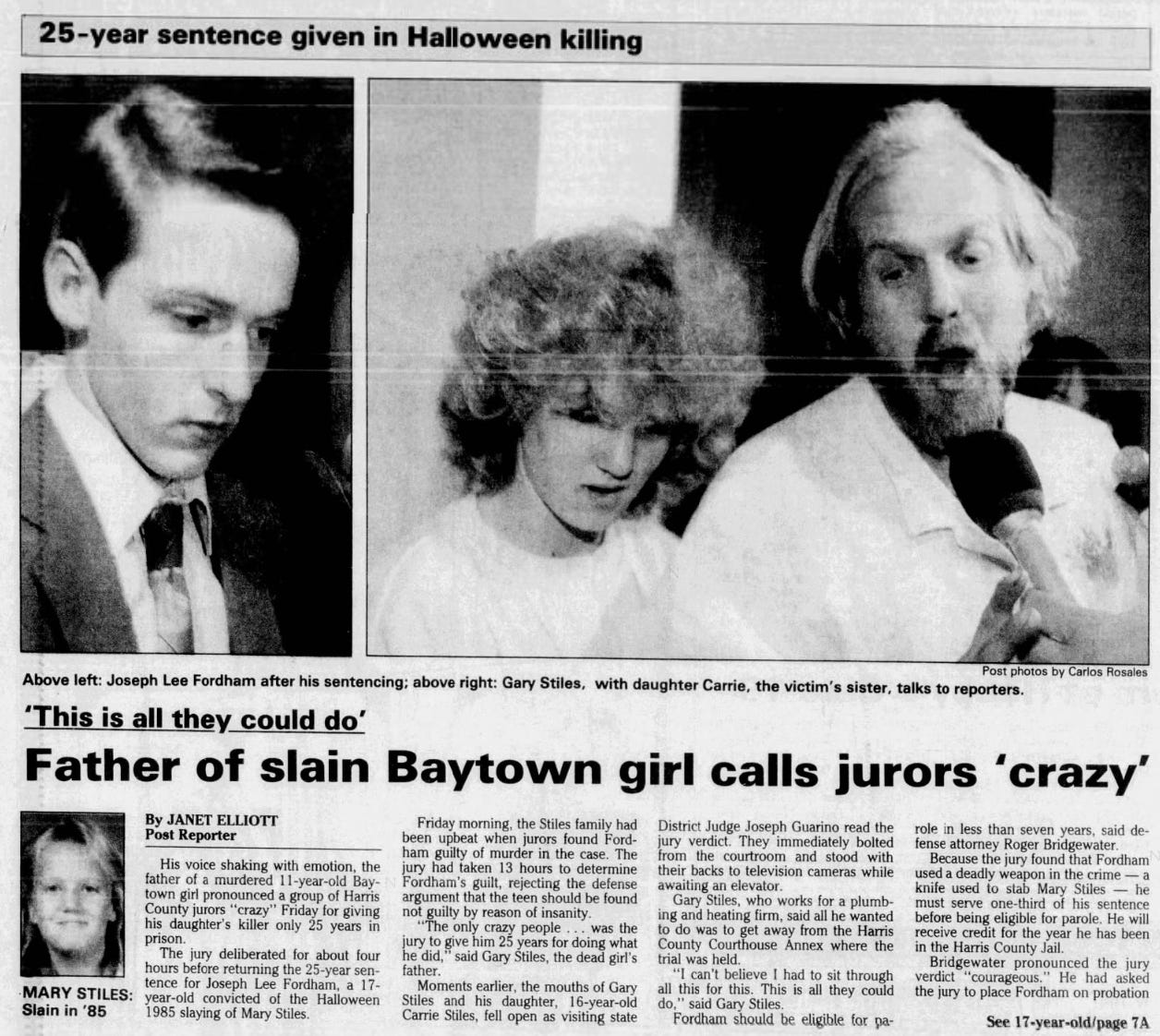
In May 1987, after about 10 hours of deliberation, the jury rejected the insanity defense and found Fordham guilty of murder. Prosecutors had asked for life. The jury gave him 25 years. Mary's father said he was disappointed by the sentence but pleased with the verdict, and he thanked the officers and prosecutors who had worked the case.
Fordham's lawyers moved quickly to appeal. Attorney Roger Bridgwater argued that the juvenile certification was handled improperly and that Fordham was treated unfairly as a result. He said the appeal was not about putting the teenager back on the street and hoped Fordham would get psychiatric help.
Early Release and Parole
For several years after the trial, Mary's family had to live with the knowledge that the person convicted of killing her would eventually become eligible for parole. Twenty-five years sounded like a long time, but it did not necessarily mean that Fordham would remain in prison for the entire period.
As the first parole review approached in 1991, the Stiles family once again found themselves having to speak about Mary's death and explain why they believed Fordham should remain in prison.
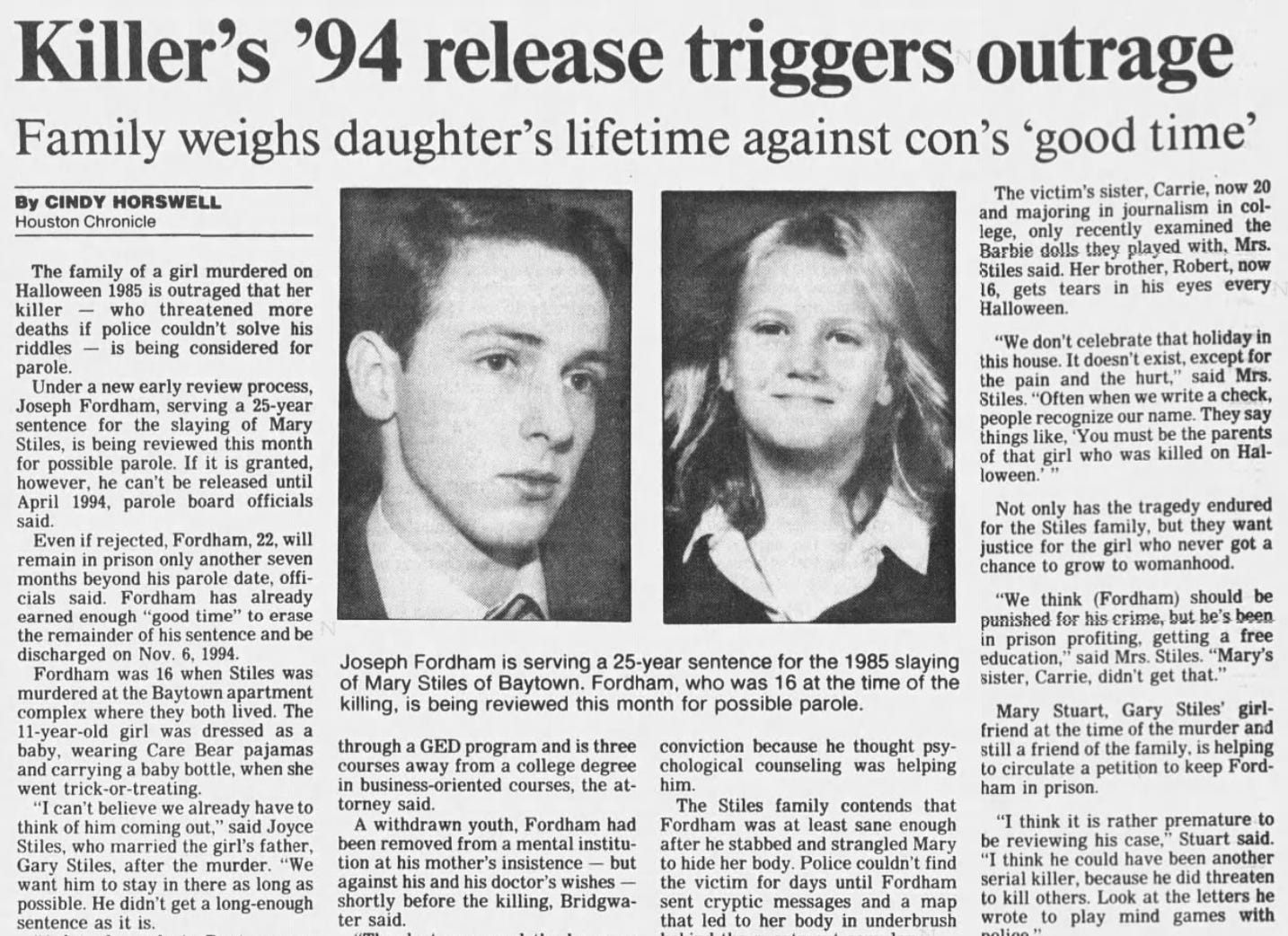
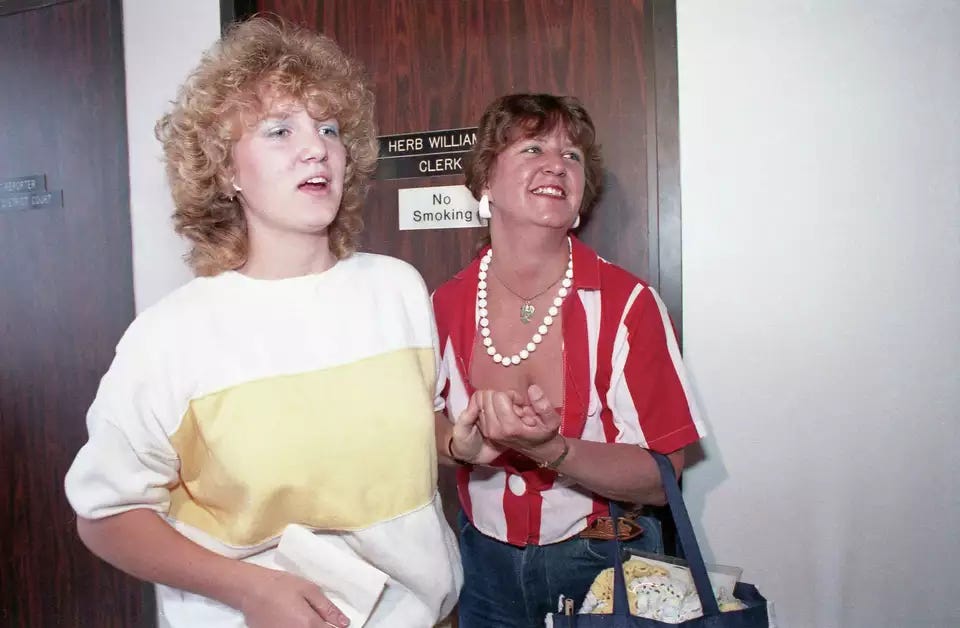
Mary's stepmother, Mary Stuart-Stiles, began circulating a petition asking the Texas Board of Pardons and Paroles not to release Fordham. She also encouraged community members to write directly to the parole board and explain why they believed he should remain in prison.
Meanwhile, Fordham's attorney told the press that his client had changed. He had earned his GED, was nearing a bachelor's degree, had received mental-health treatment, and had dropped part of his appeal so he could continue his rehabilitation program.
Due to severe overcrowding in the Texas prison system, Fordham was released on parole after serving less than eight years. Understandably, Mary's family found Fordham’s early release difficult to accept. Instead of serving the majority of his sentence behind bars, Fordham was paroled after less than eight years.4
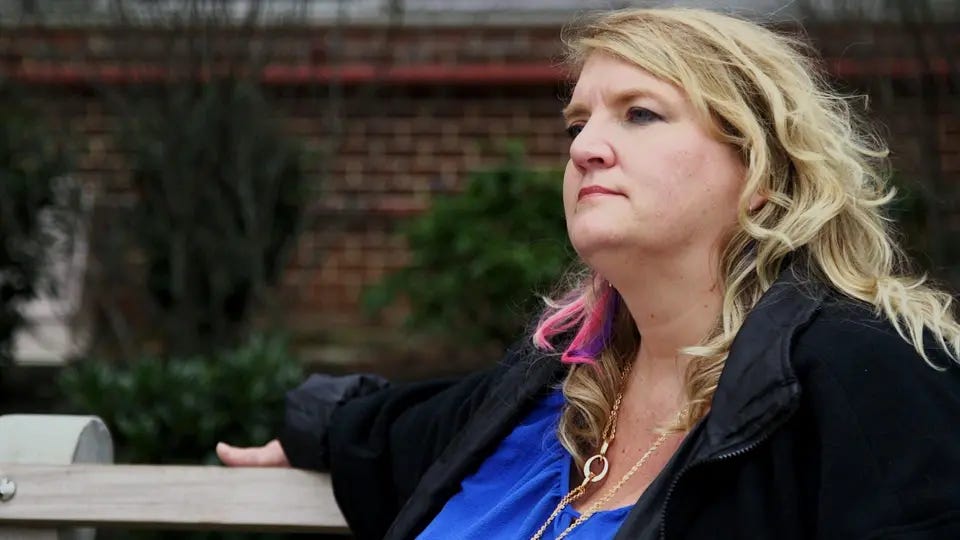
For Carrie Stiles, Mary's older sister, the release became something she could not simply ignore. Carrie had been a teenager when Mary was murdered, and the case had changed the direction of her own life, influencing her to become a journalist. She said that she struggled for decades with anger toward Fordham and with the fact that he had been released so early.
Carrie eventually decided that she needed to know where Fordham was after his release. Because he had been a minor when he was arrested, locating him as an adult was not easy. She eventually found his grandmother and kept track of Fordham from a distance.
In 1998, Fordham’s release was revoked after he moved to Indiana without permission and failed to report to his parole officer for three months, causing him to return to prison. In March 2004, he was paroled again and settled in Georgia, where he lived with his grandmother under supervision.
"It Just Wasn't Long Enough"
In August 2014, Fordham was 45 years old and weeks away from his parole ending in September. In the early hours of August 11, he left for his job at a bus plant in Fort Valley, Georgia, and vanished. The Bleckley County Sheriff's Office issued a missing-person bulletin. U.S. Marshals located him at a hotel in Warner Robins, Georgia, and he was taken into custody for violating his parole.5
Fordham had attempted to take his own life shortly before authorities found him, and he was taken back into custody. At the time, Carrie was working at the San Antonio Express-News when she saw his photograph. The timing surprised her because she knew that his parole was almost over.
Through Fordham's parole officer, Carrie was able to question him as to why he had disappeared and attempted to take his life. His answer surprised her. "It just wasn't long enough," he said, referring to the amount of time he served in prison for Mary’s murder.6
Hearing that he felt his sentence had not been long enough changed something inside Carrie. For years, she had also believed Fordham had escaped punishment for what he did to Mary. The anger she had carried since she was a teenager began to lose some of its hold. She later described the decision to forgive him as powerful and said it felt like an incredible weight had been lifted from her shoulders.
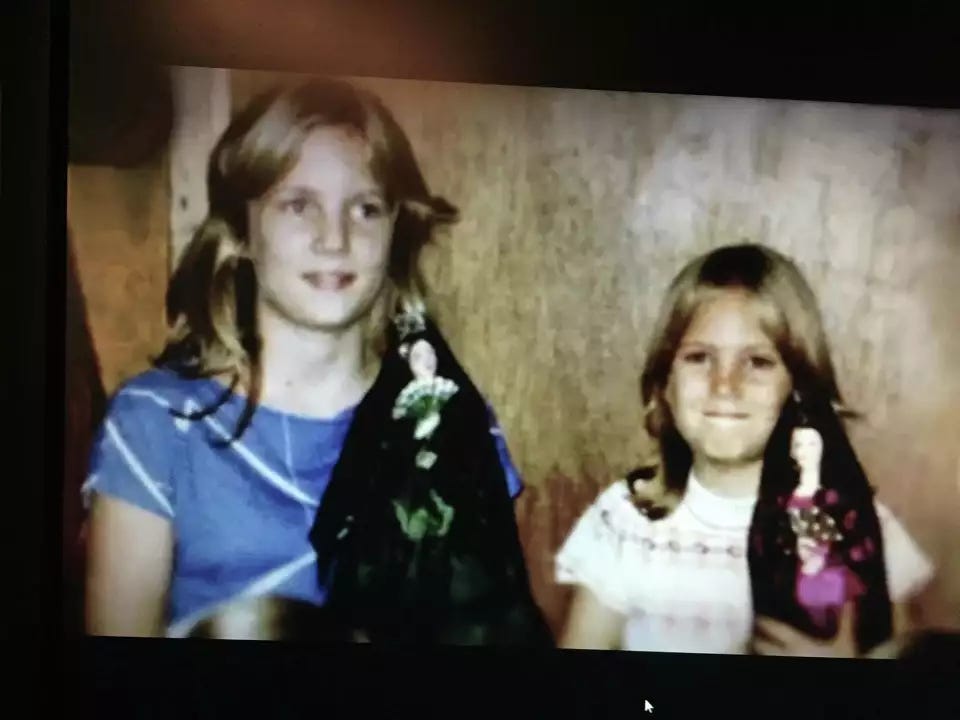
Carrie spoke publicly about that forgiveness on Investigation Discovery's On the Case with Paula Zahn. The episode, "Deadly Riddle," aired on July 16, 2017, and revisited the case through interviews, old photographs, and dramatizations.7 For Carrie, it meant opening a part of her life she had kept private for three decades.
She did it because she believed the human cost behind the headlines was worth telling. She said forgiving Fordham didn't mean forgetting Mary or excusing what had happened. It meant refusing to let her anger at him consume her life. By sharing her story, Carrie ensured her little sister’s memory would live on through those who knew and loved her.
"Mary Lorene Stiles (1973–1985)." Find a Grave, memorial 124293100. https://www.findagrave.com/memorial/124293100/mary_lorene-stiles
"Joseph Fordham Mary Stiles." Archival news footage and case notes, clip 710130. Houston: KHOU, 1985–1987. https://kurator.com/en/video/detail/710130
Hollis, Matt. "Program to Feature Baytown Murder." Baytown Sun, July 16, 2017. https://baytownsun.com/local/program-to-feature-baytown-murder/article
Aubespin, Eleska. "Georgia Lawmen Seek Missing Baytown Killer." Baytown Sun, August 17, 2014. https://baytownsun.com/news/georgia-lawmen-seek-missing-baytown-killer/
WMGT 41NBC. "FOUND: Bleckley County Sheriff's Office Searching for Missing Man." 41NBC News, August 14, 2014. https://www.41nbc.com/found-bleckley-county-sheriffs-office-searching-for-missing-man/
"National TV Show Focuses on Murder of San Antonio Journalist's Sister." MySA / San Antonio Express-News, July 2017. https://www.mysanantonio.com/entertainment/movies-tv/article/National-TV-show-focuses-on-murder-of-San-Antonio-11286727.php
On the Case with Paula Zahn. "Deadly Riddle." Season 15, episode 8. Investigation Discovery, July 16, 2017. https://www.amazon.com/s?k=On+the+Case+with+Paula+Zahn+season+15