


Background
The story of the Bluebelle and Terry Jo Duperrault began with a happy family finally taking the trip they'd dreamed of for so long. Within only a few days, though, their story became one of unfathomable loss.
Against all odds, Terry Jo survived an experience and conditions that she never should have endured. After being rescued, she revealed the truth of what had really happened to her family onboard that vessel.
Despite the tragedy she endured, Terry Jo went on to live a meaningful life and impact real change, becoming an inspirational figure for all who have heard her story.
The Duperrault family
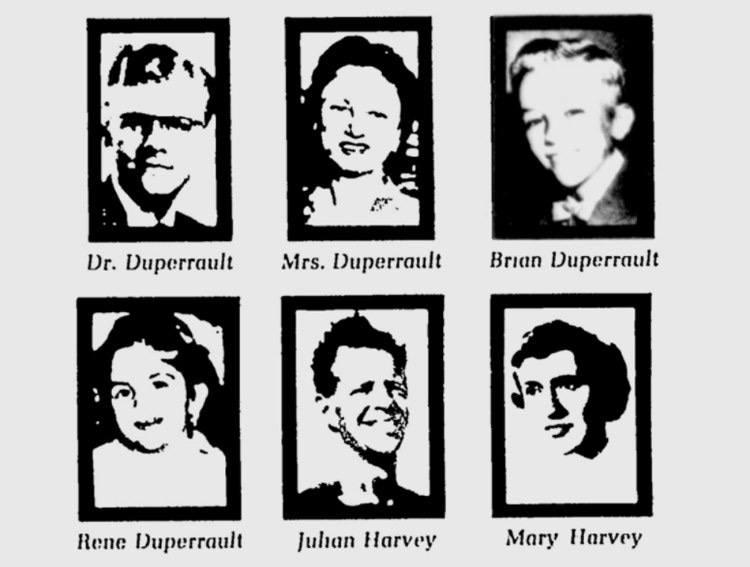
Arthur and Jean Duperrault were Green Bay, Wisconsin, residents and the proud parents of Brian, Terry Jo, and René. Arthur was a contact lens optometrist. As a former World War II veteran, he had also spent time at sea and dreamed of taking his family on an ocean expedition. The Duperrault family began putting money aside to make that dream a reality.1
As far as is known, the Duperraults lived a comfortable, quiet, and happy life. Over the course of a few years, they had managed to save up enough money to afford the vacation of a lifetime – Arthur's dream of sailing his family from Florida to the Bahamas was about to become a reality.
By the summer of 1961, they had everything prepared. They were going to escape the harsh Wisconsin weather and embark on their adventure, sailing to the Bahamas and docking at multiple tropical destinations. The family even made preparations to extend their voyage if everyone was enjoying themselves.
This long-awaited journey should have been a treasured family memory, but they could never have predicted how their dream would quickly become a living nightmare.
Setting sail
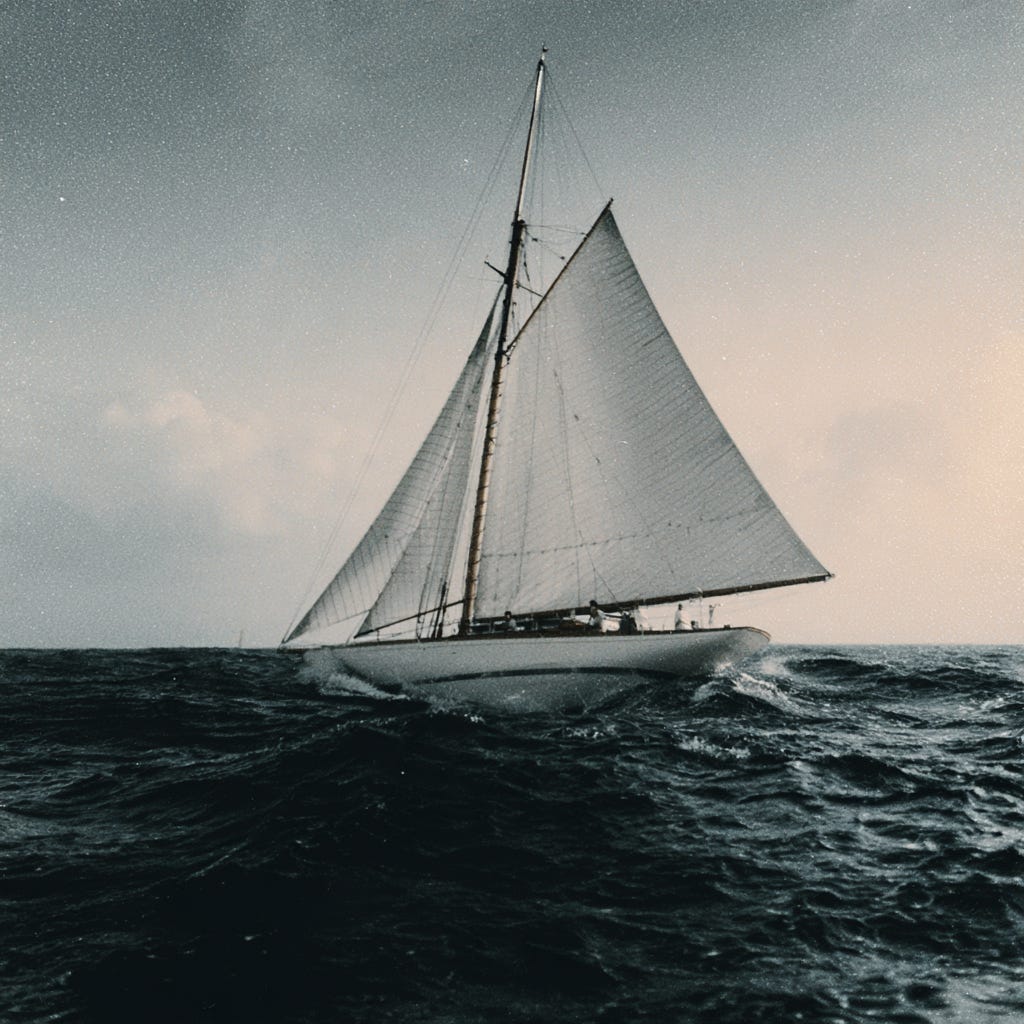
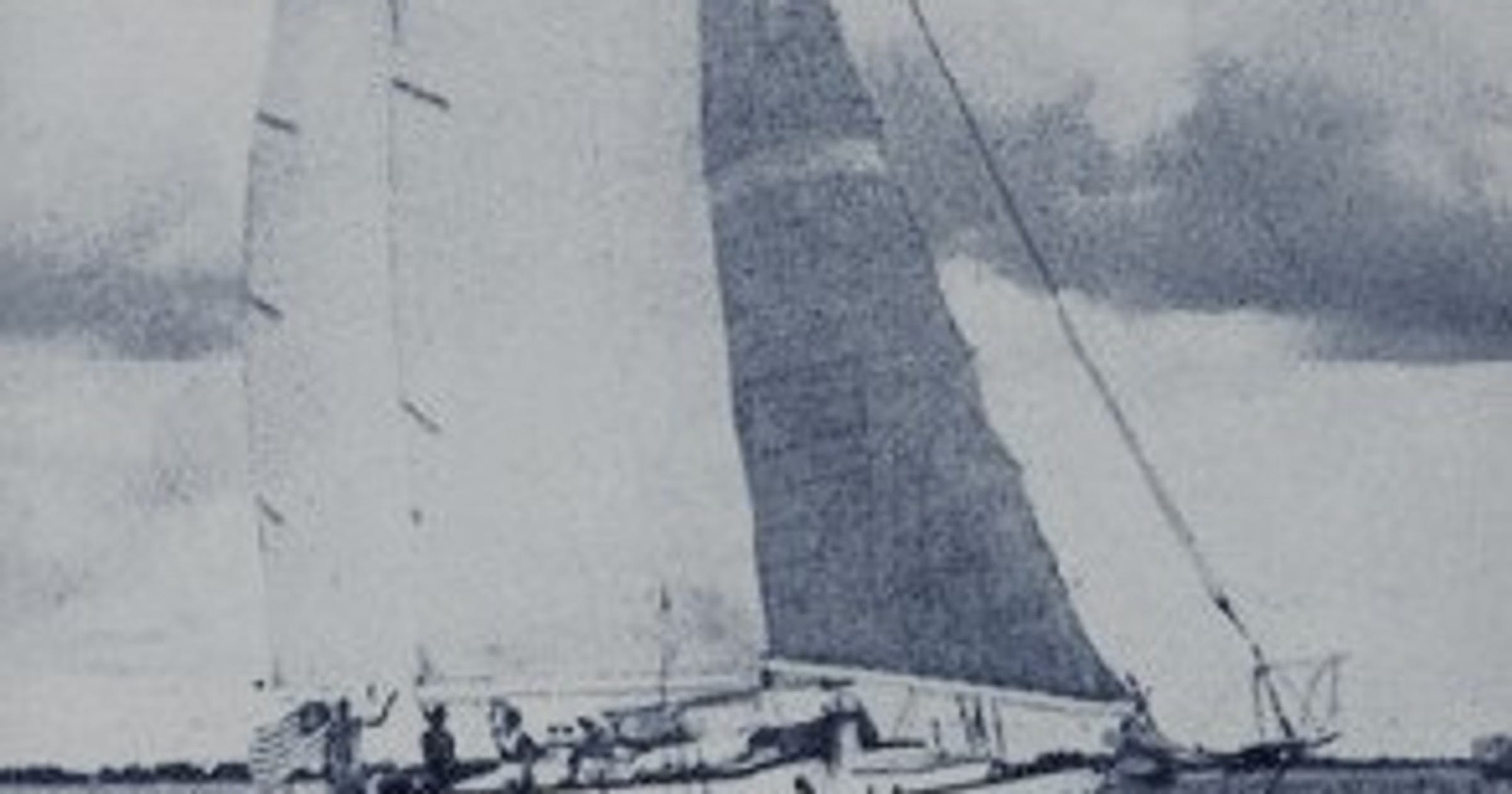
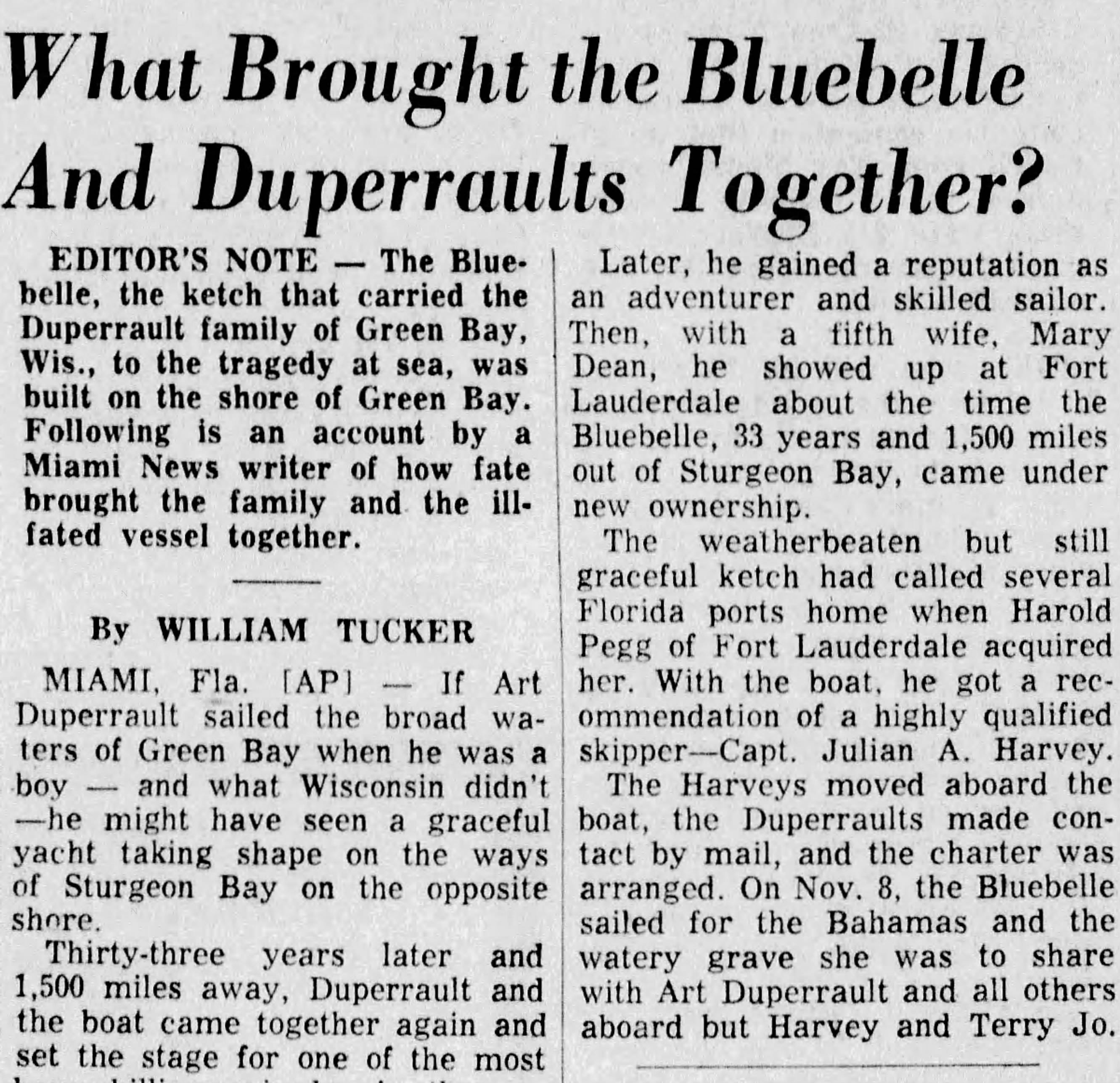
It was November of 1961, and the Duperraults were ready to set sail. Arthur had chartered a 60-foot sailboat, Bluebelle, to carry his family from Fort Lauderdale, Florida, to the Bahamas. The boat came with a captain: Julian Harvey, a notable local yachtsman.
Though 44-year-old Harvey was known for his sea legs, he was also known for his shaky relationships. Still, his sixth wife, Mary, was also brought onboard to serve as the cook for the Duperrault family cruise.

Around midday on November 8th, 1961, Arthur and Jean boarded the Bluebelle alongside 14-year-old Brian, 11-year-old Terry Jo, and 7-year-old René. The ship left port in the early afternoon, and the Duperraults' long-awaited adventure had begun. They spent their first four days at sea making stops along the northwestern region of the Bahamas, snorkeling and doing all the usual touristy things.
On November 12th, they made their final port of call before beginning their journey back to Florida. Here, at Sandy Point, Arthur told Roderick Finder, the British district commissioner, that this had been a "Once-in-a-lifetime vacation," and expressed his desire to return soon with his family.2 Unbeknownst to Arthur, trouble lay ahead once the Bluebelle left port that evening.
A Shocking Discovery
It was midday on November 13th. A crew member of an oil tanker spotted a man in a dinghy waving his hands erratically. The man was yelling for help, crying out that he had a deceased child onboard the small vessel.
The Gulf Lion crew pulled the man onboard, and when they did, they saw the lifeless body of a young redheaded girl wearing a life jacket. The man told the oil tanker crew that he was Julian Harvey, Captain of the Bluebelle, and he identified the young girl in the dinghy as René Duperrault.3
According to Harvey, a strong squall had hit the Bluebelle at around 11 p.m. the previous night. The squall snapped the vessel's main mast and caused it to keel over between the Abaco Islands and Great Stirrup Cay.
Harvey reported that his wife and Arthur Duperrault were injured, and that the falling mast pierced the ship's hull. The rigging then pulled down the mizzen mast, and Harvey became separated from the other passengers.
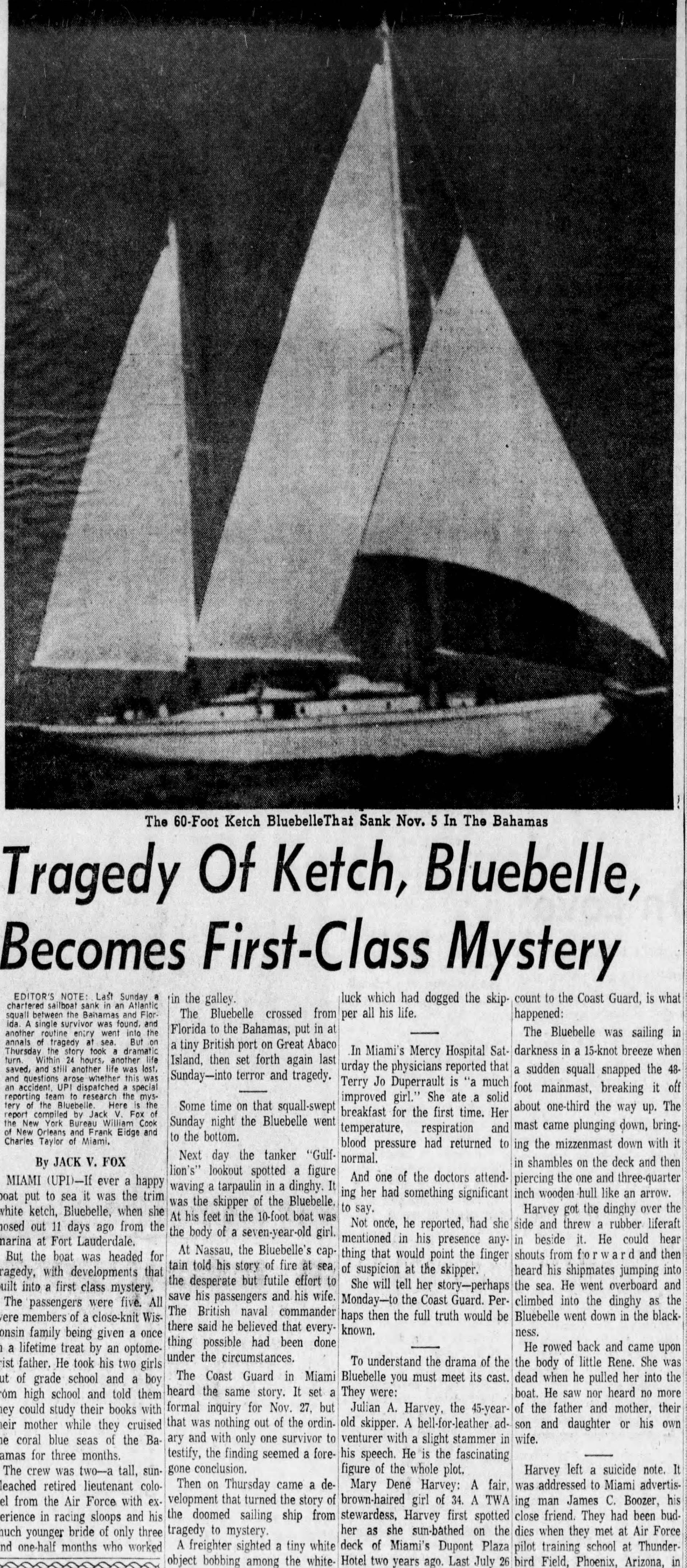
He claimed he had attempted to retrieve a wire cutter from the cabin to cut his way through the deck space, but a fire broke out onboard that prevented him from doing so. Unable to rescue the other passengers, Harvey had been forced to abandon the ship alone in the dinghy.
He said that he had seen the body of René floating by, and he had pulled her into the dinghy and attempted resuscitation, but to no avail. Harvey claimed he had kept René’s body in the dinghy with him out of respect.
Local authorities took Harvey to Nassau for questioning. It was revealed that René had died of drowning, which seemed consistent with his account of the events. However, investigators were suspicious of Harvey due to his shockingly calm demeanor and, more importantly, the fact that his dinghy was full of survival supplies.
Despite their suspicion, there was no evidence to disprove his claims, and he was released from custody and allowed to return to Miami on November 15th, where he’d be questioned again by the U.S. Coast Guard. Harvey had no idea that another discovery would soon be made that would change the narrative completely.
The Sea Orphan
On November 16th, second officer Nicolaos Spachidakis of the Greek vessel Captain Theo spotted something on the water approximately one mile from the freighter. He summoned the ship’s Captain, and together they realized the object on the horizon was not a small fishing boat, but rather a small white raft.
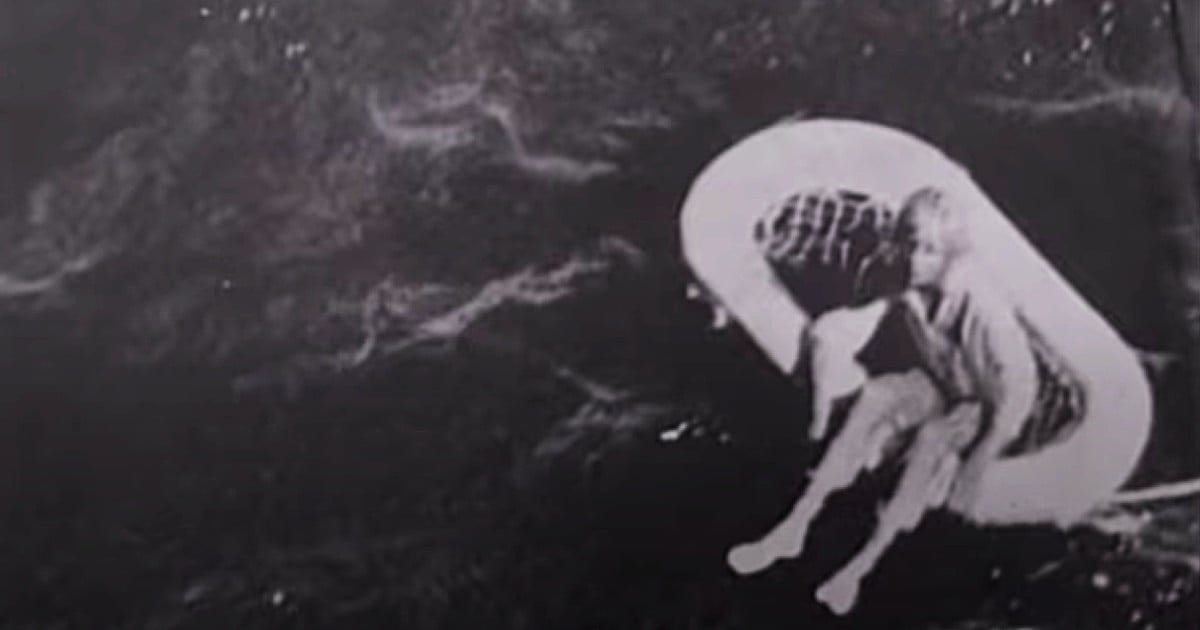
Onboard the raft was a young girl in a white blouse and pink corduroy slacks. She was waving weakly toward the ship, leaning back on her cork float. The Captain ordered the engines to be shut off and a life raft lowered.
As crew members closed in for the rescue, they spotted sharks circling near the float and urged the child not to jump into the water. They carefully lifted her aboard the raft and hoisted her up to the ship, placing her in a spare cabin onboard.4
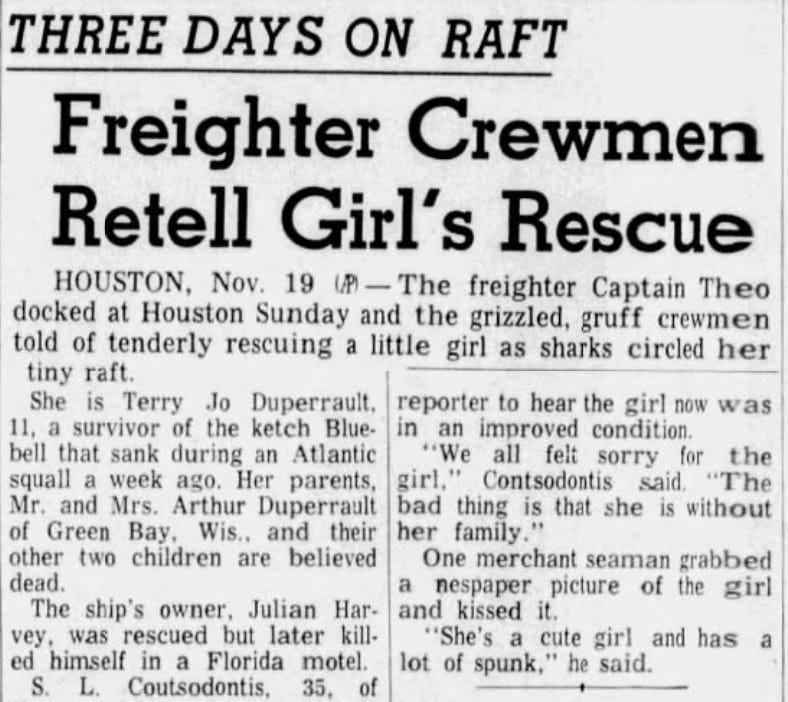
The child was exhausted, incoherent, and barely able to speak at all. The crew brought her water and orange juice, and they carefully cleaned her frail body to help stop further dehydration. The girl identified herself as 11-year-old Terry Jo Duperrault, and she told the crew that she had been drifting aimlessly on the cork float for days after her ship had sunk.
That was nearly all the information Terry Jo was able to provide before her body gave in to the exhaustion and she entered a semi-comatose state. The Captain called the Coast Guard to report what had happened and alert them to Terry Jo's need for medical intervention.
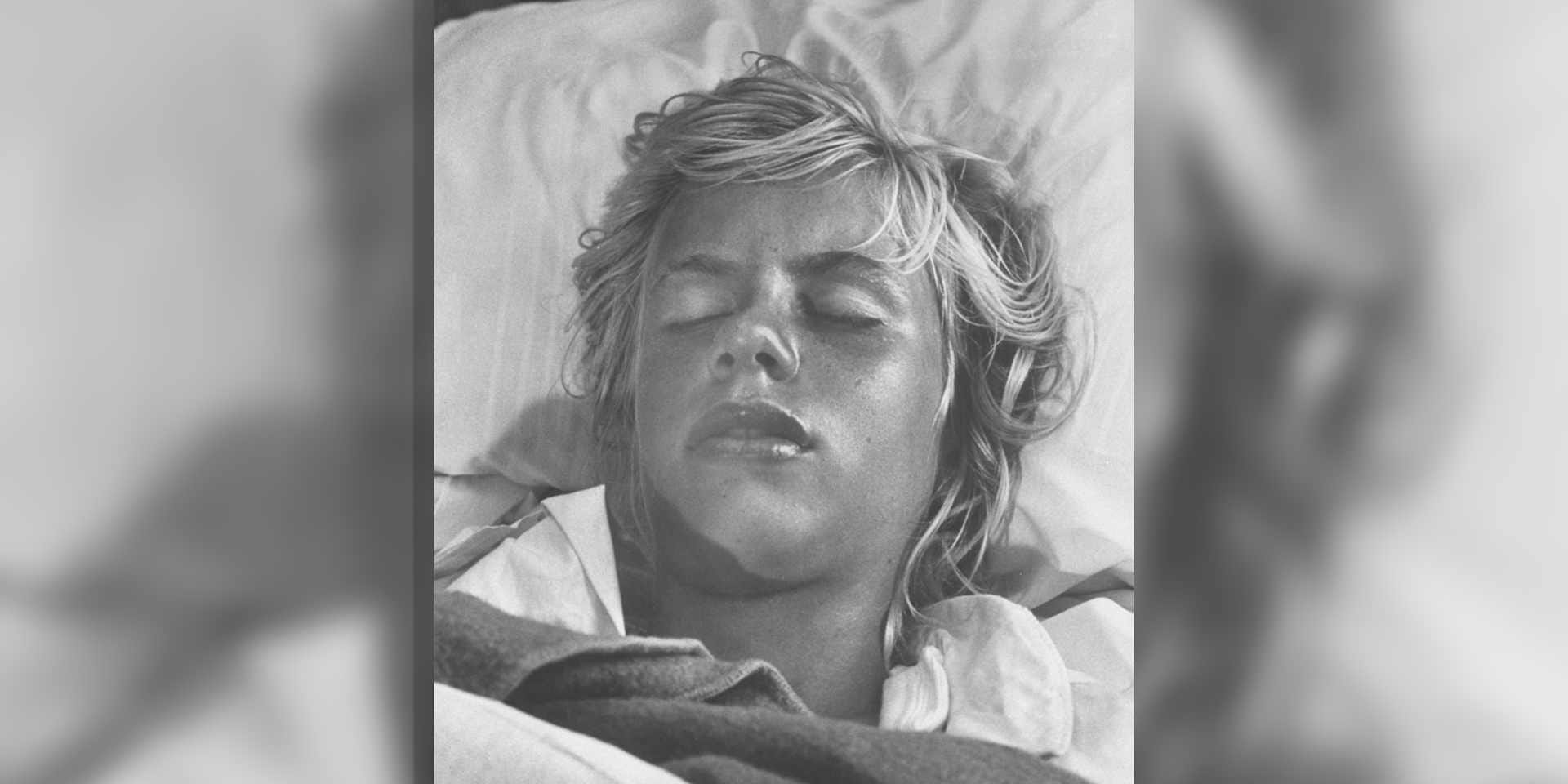
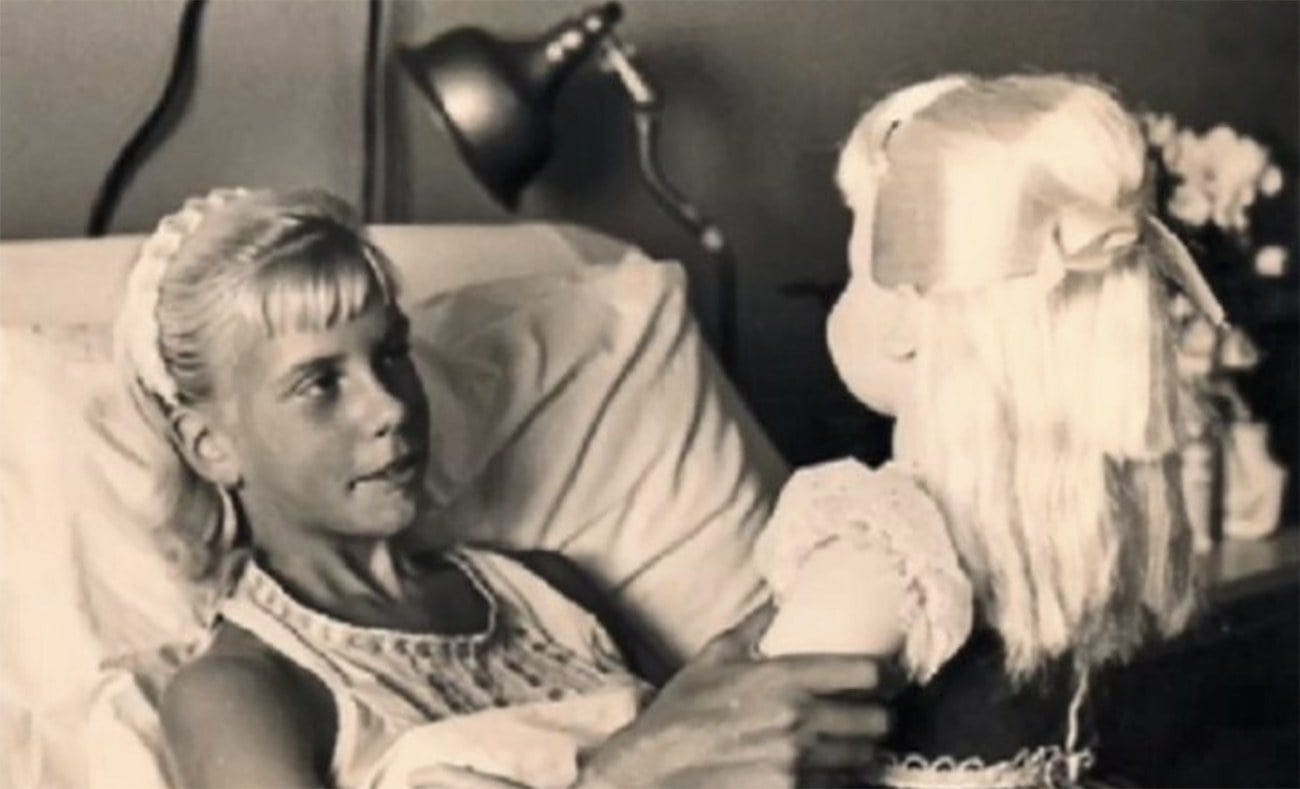
A rescue helicopter was sent to retrieve her, and they airlifted her to a hospital in Miami. Terry Jo arrived in critical condition, and she was suffering from a combination of severe sunburn, dehydration, and exposure to the elements. For more than two days, she was unable to speak to police or the Coast Guard about what had happened.
It took four days after her initial rescue for Terry Jo to find her voice again, but when she did, she told the harrowing story of what really happened to the Bluebelle and her family.
Mutiny and Massacre
Terry Jo told investigators that on the evening of November 12th, the Bluebelle had begun its voyage back to Florida. After dinner, Terry Jo had gone down to the lower cabin at around 9 p.m. to sleep. Her parents, siblings, Captain Harvey, and his wife remained aboveboard on the deck.
Some time later, Terry Jo was awoken by the screams of her brother Brian, calling out for their father. She made her way above deck, and there she saw the dead bodies of Brian and her mother, lying in the main cabin near the galley.
Further on the deck, she spotted Harvey carrying a bucket. He hit her and shoved her below deck, screaming at her to get back down. In shock and terrified, Terry Jo returned to her cabin and shortly thereafter saw a mixture of oil and water beginning to flood the floor.5
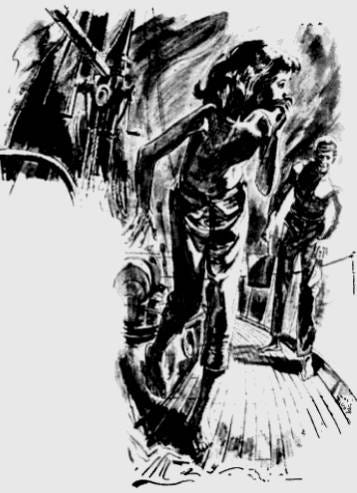
Harvey came down to her cabin, this time carrying a rifle rather than a bucket. Terry Jo froze, and although she made eye contact with Harvey, he said nothing and returned above deck. The cabin, meanwhile, was continuing to flood with oil and water. It quickly became too flooded for Terry Jo to stay there, forcing her to return above deck and face whatever horror awaited.
She saw Harvey standing on the deck, and the dinghy was deployed in the water below. He asked her if the dinghy was loose, and she told him she did not know. Harvey ordered Terry Jo to hold the rope attached to the dinghy while he went to get something. The rope slipped through her fingers, and when Harvey came back, he dove overboard and swam to the dinghy, leaving Terry Jo standing alone on the rapidly sinking sailboat.
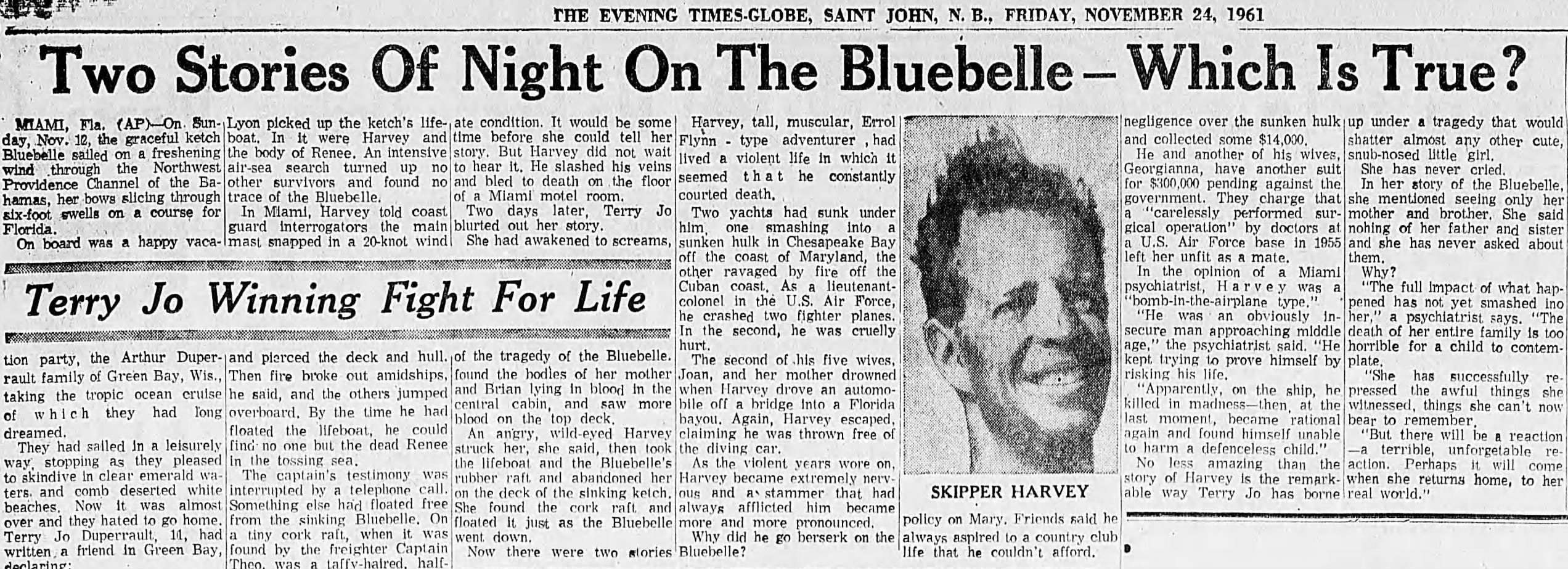
Somehow, despite the nightmare unfolding around her, Terry Jo remembered a cork float lashed to the deck. As the deck began sinking below the water, she managed to untie the float and toss it overboard. She swam toward it and managed to climb on top, drifting away from the wreckage of the ship.
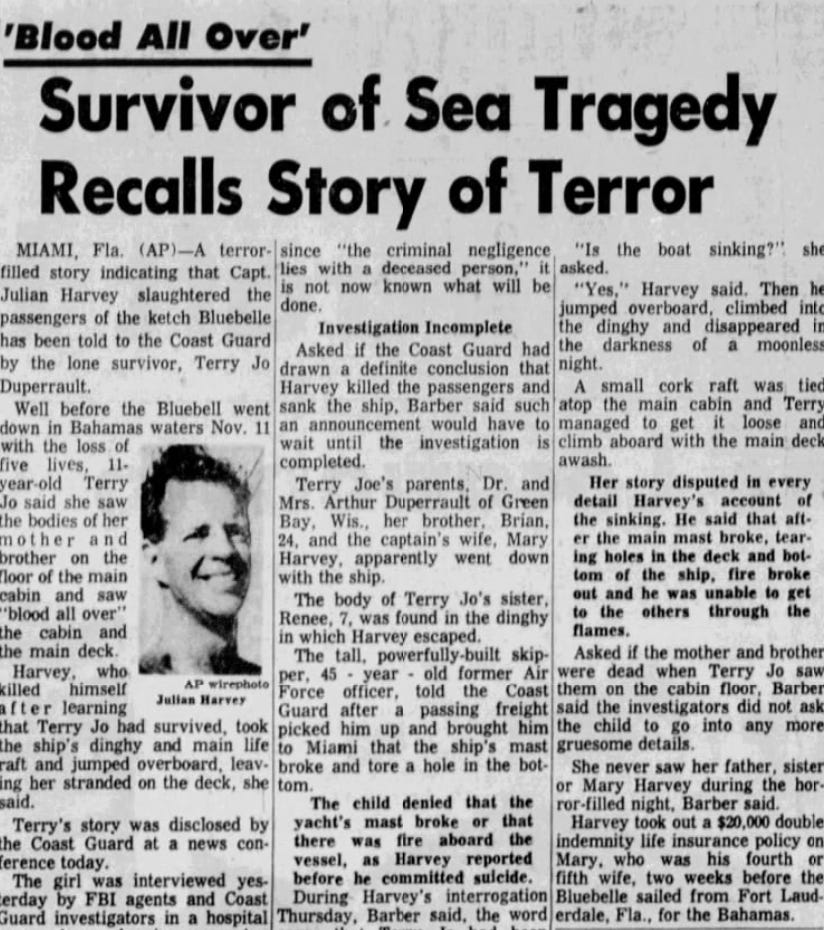
She would be stuck on the cork raft, a vessel so small she could only sit upright on it, for three and a half days with no food, water, or refuge from the harsh sun and wind. In her recounting of the events, Terry Jo insisted that the mast of the Bluebelle had never broken, there was never a fire onboard, and the ocean was calm that night – all elements that directly contrasted Harvey’s story.
She was told that Harvey had been found alive, and that René’s body was found with him. As though she hadn’t already endured enough trauma, investigators had to tell young Terry Jo that the bodies of her parents and her brother had been lost at sea.
Aftermath
On the morning of November 16th, Harvey was being questioned by the Coast Guard. During the interrogation, he was informed that Terry Jo had been rescued that very day, and that she was alive. He responded with an exclamation and a calm, “Isn’t that wonderful?” Lieutenant Ernest Murdoch told Harvey that an official investigation was being launched into the sinking of the Bluebelle and the loss of her passengers. Harvey asked to be excused to go speak with his wife’s family, and his request was granted.
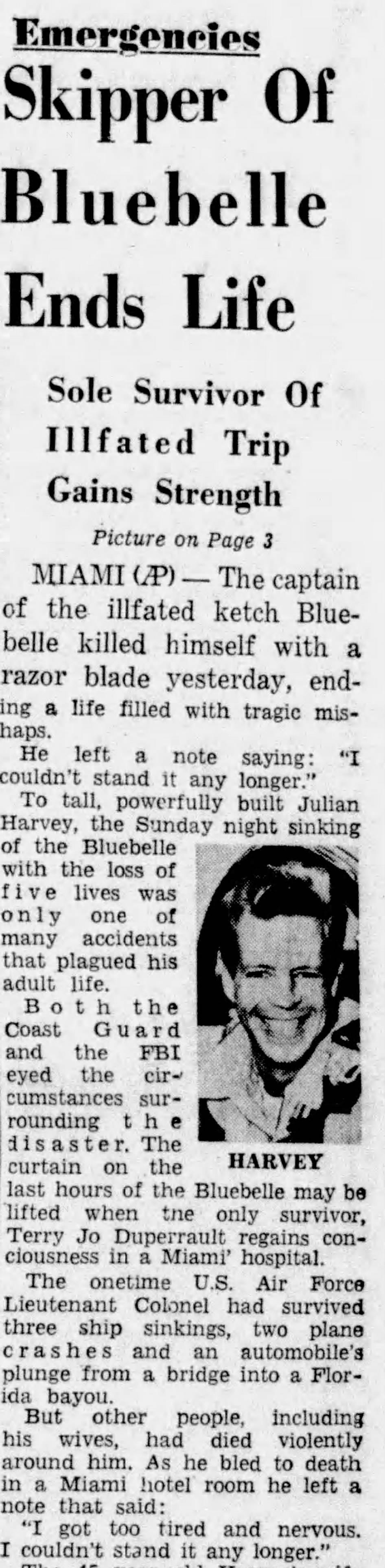
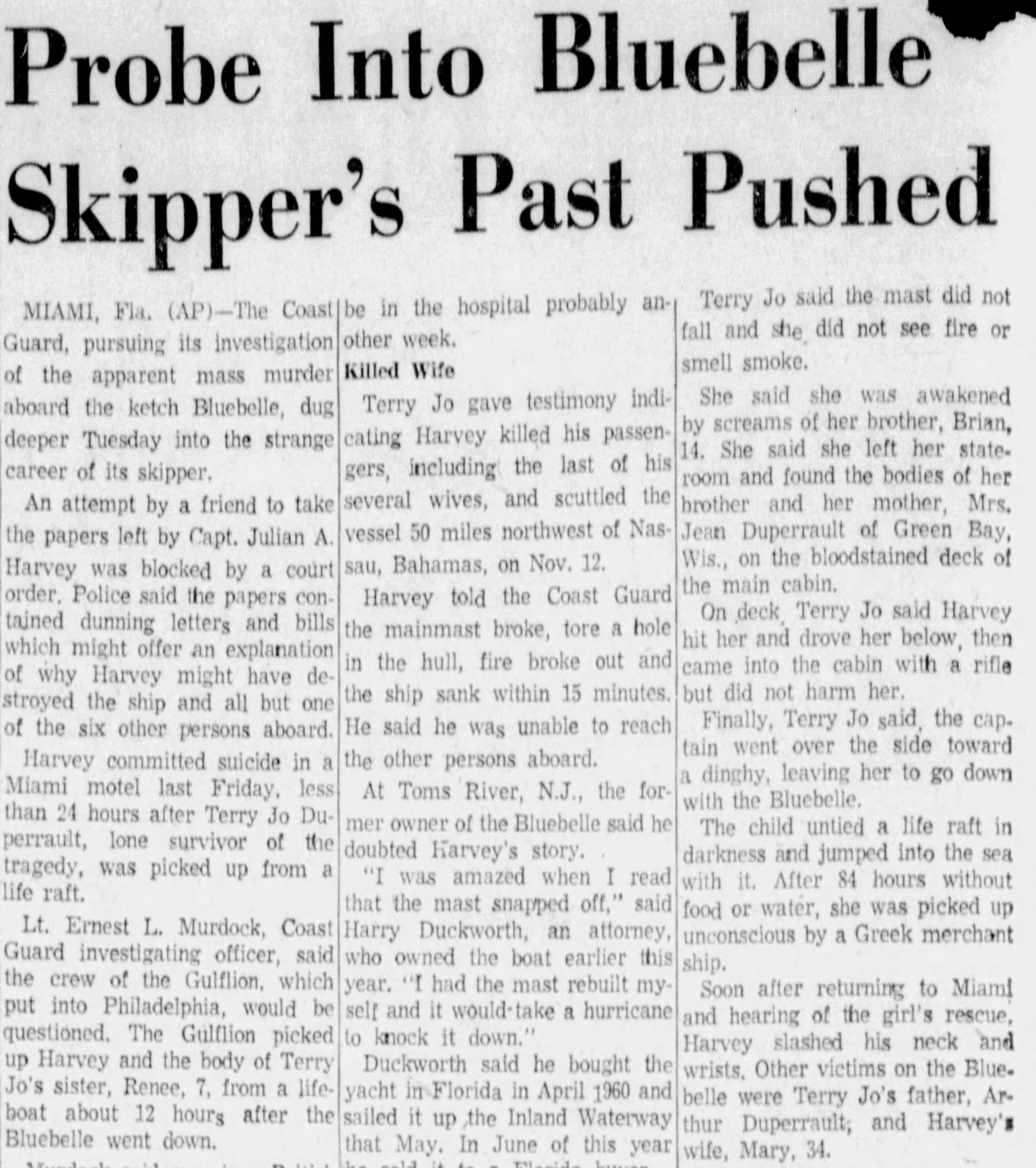
Harvey then drove to the Sandman Motel, where he paid cash for his room under the name of John Monroe. In the room, he wrote a two-page suicide note, then took his own life by using a razor blade to cut his thigh, ankles, and jugular vein.
A maid discovered his body lying in the motel room bathroom around two hours later. The note left behind was addressed to a friend from his previous days serving in the military, and although the note did not explain why Harvey had done what he’d done, it ended with, “I got too tired and nervous. I couldn’t stand it any longer.” In the note, Harvey also requested his friend look after his 14-year-old son, Lance, and asked the recipient to make sure he was buried at sea.
A full investigation into Harvey’s background and history was launched after his death. It was revealed that Harvey had been having long-term and ongoing financial problems, stemming largely from his inability to hold a steady job following his military service in both World War II and the Korean War.
He had married Mary Dene in July of 1961, and two months later, he had taken out a double indemnity life insurance policy on her. In October of 1961, one month before the Duperrault family’s voyage, the owner of the Bluebelle had hired Harvey to take tourists on cruises in the vessel in exchange for $300 per month and free lodging onboard.
Investigators believed Harvey was planning to murder Mary at sea and use the tourists onboard as witnesses to corroborate his claims that it had been an accident, allowing him to cash in the life insurance policy he’d taken on her. The Duperraults just so happened to be Harvey’s first chartered clients.
The inquiry concluded that Harvey intended to carry out that plan, and likely had no intention of harming the Duperrault family. However, they speculated that Arthur may have caught Harvey either in the act of murdering Mary or in the process of disposing of her body. If that were the case, Harvey would need to get rid of the witnesses, who were now witnesses to murder and not witnesses for his insurance payout.
Investigators felt strongly that Harvey likely grabbed René’s body from the water not out of remorse, but to help make his sob story seem more credible. The insurance-fraud-gone-wrong theory seemed especially more likely when investigators discovered that Harvey had survived a car accident in 1949 that had claimed the lives of his second wife and her mother. Harvey drove the car off a bridge at a high speed, and while he swam to safety, he left his wife, Joan, and her mother to drown.
Coupling that with his previous losses of two other vessels under strange circumstances, and authorities were confident that had Harvey not taken his own life, they would have been able to successfully convict him for the murders of all the passengers onboard the Bluebelle and the attempted murder of Terry Jo.
A Trail of “Accidents”
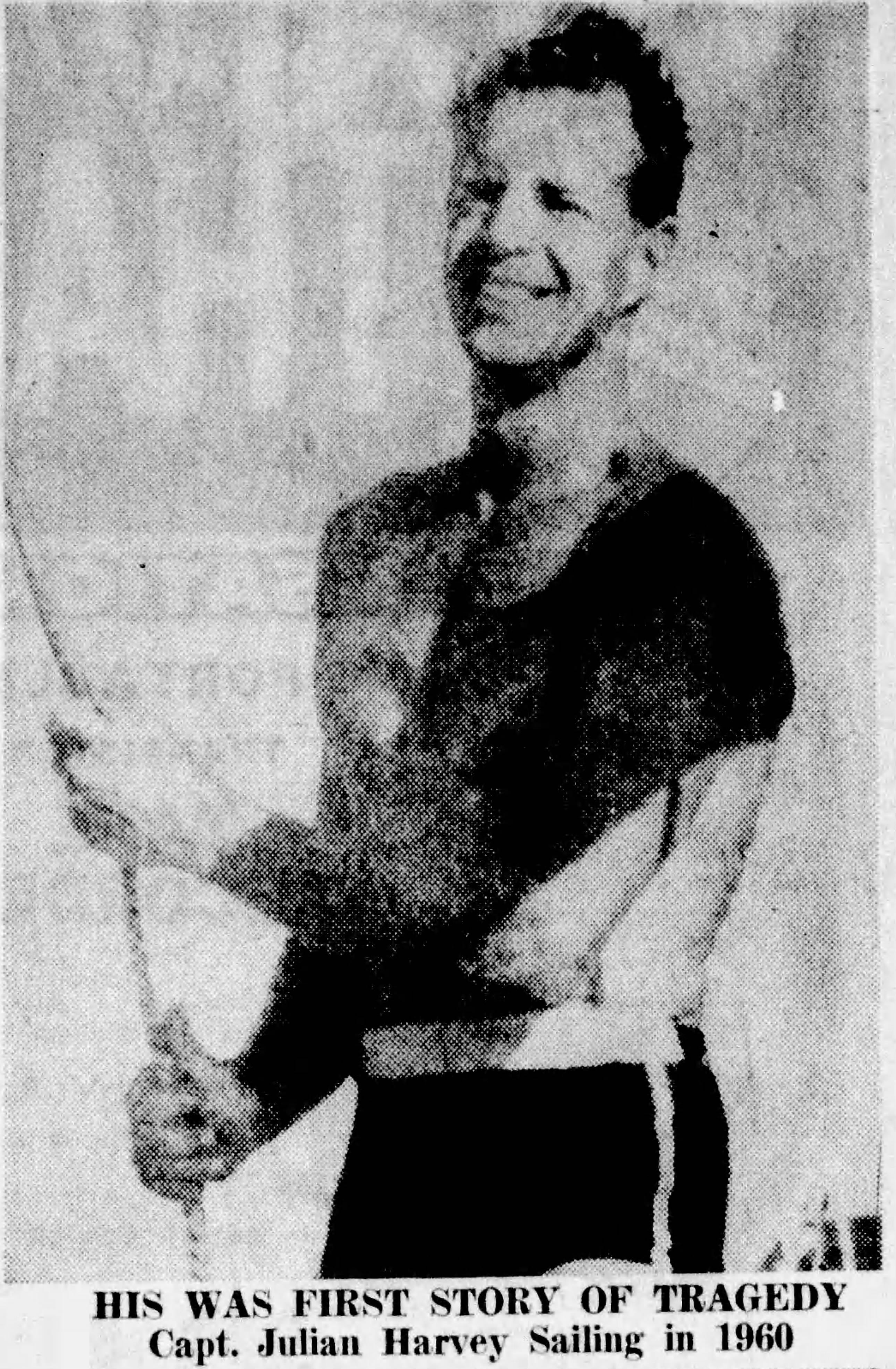
Julian Harvey had walked away from the water before. In April 1949, he was driving his wife and her mother through the Florida Panhandle when, as the story was later told, “they crossed an old wooden bridge over a bayou, the car went into a skid, crashed through the railing, and plunged into the murky waters.”6
Six years later, Harvey’s 68-foot yawl, Torbatross, struck a submerged wreck in Chesapeake Bay and sank. One of his passengers remembered it this way: “I remember we sailed around the wreck twice. Harvey said he was trying to read the markings on the buoy.”
A federal court awarded Harvey $14,258 for the loss. Then his next boat, the Valiant, went down too, and according to TIME, Harvey “confided to friends in Miami that he had scuttled Valiant for the insurance.”
Even the man at the Bluebelle‘s helm was not what he seemed. In a lawsuit that followed the massacre, the ketch’s owner alleged that Harvey “was not a licensed captain” and that hiring him “resulted in the owner having to pay a fine.”7
The Duperraults had trusted their lives to a charming, decorated war hero. The record behind him told a different story.
Why Did He Let Her Live?
It was the question that haunted everyone who followed the case. Erle Stanley Gardner, the creator of Perry Mason, called it “the mystery of the decade” in a column published in March 1962: “How did little Terry Jo Duperrault live through a murderous rampage? Why hadn’t Julian Harvey shot her, bludgeoned her, or pushed her into the water without a life preserver?”
Harvey had stood over her with a rifle and looked her in the eye. He said nothing. Then he left her on a sinking boat. When the Coast Guard released its findings the following spring, its answer was a cold one: Harvey had spared the girls “probably in the assumption that they would drown when the vessel sank.”
Terry Jo would spend the rest of her life with a different answer. “I thought that I was spared for a reason,” she said, “and the reason would be to help other people.”
Hope from Tragedy
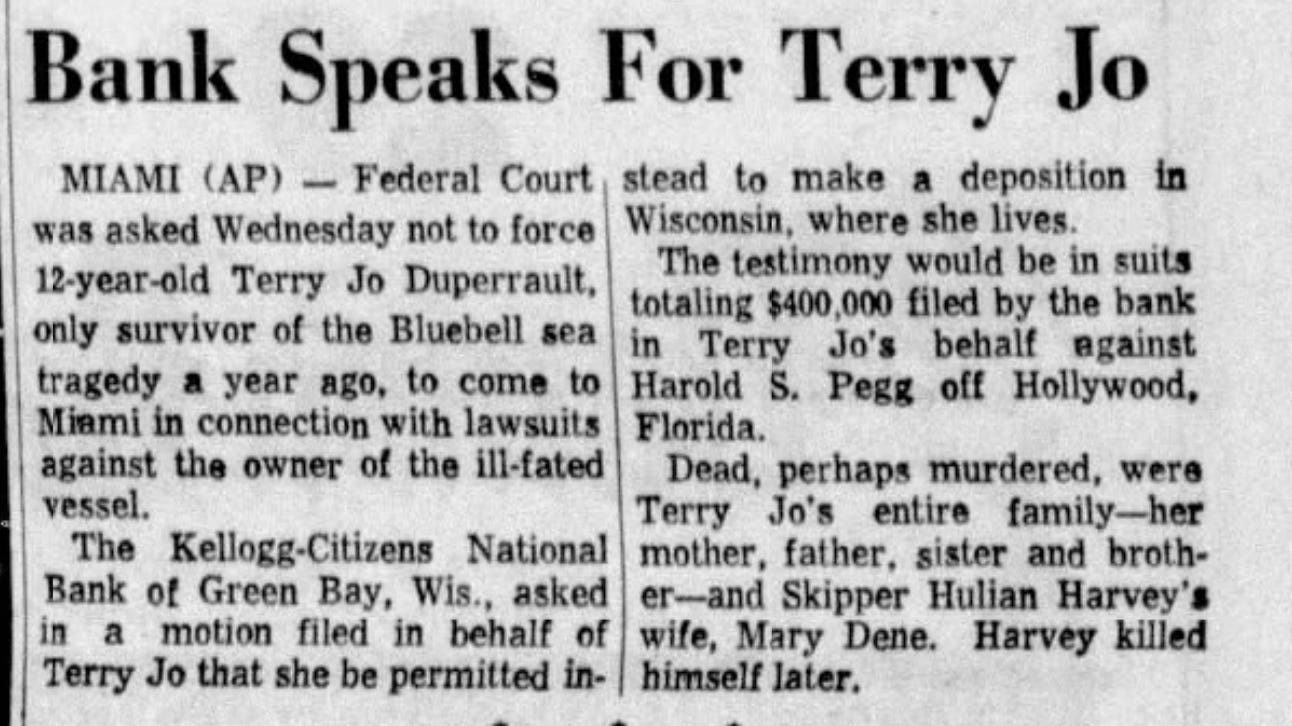
After the horrific loss of her family, Terry Jo moved in with her aunt, grandmother, and cousins back in Wisconsin. She changed her name to Tere the following year, which spoke to her determination to not view herself as a victim. She did not receive any trauma counseling, and for over twenty years, she did not speak publicly about her story of incredible loss and incredible survival.
Tere went on to marry, and she had three children. As an adult, Tere found herself drawn to water. She applied with the Department of Natural Resources for a position with fisheries, then went on to work in Water Resources and Water Regulation and Zoning. In a 2010 interview, Tere said, “Julian Harvey abandoned me thinking the ocean would swallow me, but instead it created a bond between me and water,” and added, “I went on to protect the water that had protected me as a little girl.”

In 2010, Tere released her memoir entitled Alone: Orphaned on the Ocean. The book was co-authored with survivalist and psychologist Richard Logan.8
In this memoir, Tere tells her story in vivid and harrowing detail, sharing the truth of what happened to her family, the days she spent adrift at sea, and her life since. Aside from her book, Tere impacted real change to maritime recommendations – her white cork float was difficult to spot at sea, and in 1962 the Coast Guard's investigation recommended that life floats and life rafts be colored international orange to help shipwreck survivors be found.
According to Tere, she believes she survived for a reason, and stated in a televised interview 49 years after that fateful night, "If one person heals from a life tragedy, my journey will have been worth it."
Closing Thoughts
Terry Jo Duperrault, now Tere Duperrault Fassbender, survived against all odds. She lost her family during what was supposed to be their vacation of a lifetime, and she found herself drifting at sea on a tiny cork float that could have very well become her final resting place.
Somehow, at only eleven years old, Tere managed to find the strength of will to stay alive. She grew not to fear water, or to hate it, but to love it and protect it with a passion. Although Julian Harvey’s actions destroyed her family, he couldn’t destroy Tere’s resilience.
From a story of such unthinkable pain came strength even more unimaginable. Today, the little girl they called the Sea Orphan stands as a testament to bravery, legacy, and not resigning oneself to being a victim, no matter what happens.
Celizic, 'Murder Rampage Left Girl Orphaned and Adrift,' TODAY (2010). https://www.today.com/news/murder-rampage-left-girl-orphaned-adrift-2d80555998
Piester, 'How a Child Survived a Massacre and 4 Days Alone at Sea,' A&E. https://www.aetv.com/articles/terry-jo-duperrault-1961-bluebelle-murders
"Bluebelle (ship)," Wikipedia, accessed September 2026, https://en.wikipedia.org/wiki/Bluebelle_(ship).
Richard D. Logan and Tere Duperrault Fassbender, "Orphaned at Sea, Tere Now Tells Story" (excerpt from Alone: Orphaned on the Ocean), TODAY, May 2010, https://www.today.com/popculture/orphaned-sea-tere-now-tells-story-wbna36964672.
Lauren Piester, "How a Child Survived a Massacre and 4 Days Alone at Sea," A&E, July 2, 2026, https://www.aetv.com/articles/terry-jo-duperrault-1961-bluebelle-murders.
Harold Schechter, "Bluebelle's Last Voyage: A True Crime," Salon, August 4, 2012, https://www.salon.com/2012/08/04/bluebelles_last_voyage_a_true_crime/.
Pegg v. Bertram, 176 So. 2d 918 (Fla. Dist. Ct. App. 1965), https://case-law.vlex.com/vid/pegg-v-bertram-no-893344324.
Barry Leibowitz, "Book 'Em: Alone, Orphaned on the Ocean," CBS News, June 17, 2010, https://www.cbsnews.com/news/book-em-alone-orphaned-on-the-ocean/.