



Background
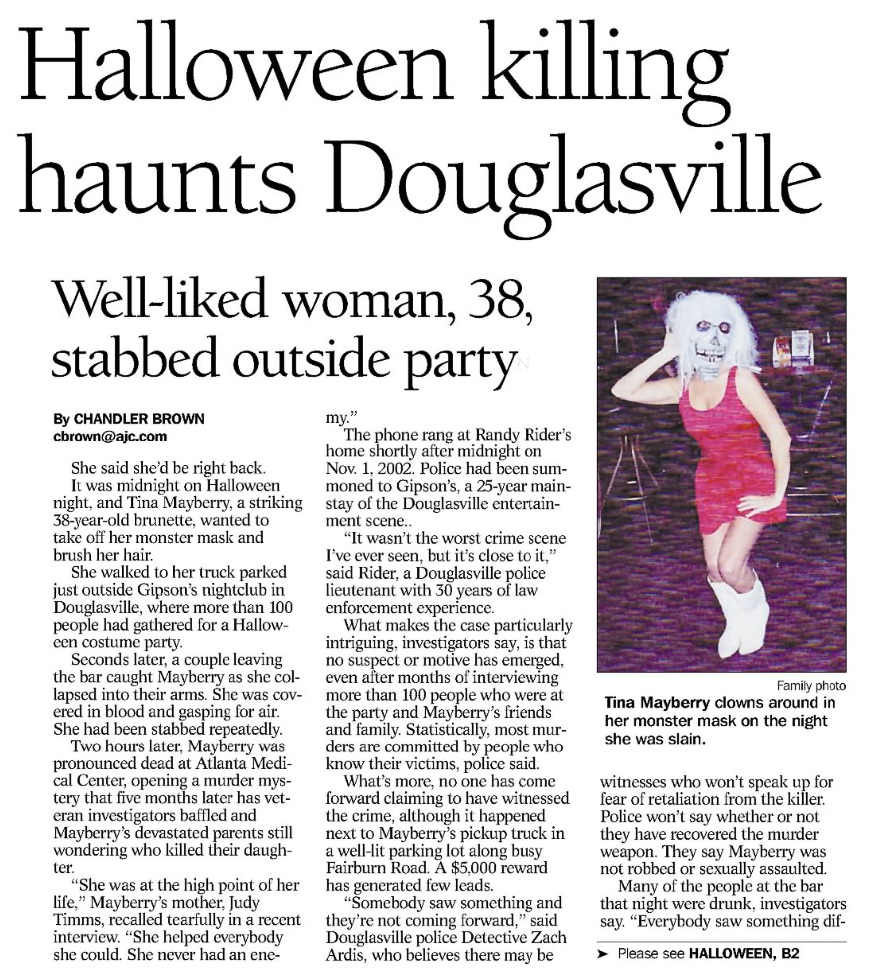
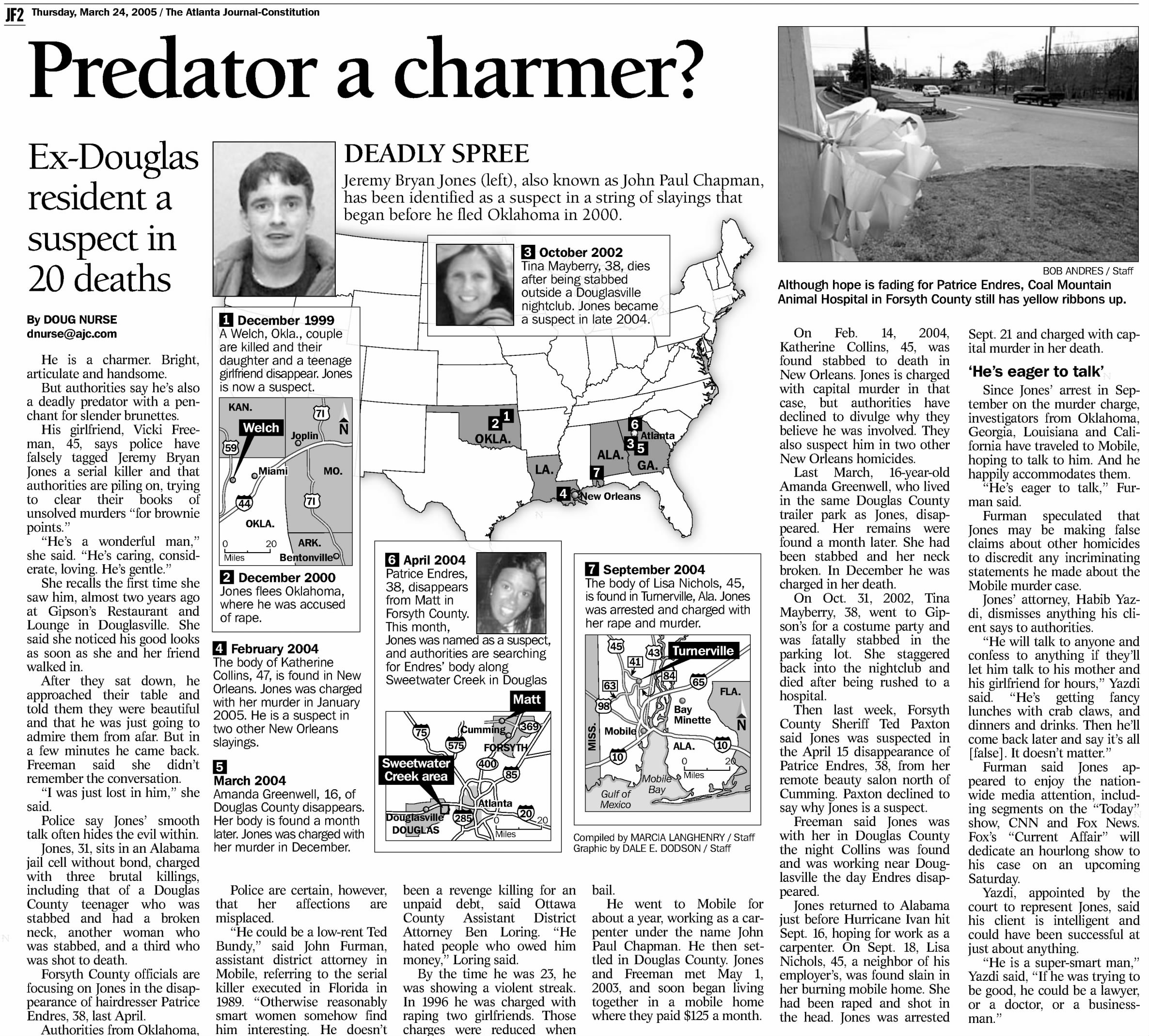
On Thursday night, October 31, 2002, 38-year-old Tina Mayberry attended a Halloween party at Gipson’s Restaurant and Lounge in Douglasville, Georgia. At some point that night, Tina stepped outside briefly. When she returned to the party, she was bleeding from multiple stab wounds. A short time later, Tina died from her wounds at Atlanta Medical Center. 1
For nearly two years, the questions surrounding Tina’s death remained unanswered. Who had attacked her outside the bar? Why had a night of Halloween celebration ended in tragedy? The mystery continued until a convicted murderer named Jeremy Bryan Jones claimed responsibility for her death, connecting Tina’s murder to a much larger investigation surrounding one of Alabama’s most notorious criminals.
Tina Mayberry
Eunice Martina “Tina” Mayberry was born on June 22, 1964, in Atlanta, Georgia. She was the daughter of William Humphrey Mayberry Jr. and Judy Elaine Wyatt. Tina’s father, William, died in 1967, and her mother later married Kenneth Timms. 2
By all accounts, Tina lived an average, unassuming life, which made what happened that Halloween night in 2002 all the more baffling.
Halloween 2002
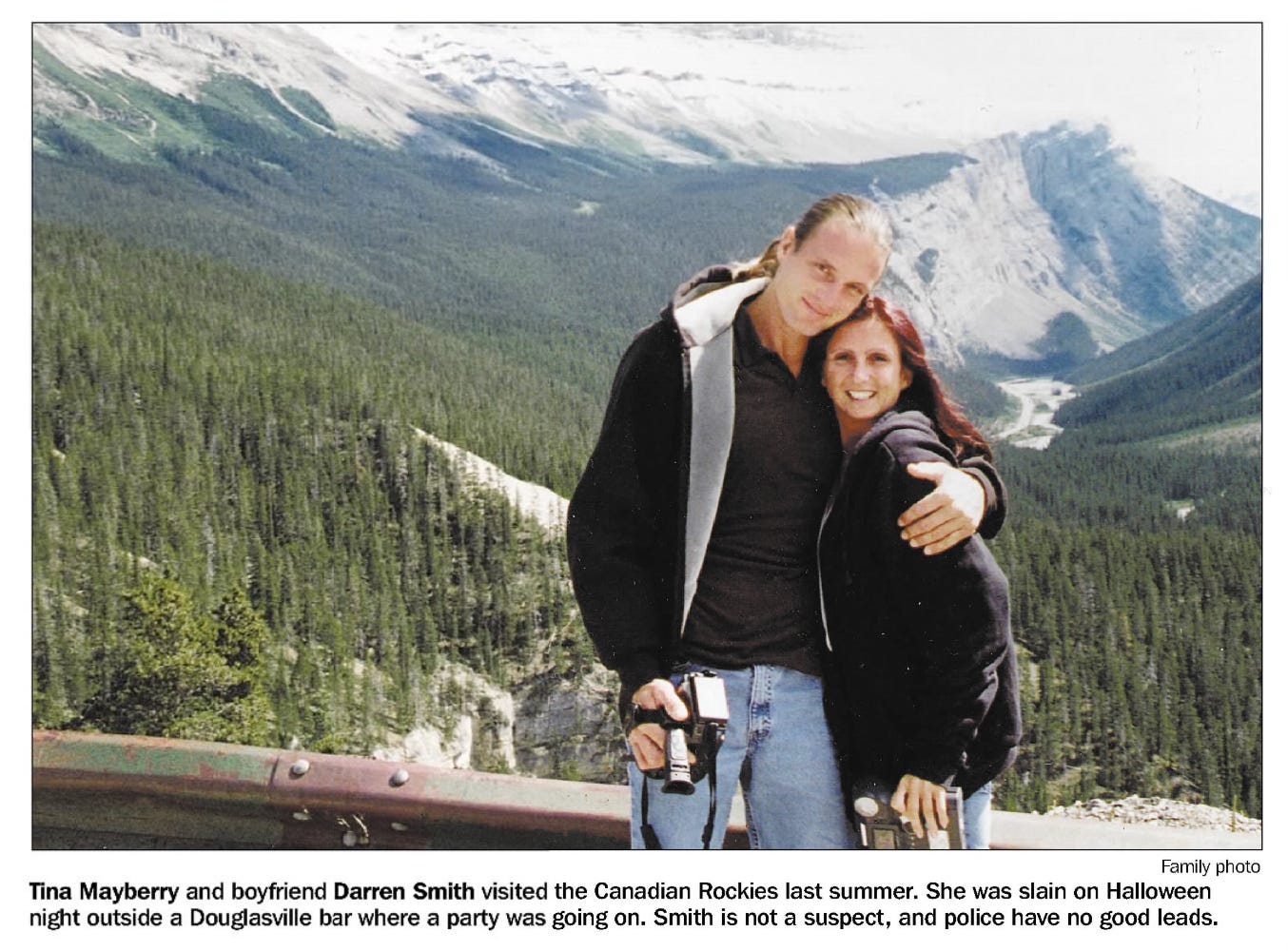
On the evening of October 31, 2002, Tina Mayberry went to Gipson’s Bar to attend a Halloween party. Inside the bar, patrons gathered wearing costumes, socializing, and taking part in the festivities. Like everyone else inside the bar that night, she appeared to be enjoying what should have been a fun evening.
At some point during the night, Tina left the bar. What happened after she walked outside would remain a mystery for years. Shortly after leaving, Tina returned to Gipson’s Bar severely injured. She had suffered multiple stab wounds and was in critical condition. The party immediately came to an end as customers and employees rushed to help her. Emergency services were contacted, and Tina was transported to the hospital for treatment.
For investigators, the situation was extremely difficult. Tina was the only person who could potentially explain what had happened outside the bar, but her injuries were too severe for her to provide them with the information they needed.
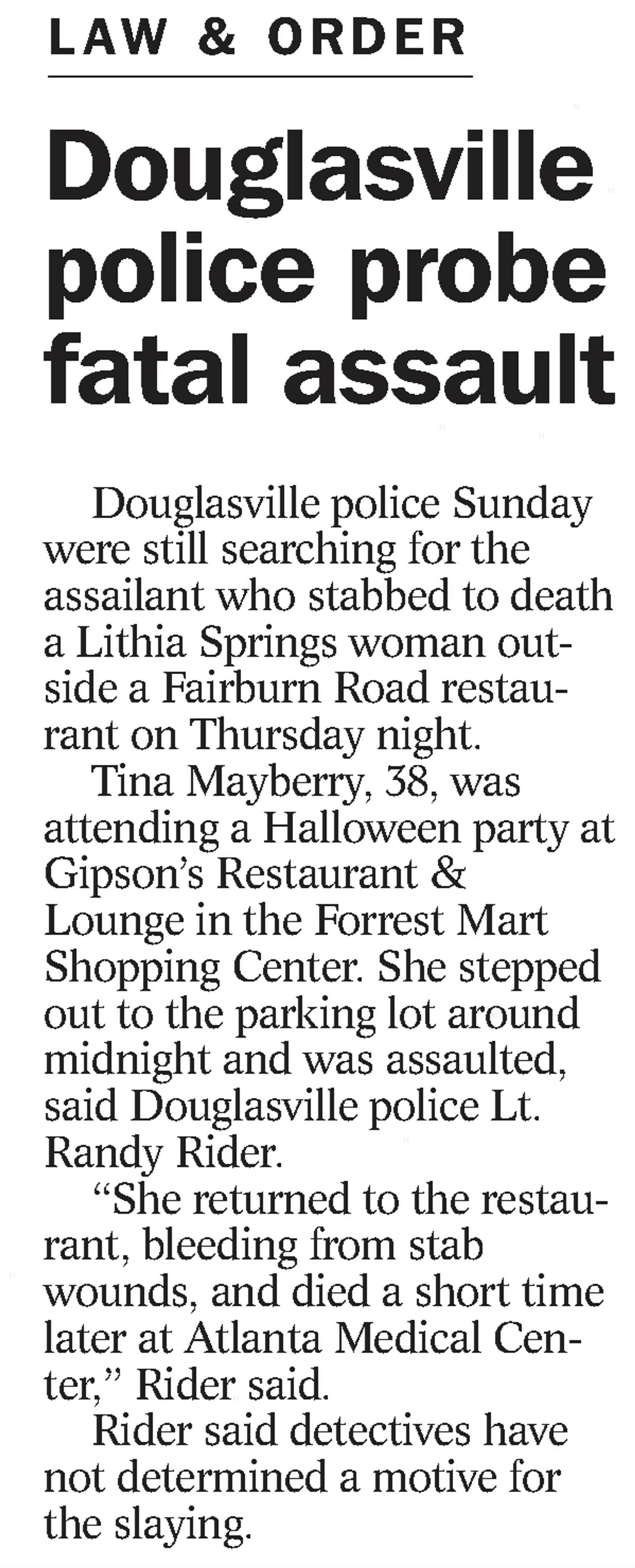
Tina Mayberry died in the hospital from severe blood loss. She was 38 years old at the time of her death. What had begun as an ordinary Halloween celebration was now a homicide investigation. Despite the party that night, there were no witnesses or suspects. The person responsible had disappeared into the night.
For years, Tina Mayberry’s murder remained unsolved. But eventually, investigators would uncover a connection to a man whose own criminal history would make him a prime suspect in Tina’s death.
That man was Jeremy Bryan Jones.
A Violent History
Jeremy Bryan Jones was born on April 12, 1973, in Miami, Oklahoma. Long before his name became connected to Tina Mayberry’s murder, Jones had already acquired a violent criminal record. By the late 1990s, Jones became increasingly involved in crime and had frequent run-ins with law enforcement. 3
His behavior escalated over time, including arrests for rape, assault, and drug possession. After a warrant was issued for his arrest on rape charges, he fled Oklahoma. After leaving Oklahoma, Jones eventually landed in Joplin, Missouri.
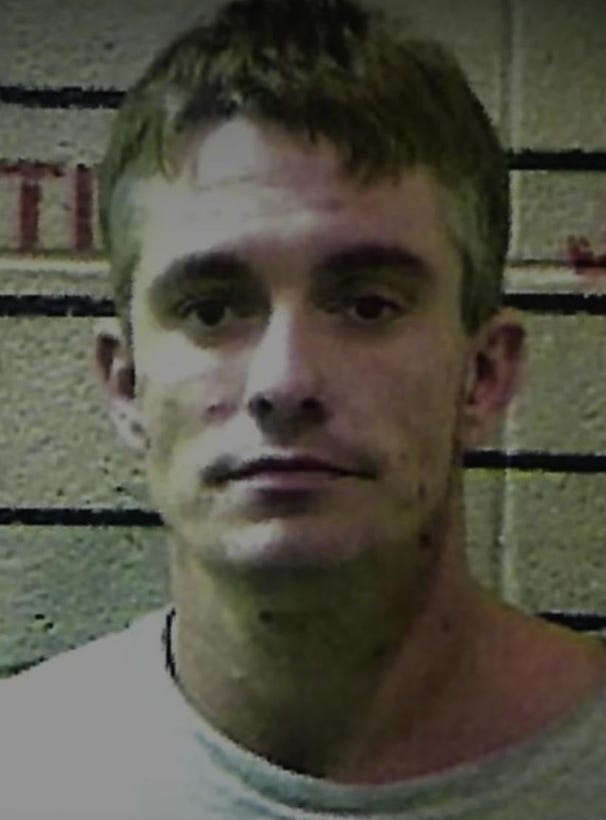
In Joplin, Jones met a woman whose son, John Paul Chapman, was in prison. He persuaded her to sell him Chapman's identification and Social Security card for about $50. In December 2000, Jones left Missouri as "John Paul Chapman" and eventually settled in Alabama — his real history hidden behind a stolen name. 4
However, his past would eventually catch up with him. In 2004, Jones was arrested in Alabama in connection with the murder of 43-year-old Lisa Marie Nichols.
The Murder of Lisa Nichols
In September 2004, Jones arrived in Turnerville, a small community near Satsuma, Alabama, looking for work in the aftermath of Hurricane Ivan, which had caused widespread destruction across the region. While there, Jones found construction and repair work for Mark and Kim Bentley. After Jones explained that he also needed a place to stay, Mark let him live in a trailer on their property with Scooter Coleman, a family relative.
While searching a closet for batteries, Jones found a .25-caliber handgun and kept it. On September 17, 2004, with Coleman and the Bentleys out of the house for the day, Jones took the gun and went to the home of a neighbor, 45-year-old Lisa Marie Nichols. He raped her at gunpoint, shot her three times, then placed her body in the bathtub and set it on fire before returning to the Bentleys' as if nothing had happened.
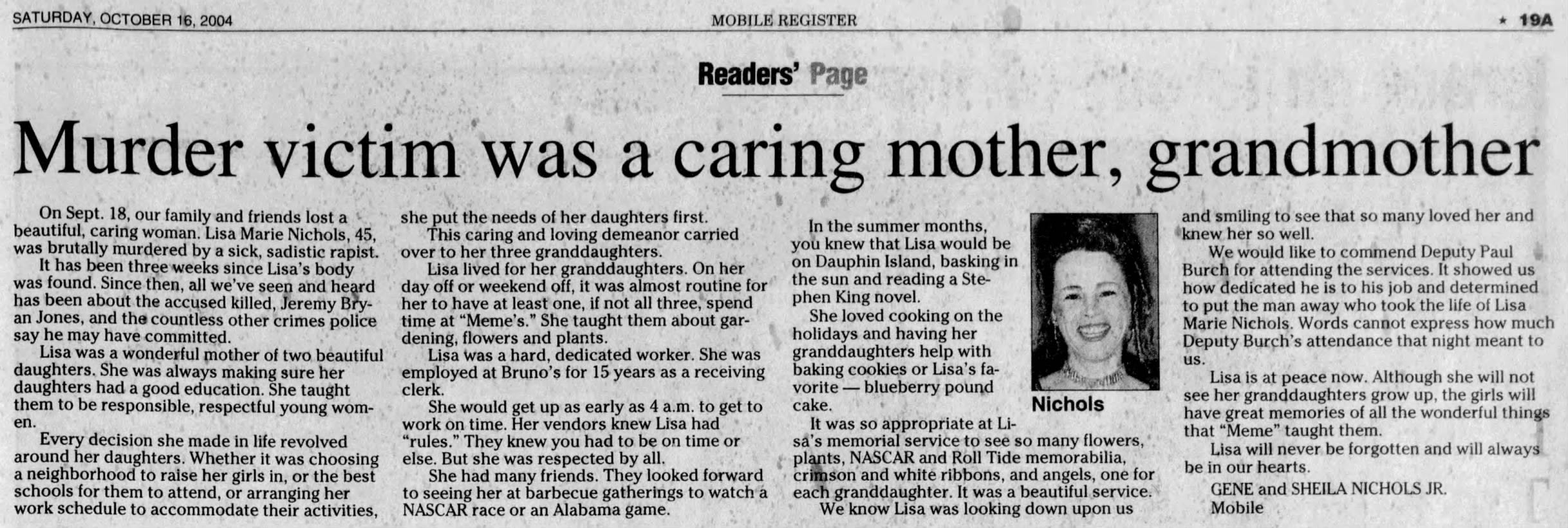
At the time, no one immediately knew what had happened inside Lisa’s home. The following day, Lisa’s family grew concerned when she failed to show up for work and stopped answering their calls. Lisa’s daughters, Jennifer Murphy and Amber Nichols, along with her son-in-law, Todd McKerchie, traveled to Turnerville to check on her.
Because the area was still without power after Hurricane Ivan, McKerchie entered Lisa’s home with a flashlight to search for her. During the search, he discovered Lisa’s charred remains inside the residence. After finding the body, McKerchie and Lisa’s daughters went to the Bentley residence and asked Kim Bentley to contact police.
According to reports, Jones showed little visible reaction after learning that a body had been discovered and did not appear willing to provide much assistance during interviews with detectives from the Mobile County Sheriff’s Office.
Investigation and Arrest
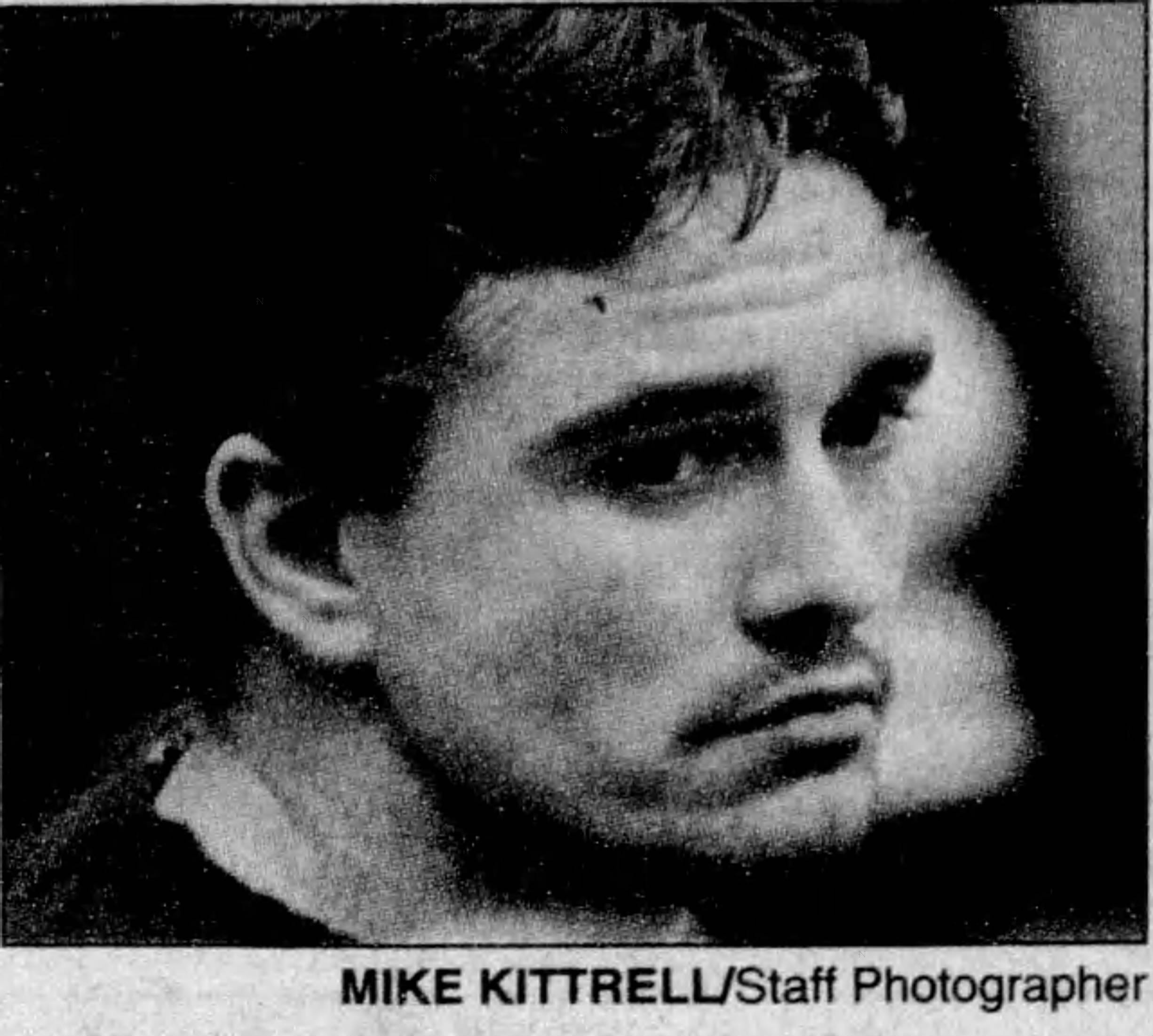
The investigation soon focused on the man that the Bentleys knew as John Paul Chapman. Three .25-caliber bullets in the house led them to Mark Bentley's handgun, which ballistics tied to the murder. When questioned, Mark Bentley admitted that he owned a handgun and handed the weapon over to investigators. Scooter Coleman said the gun had likely been taken by "Chapman." 5
The gun was examined, and several details connected it to Lisa’s murder. Investigators discovered signs indicating that the weapon had been recently fired, including gunpowder traces, soot residue, and bullet casings. Further testing confirmed that the handgun was the same weapon used in the murder of Lisa Nichols.
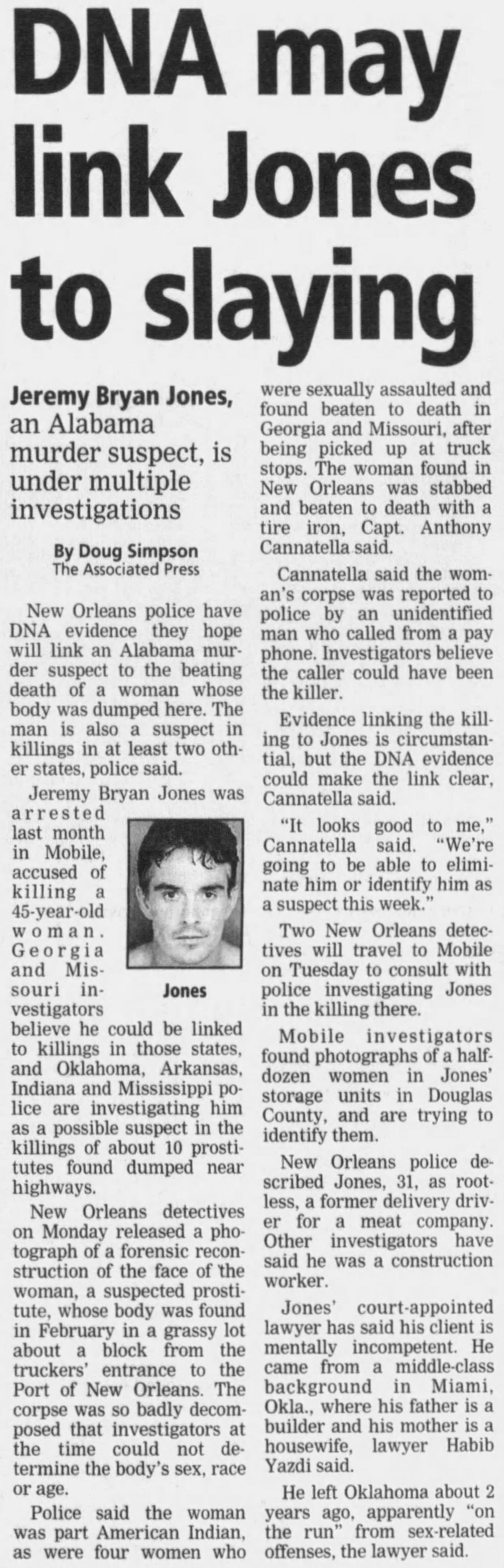
On September 19, Jones fled Turnersville. While authorities searched for him, information about the suspect was shared with law enforcement agencies in neighboring states. This led to a major breakthrough when the Missouri Attorney General's office found that the suspect's date of birth and Social Security number belonged to a John Paul Chapman who was serving a prison sentence in Missouri.
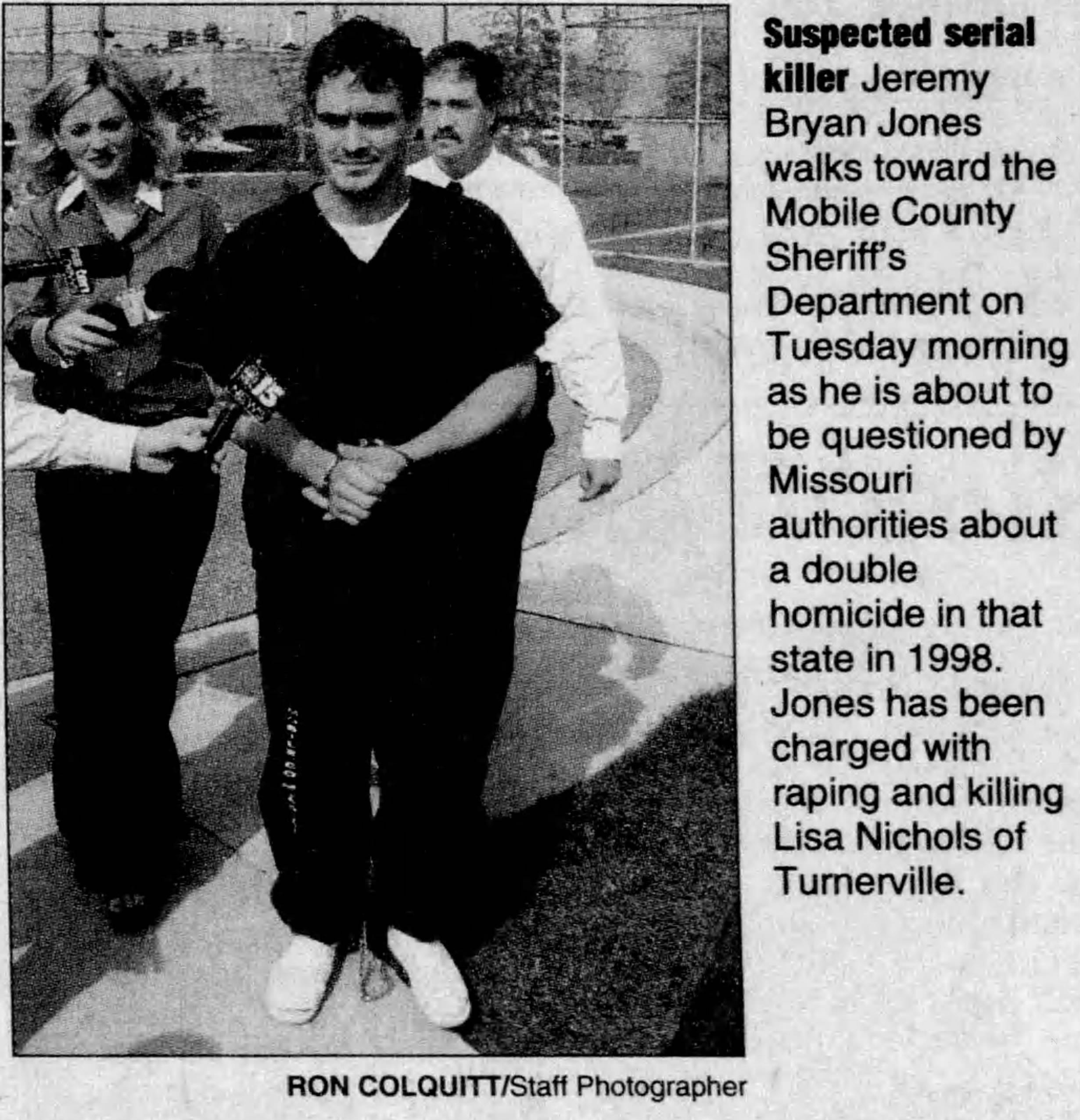
When confronted, Chapman’s mother revealed that she had sold her son’s personal information to a man named Jeremy Bryan Jones, allowing Jones to assume his identity and disappear. On September 21, 2004, Jones was arrested in Mobile, Alabama. Investigators then obtained fingerprint records connected to Jones’ previous arrest in Miami, Oklahoma, in 1990, confirming that the man arrested in Alabama was not John Paul Chapman. He was Jeremy Bryan Jones.
Initially, Jones denied involvement in Lisa Nichols’ murder. However, after forensic evidence connected him to the crime, Jones changed his story and admitted responsibility. Jones later claimed that he had committed the murder while under the influence of methamphetamine. However, his statements changed several times during questioning, creating inconsistencies in the details he provided.
The arrest of Jeremy Bryan Jones did more than solve the murder of Lisa Nichols. It opened the door to a much larger investigation. Though they did not know it at the time, authorities would soon learn the truth about Jeremy Jones’ deadly past.
Confessions
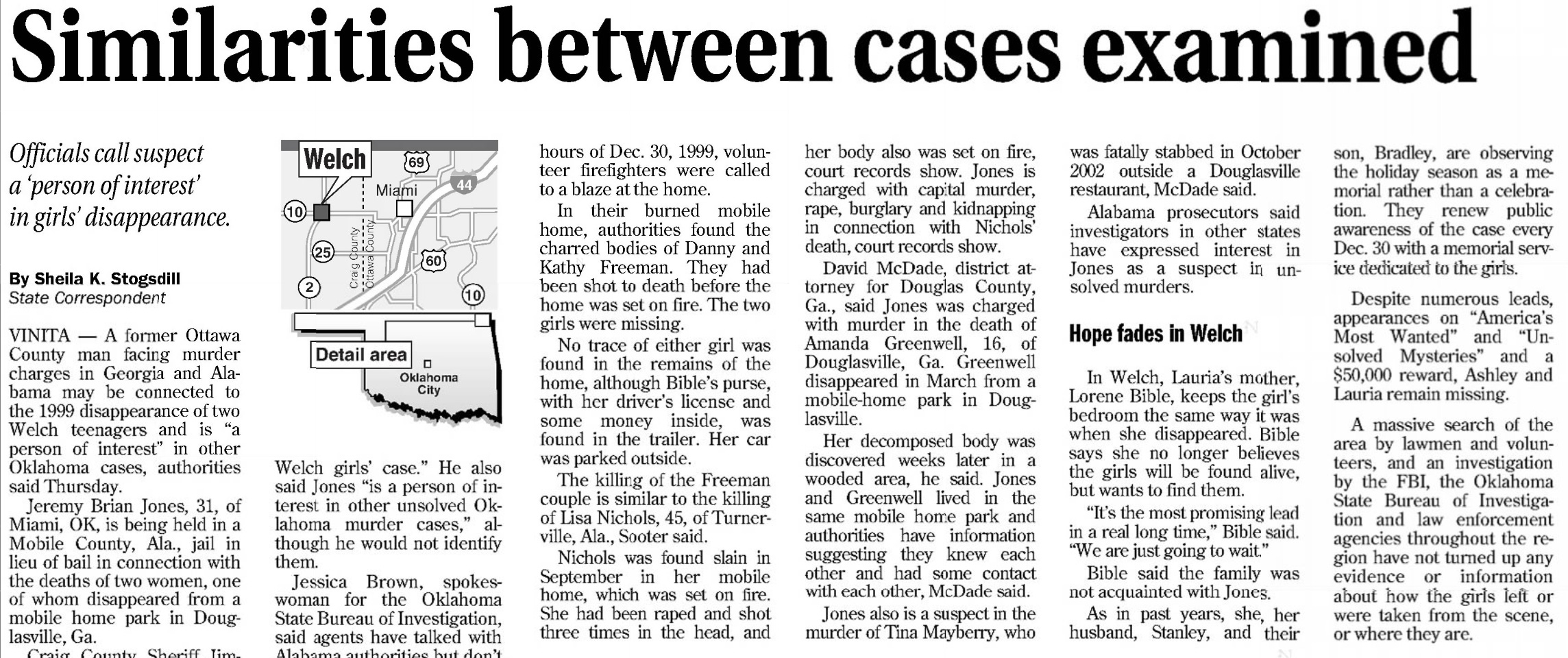
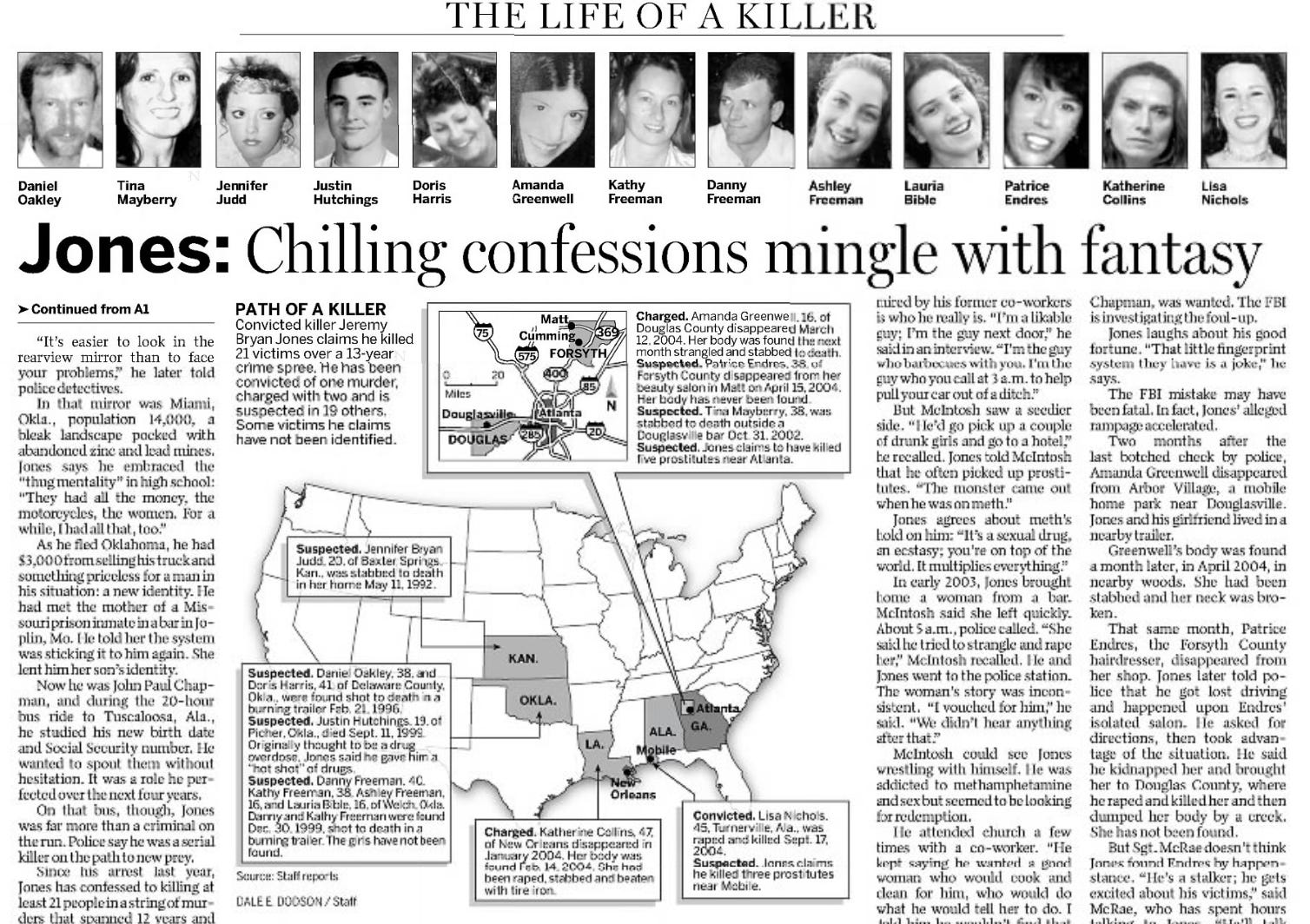
As investigators continued questioning Jones about his past, he began making claims about other crimes. Jones claimed responsibility for as many as 21 murders, including the unsolved 2002 Halloween night murder of Tina Mayberry. 6
According to Jones, he was inside Gipson’s that night when he encountered Tina during a Halloween celebration. He claimed that she was dressed as Betty Boop and that after speaking with her, he convinced her to leave the bar with him. Jones stated that once they were outside, he assaulted Tina before stabbing her several times in the chest and stomach.
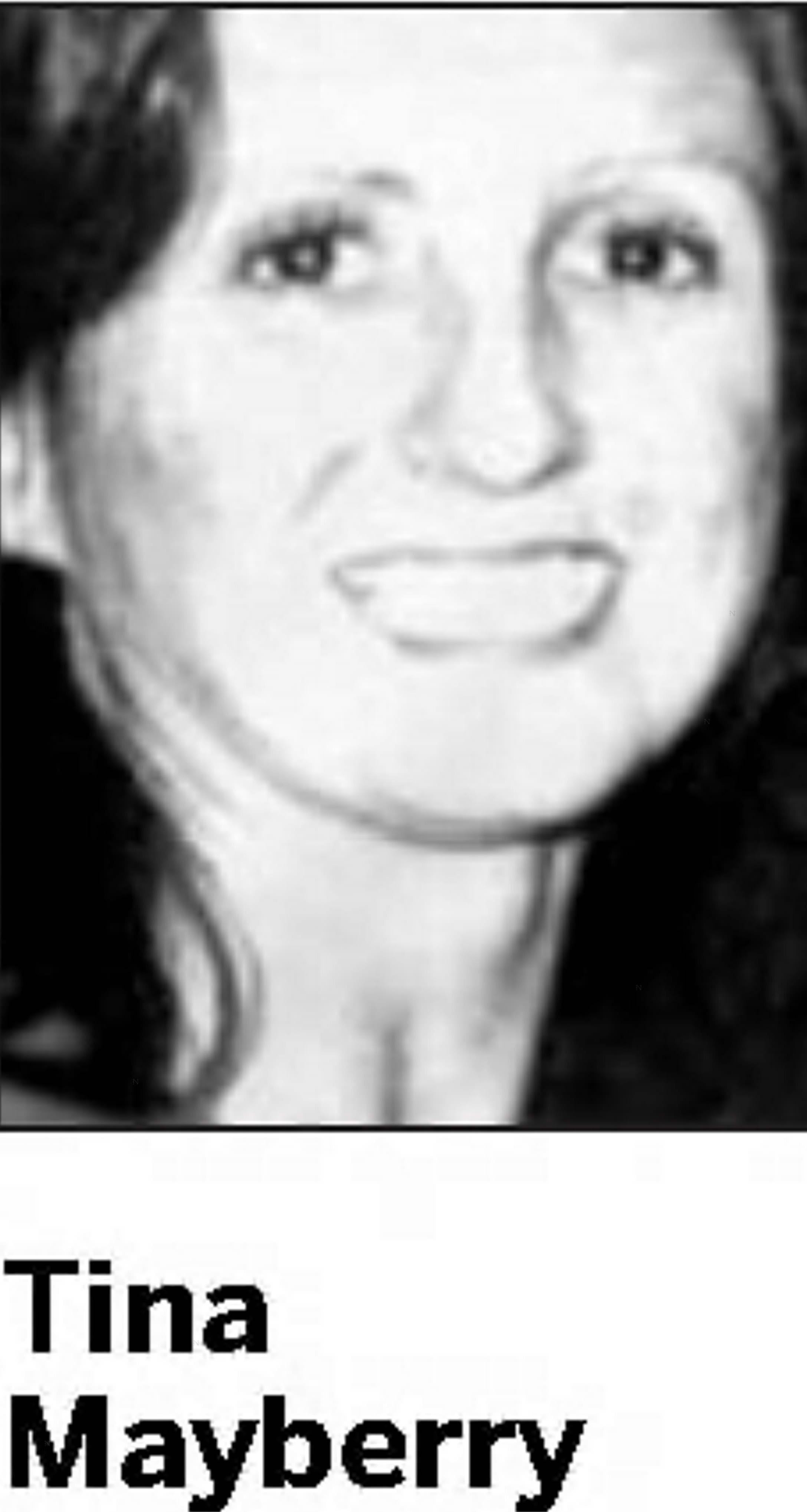
For nearly two years, Tina Mayberry’s murder had no suspect. There were no witnesses who could identify the attacker, and Tina was unable to provide investigators with a description of the person responsible before she died. However, after Jones’ arrest, the owner and employees of Gipson’s Bar identified him as a regular customer at the establishment around the time of Tina’s death.
In fact, a year after the murder of Tina Mayberry, Jones, who was still living in the Douglasville area, was arrested for disorderly conduct. His fingerprints were run through the Integrated Automated Fingerprint Identification System (IAFIS). However, due to an error, the system incorrectly identified his fingerprints, and after paying a fine, Jones was allowed to leave. He left Georgia soon after.
The confession brought new attention to Tina’s case and provided investigators with a possible explanation for what had happened on October 31, 2002. However, unlike the murder of Lisa Nichols, Tina Mayberry’s death would never result in a separate trial or conviction.
Trial and Conviction of Jeremy Jones
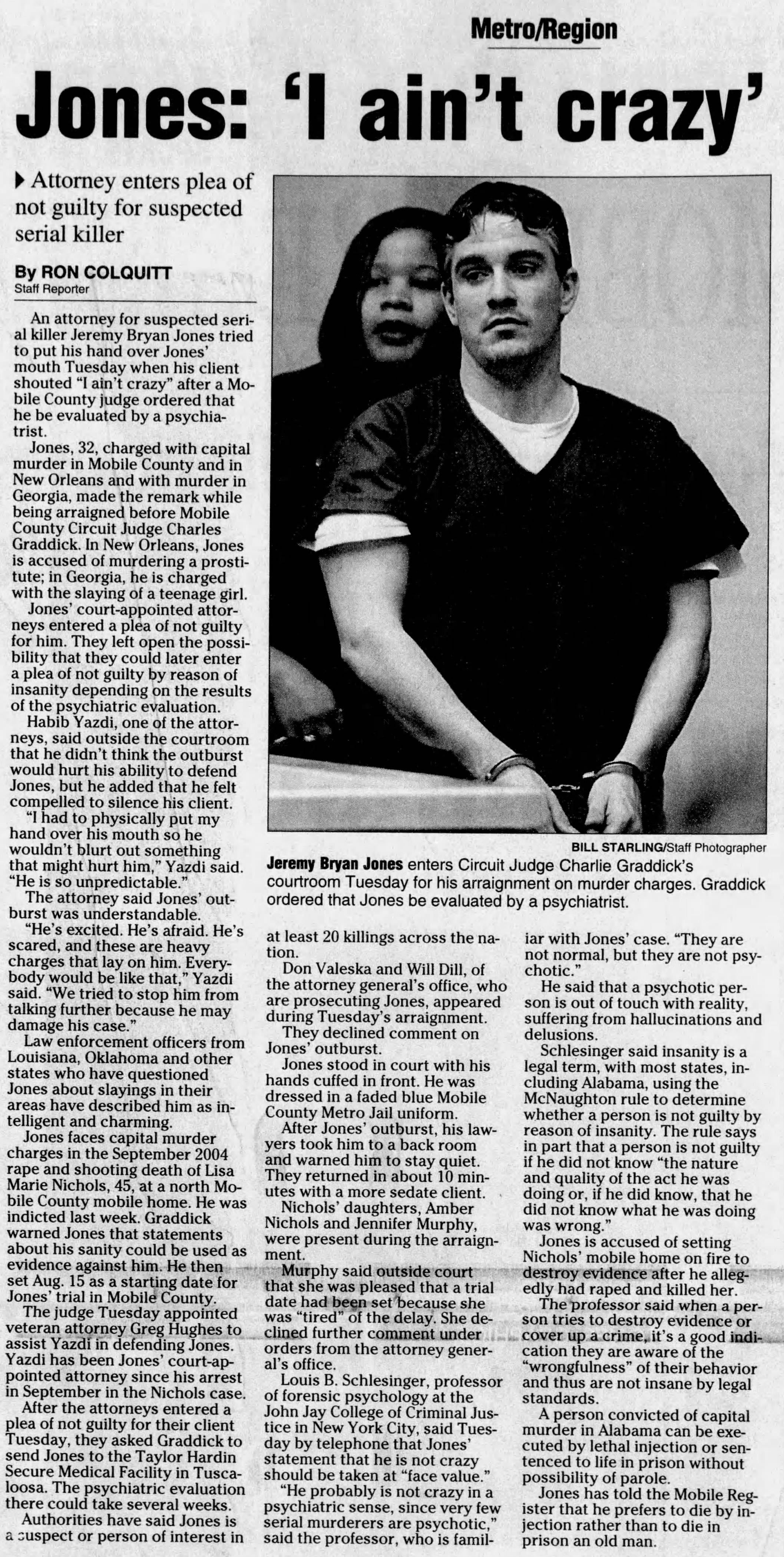
While Jones’ statements about Tina Mayberry and other crimes attracted attention, the case for which he stood trial was the murder of Lisa Nichols. Jones’ trial was originally scheduled to begin on August 15, 2005. However, proceedings were delayed after his attorneys requested that he undergo a mental evaluation before standing trial.
The evaluation determined that although Jones had mental impairments, he was considered legally sane and capable of understanding the proceedings against him. The trial officially began on October 19, 2005, in Mobile County, Alabama.
The prosecution presented several pieces of evidence against Jones, including his own confession, fingerprints found during the investigation, testimony from Scooter Coleman, the handgun used in Lisa Nichols’ murder, and DNA evidence linking blood found on Jones’ clothing to Lisa Nichols.
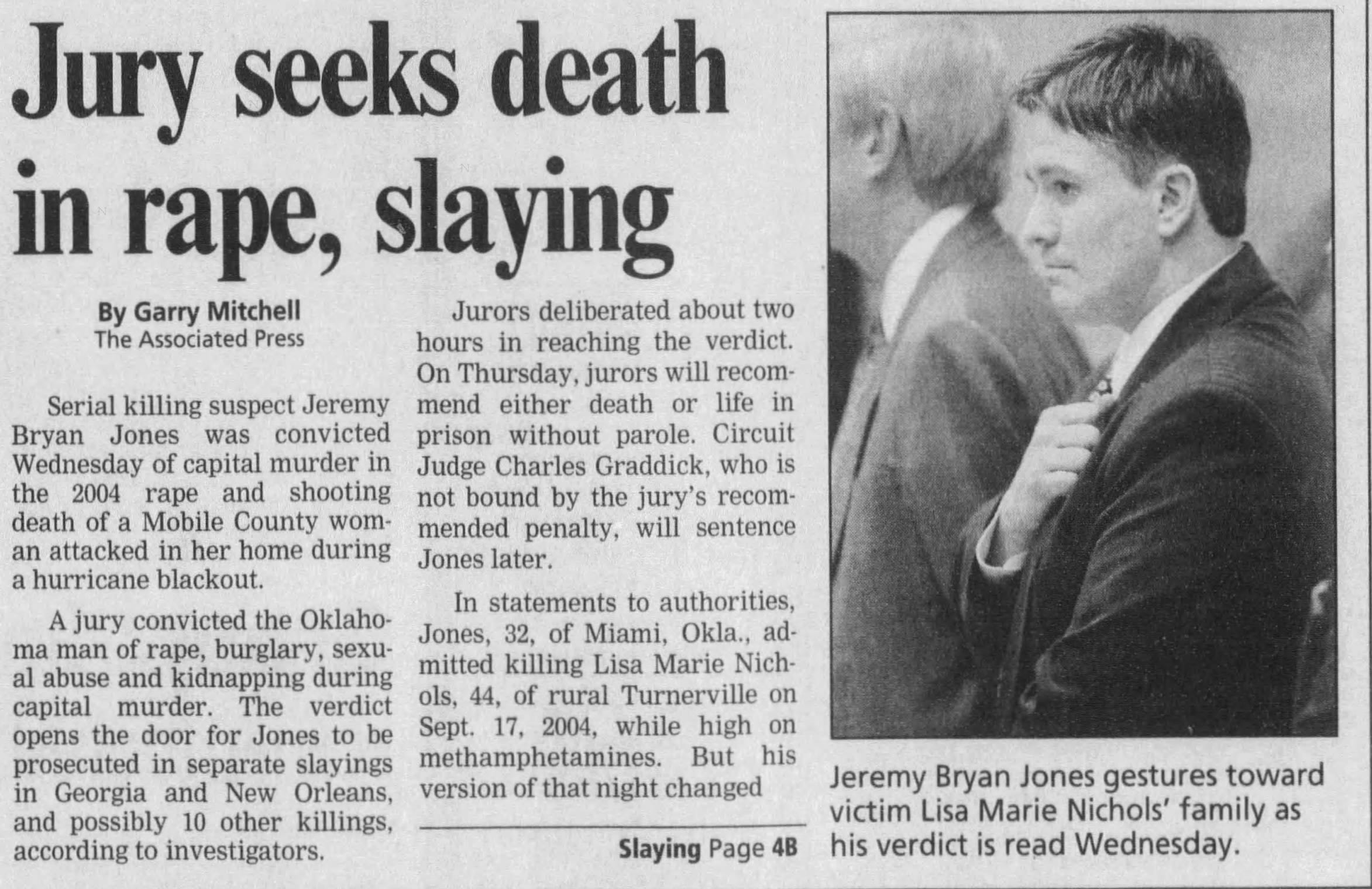
During the trial, Jones changed his position and recanted his previous confessions. However, the jury did not accept his claims, and Jones was found guilty of the murder of Lisa Nichols.
Sentencing
Following Jones’ conviction, the Mobile County Prosecutor’s Office sought the death penalty. Jones’ attorneys argued that he should receive a sentence of life imprisonment without parole, stating that he was under the influence of drugs and suffering from mental impairments at the time of the crime.
However, the court found these mitigating factors insufficient to forgo the death penalty. On December 1, 2005, Jeremy Bryan Jones was sentenced to death. Although the conviction brought justice for Lisa Nichols’ family, questions remained about the other crimes Jones claimed responsibility for.
Questions Remain
For Tina Mayberry's family, Jones's confession provided an answer, but not a verdict. Although Jones claimed responsibility for Tina’s murder, the case never resulted in a separate conviction. Unlike the murder of Lisa Nichols, where Jones was tried and sentenced, Tina’s death remained connected to him only through his confession and statements made after his arrest. Legally, no one has been convicted of the murder.
Tina Mayberry was laid to rest at Sunrise Memorial Gardens in Lithia Springs, Georgia.
Following Jones' conviction for the murder of Lisa Nichols, He was transferred to the Holman Correctional Facility in Atmore, Alabama, where he remained on the state’s death row. Despite his conviction for Lisa Nichols’ murder, questions continued to surround the other crimes Jones claimed responsibility for.
Over the years, Jones has disputed many of his original claims. He later stated that he was only responsible for Nichols’ murder and that some of his additional confessions were false. Jones claimed he made those statements to get better conditions while in jail.
His attorney, Habib Yazdi, supported those claims, arguing that Jones had used the attention surrounding his case to obtain privileges, including additional phone access and improved treatment while incarcerated. Because of these conflicting statements, Jones’ involvement in the other crimes remains in question.
For Tina Mayberry’s family, however, the most important question had always been what happened on Halloween night 2002. Tina’s story is a reminder that behind every investigation is a person whose life mattered, and a family that deserves answers.
Wikipedia. "Jeremy Bryan Jones." Wikipedia. https://en.wikipedia.org/wiki/Jeremy_Bryan_Jones
Find a Grave. "Eunice Martina 'Tina' Mayberry." Find a Grave, memorial no. 114093229. https://www.findagrave.com/memorial/114093229/eunice_martina-mayberry
Serrano, Richard A. "A Killer's Many Confessions." Los Angeles Times, May 5, 2005. https://www.latimes.com/archives/la-xpm-2005-may-05-na-killer5-story.html
Oxygen. "Man Using John Paul Chapman Alias Killed Lisa Nichols." Oxygen — Floribama Murders, n.d. https://www.oxygen.com/floribama-murders/crime-news/man-using-john-paul-chapman-alias-killed-lisa-nichols
Associated Press / Fox News. "Police Look for Link Between Georgia, Alabama Killings." Fox News, October 2004. https://www.foxnews.com/story/police-look-for-link-between-georgia-alabama-killings
NBC News / Associated Press. "Convicted Murderer Admits Killing 12 More." NBC News, November 2005. https://www.nbcnews.com/news/amp/wbna9902189