


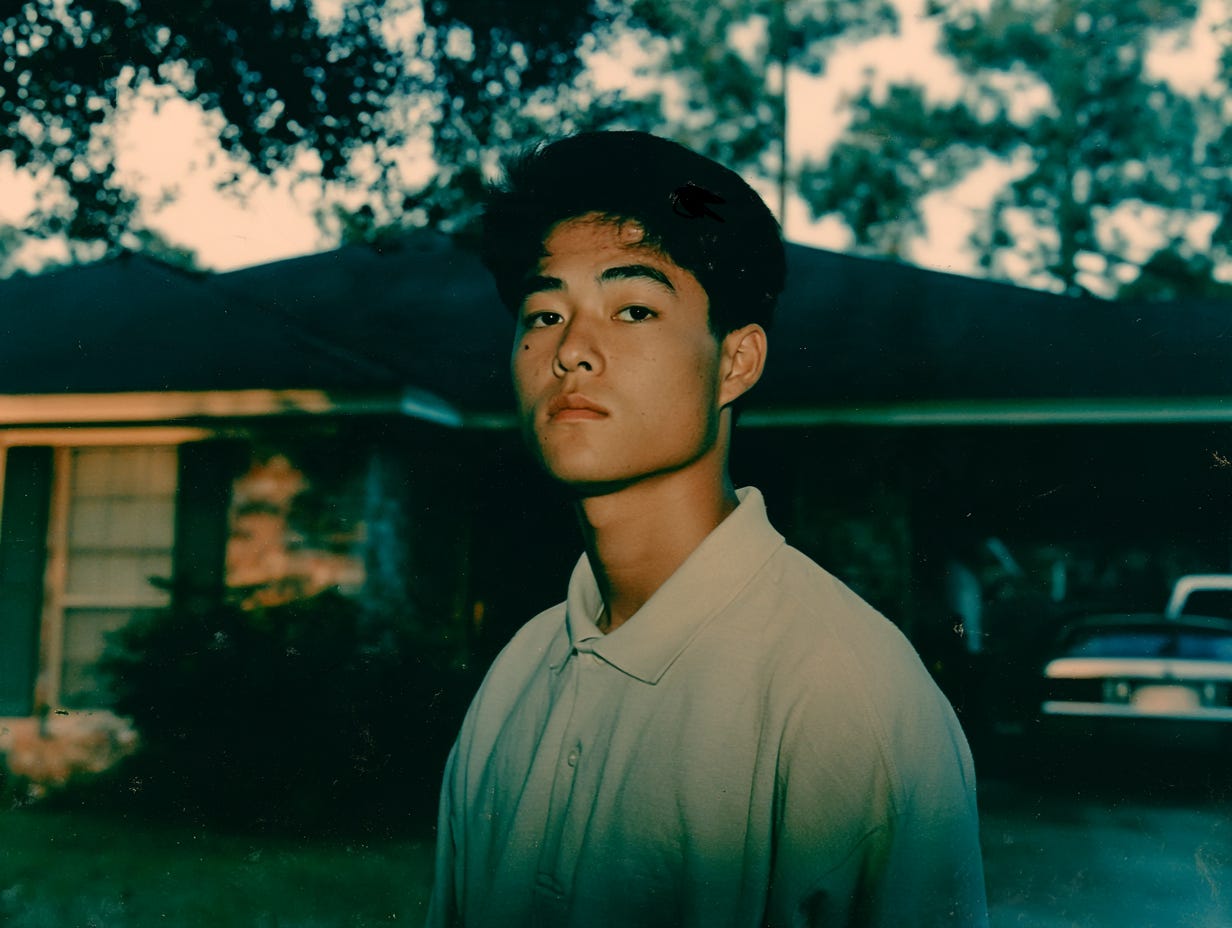
On October 17, 1992, 16-year-old Japanese exchange student Yoshihiro Hattori was shot and killed outside a home in Baton Rouge, Louisiana, after he and a friend mistakenly went to the wrong house while looking for a Halloween party.1 What began as a teenager's excitement at an unfamiliar American tradition quickly became an international controversy.
Crossing Cultures
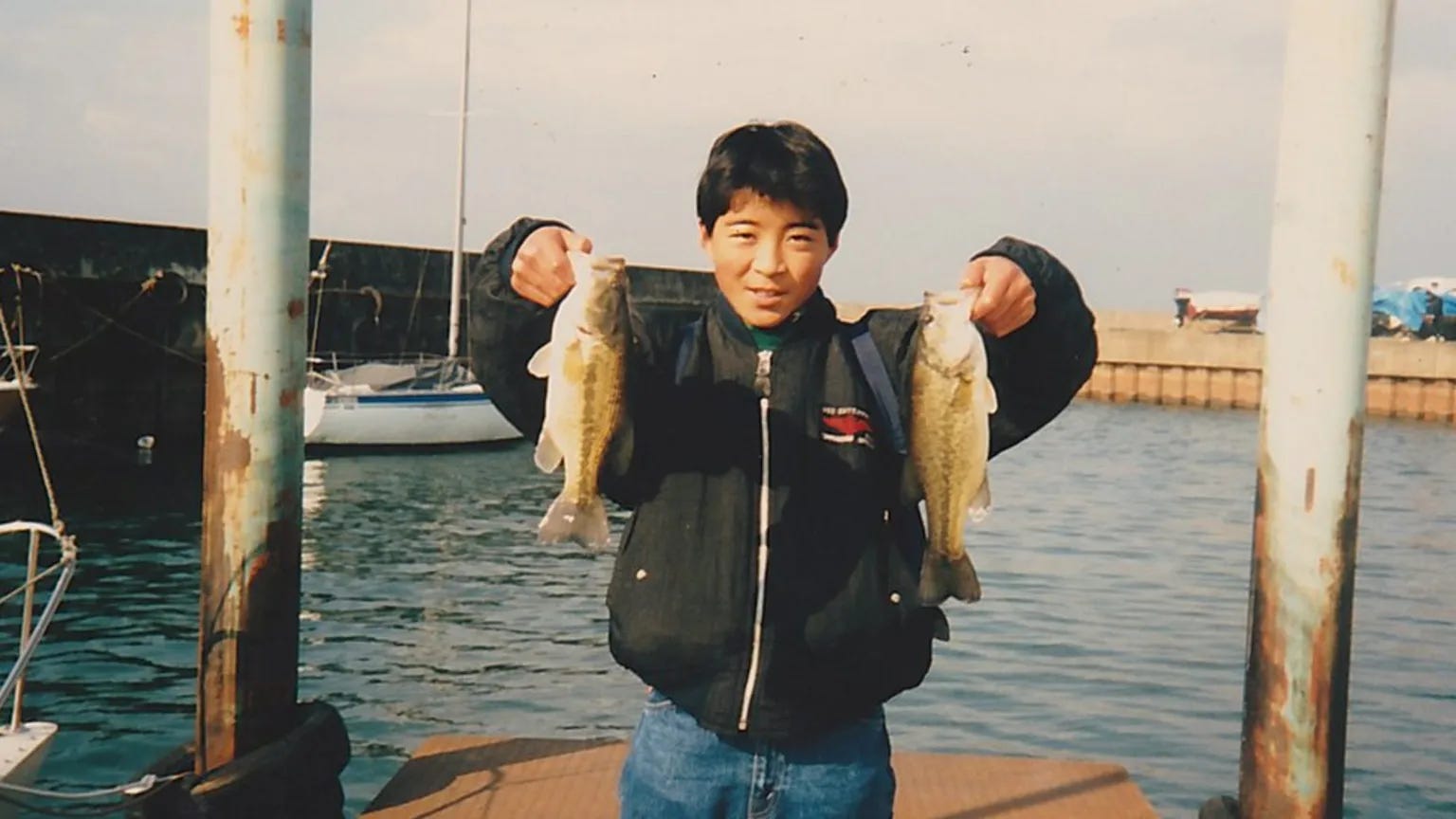
Yoshihiro Hattori was born on November 22, 1975, in Nagoya, Aichi Prefecture, Japan. He was the second of three children raised by his father, Masaichi Hattori, an engineer, and his mother, Mieko.2 As a teen, Yoshihiro attended Aichi Prefectural Asahigaoka High School in Nagoya. Friends and classmates remembered him as a cheerful, outgoing young man who enjoyed connecting with others.
He had a natural curiosity about people and cultures beyond Japan. Like many young people who dream of seeing the world, he wanted to understand other cultures directly. In 1992, that opportunity came when Yoshihiro was selected to participate in an international exchange program that brought him to the United States. He arrived with the excitement and curiosity of a teenager beginning a new adventure.
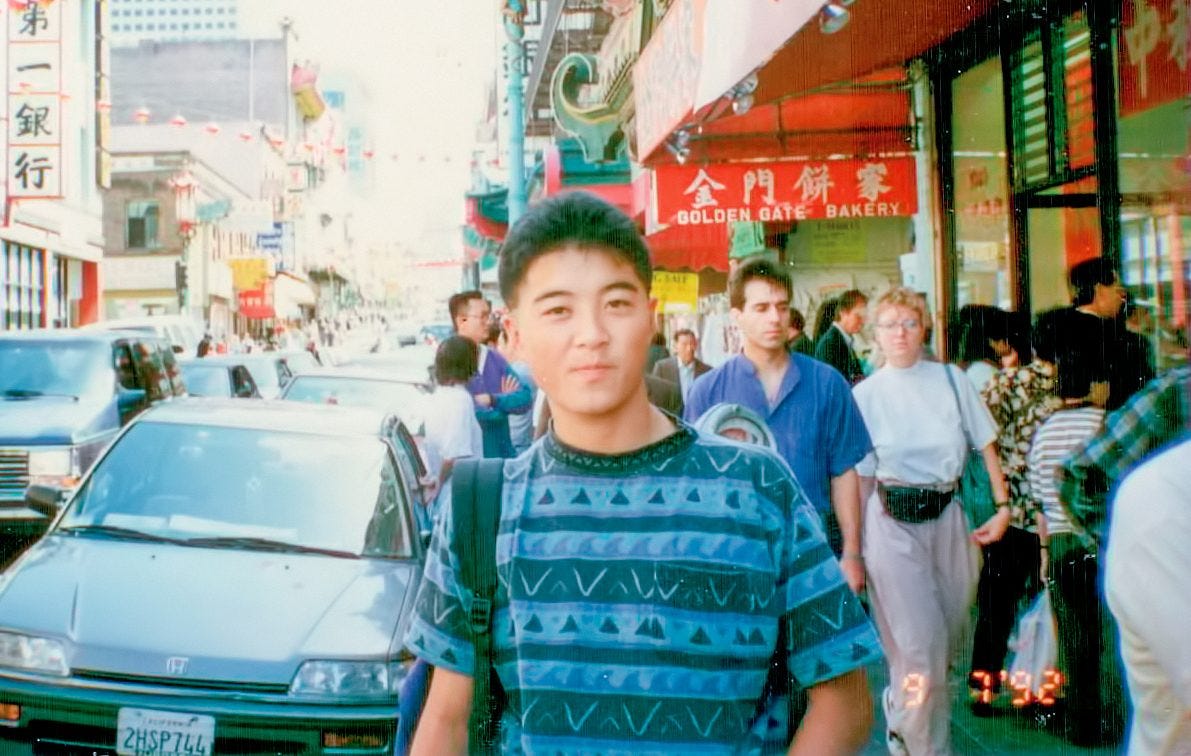
In August 1992, 16-year-old Yoshihiro Hattori arrived in the United States as part of the American Field Service (AFS) student exchange program. His journey was made possible through the exchange program and a scholarship provided by the Morita Foundation.
Yoshihiro was met by his host family, the Haymakers, in Dallas, Texas. The family welcomed him and drove him from Dallas to their home in Baton Rouge, where he would spend his exchange year experiencing American life as a member of their family. He lived as a homestay student with Richard and Holley Haymaker and their teenage son, Webb. Richard was a college professor, and Holley was a physician.
The language, customs, and daily life were all new, but Yoshihiro embraced his new surroundings. For him, the exchange was about connection and experience, not just education. Among the American traditions he was eager to experience was Halloween.
October 17, 1992
On the evening of Saturday, October 17, 1992, Yoshihiro and his homestay brother, Webb Haymaker, set out for what should have been a fun night out. They had been invited to a Halloween party for Japanese exchange students in East Baton Rouge Parish.
Yoshihiro had dressed as Tony Manero, the John Travolta character from the 1977 film Saturday Night Fever, in a white tuxedo-style costume. Webb, recovering from a swimming-pool injury, wore a neck brace and bandages as an "accident victim." Driving through the neighborhood, the two believed they had found the right place.
From the outside, the house appeared to match what they were looking for. The Halloween decorations made it seem like the home was connected to the celebration they were attending.
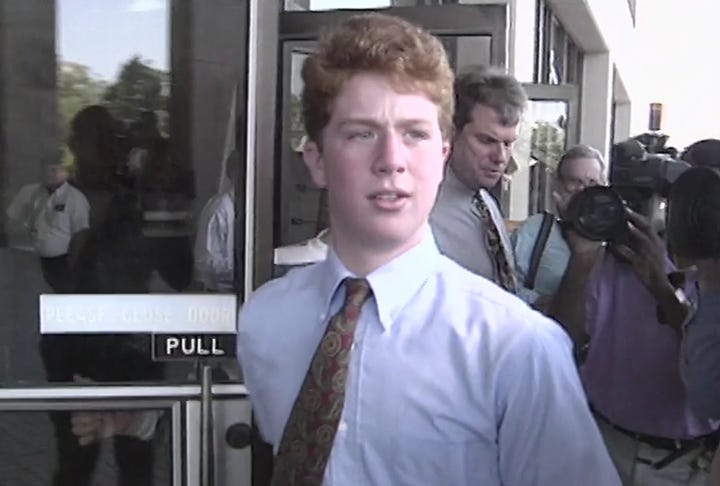
However, the two teenagers had mistakenly arrived at the home of 30-year-old Rodney Peairs and his wife, Bonnie. Inside, the Peairses were spending a quiet evening at home and were not expecting any visitors.
A Deadly Misunderstanding
Yoshihiro and Webb rang the doorbell and waited, but no one answered. Instead, Bonnie Peairs opened the side door and saw Webb standing a few yards away. Bonnie, unaware of what was happening, simply saw two strangers in costumes at her home at night.
Webb tried to explain the reason they had come to the house. However, the situation quickly became confusing. Communication was difficult. Yoshihiro was still learning English, and although he could understand basic conversation, he was not completely comfortable communicating in a stressful situation.
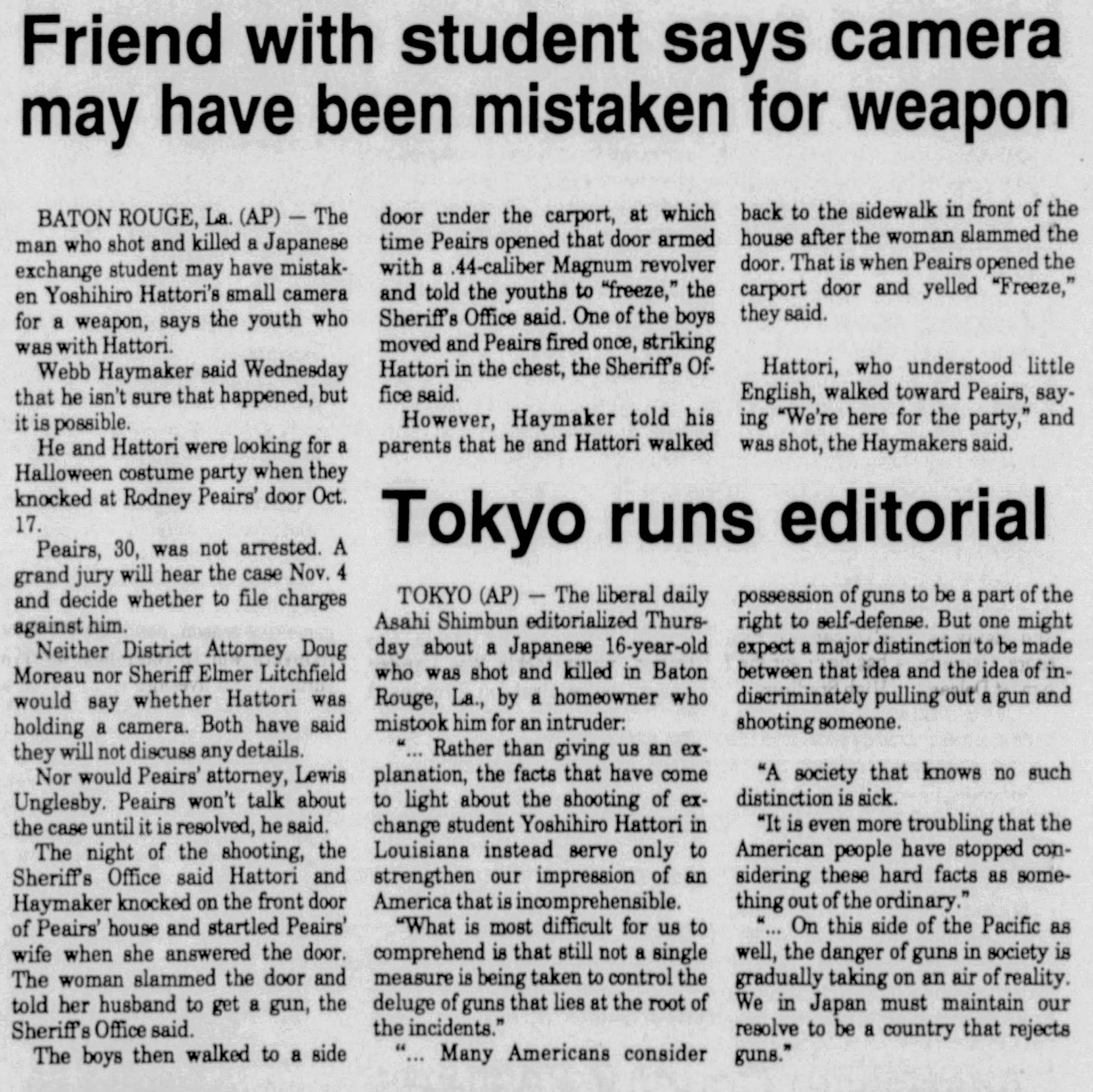
The two boys tried to explain that they were looking for a party, but their message wasn't immediately understood. According to her later testimony, Bonnie became frightened when Yoshihiro allegedly came quickly around the corner toward her; she shut the door and told her husband to get his gun.
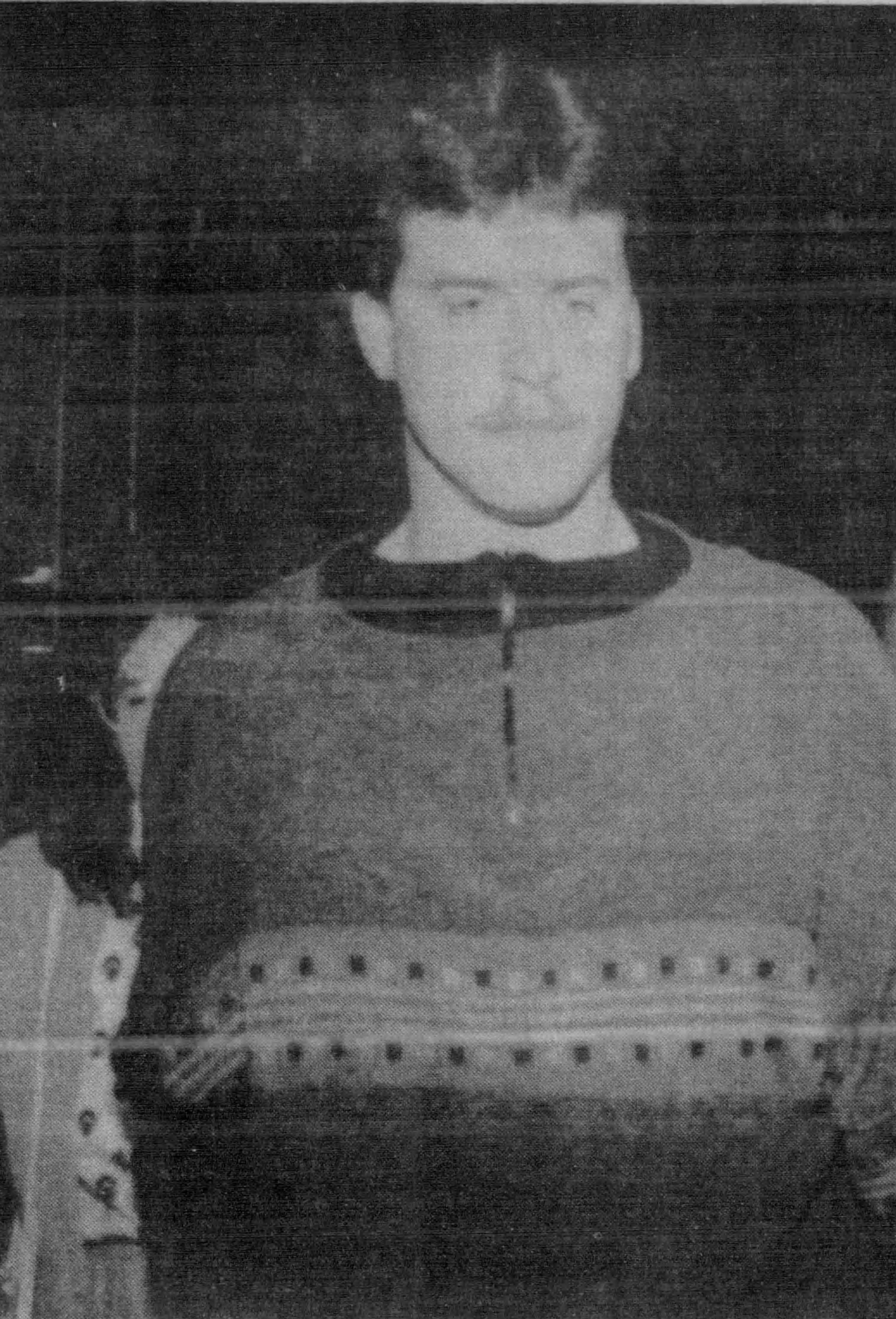
Realizing something was wrong, Yoshihiro and Webb turned back toward their car. Before they could leave, Rodney Peairs opened the carport door holding a .44 Magnum revolver. According to later testimony, Yoshihiro turned toward him and said, "We're here for the party," and Peairs pointed the gun and shouted, "Freeze!"
Webb saw the gun and tried to warn Yoshihiro, who was not wearing his contact lenses that night and may not have grasped the seriousness of the situation. Yoshihiro was carrying a camera, which Peairs later said he mistook for a weapon. When he was about five feet away, Peairs fired once and struck Yoshihiro in the chest. Peairs then retreated inside.
Webb ran to a neighbor for help and returned to find Yoshihiro on his back, gravely wounded. Neighbors tried to help as they waited for paramedics; Bonnie Peairs reportedly told a neighbor calling for aid to "go away," and the couple did not come out until police arrived about forty minutes later.
Emergency responders eventually arrived and rushed Yoshihiro to receive medical treatment. The bullet had caused severe internal injuries, passing through the upper and lower lobes of his left lung and exiting near his seventh rib. Despite emergency efforts, Yoshihiro died in the ambulance minutes after being shot.
A 16-year-old who had traveled thousands of miles to experience American life was gone because of a misunderstanding at a stranger's door.
International Incident and Investigation
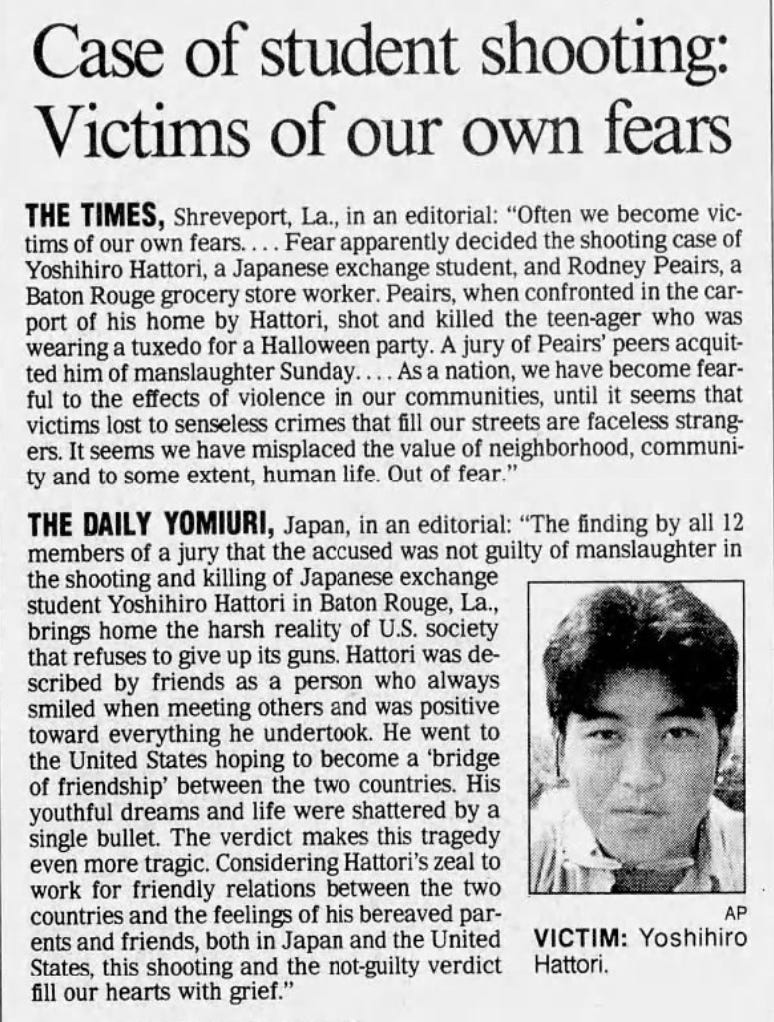
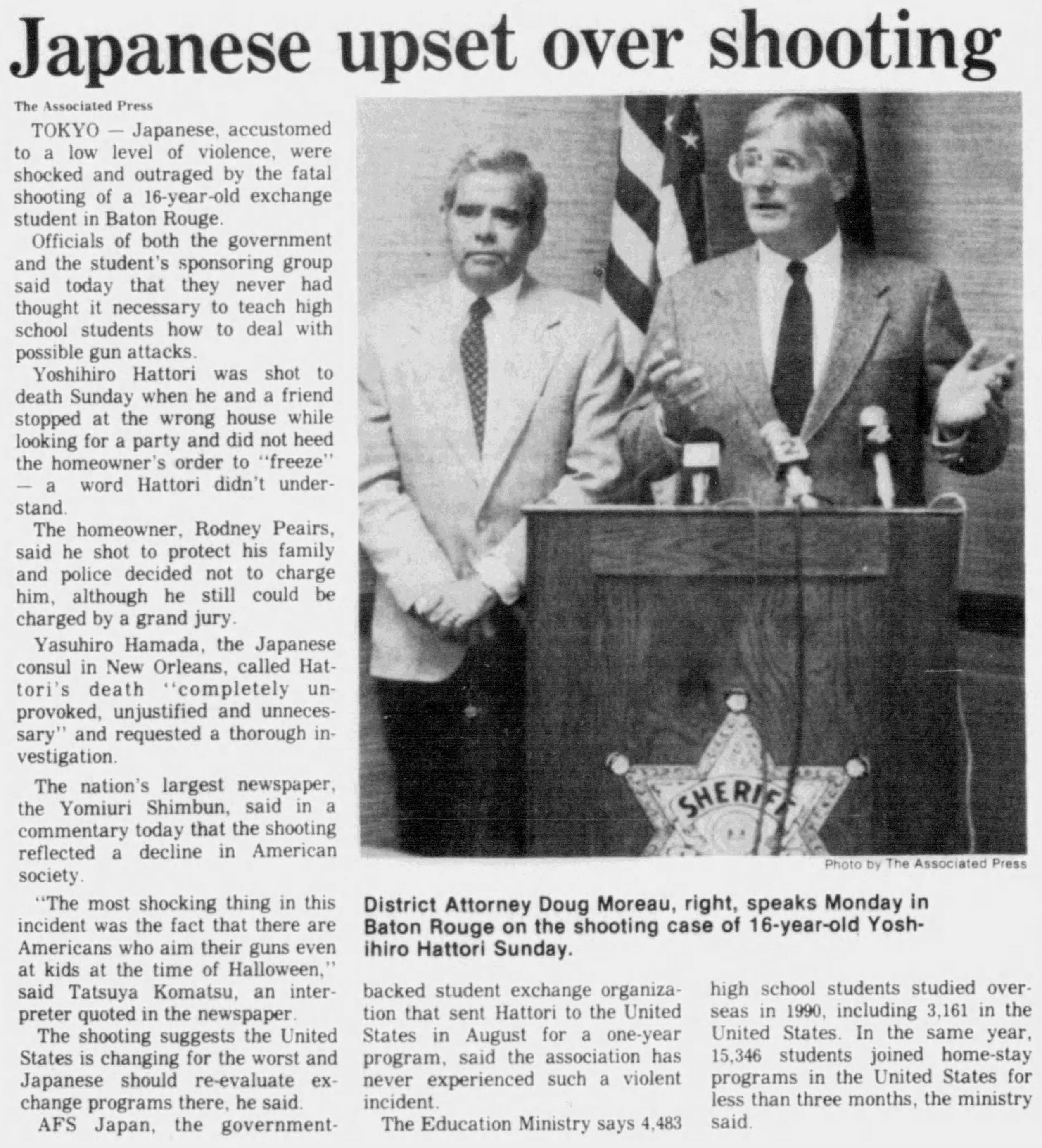
The death of Yoshihiro Hattori quickly became more than a local tragedy. In Japan, where civilian gun ownership is tightly restricted, the killing of an unarmed teenager caused widespread shock and grief, and raised hard questions on both sides of the Pacific: Could it have been prevented? Was Peairs genuinely in danger? When fear takes over, how should the law assign responsibility?3
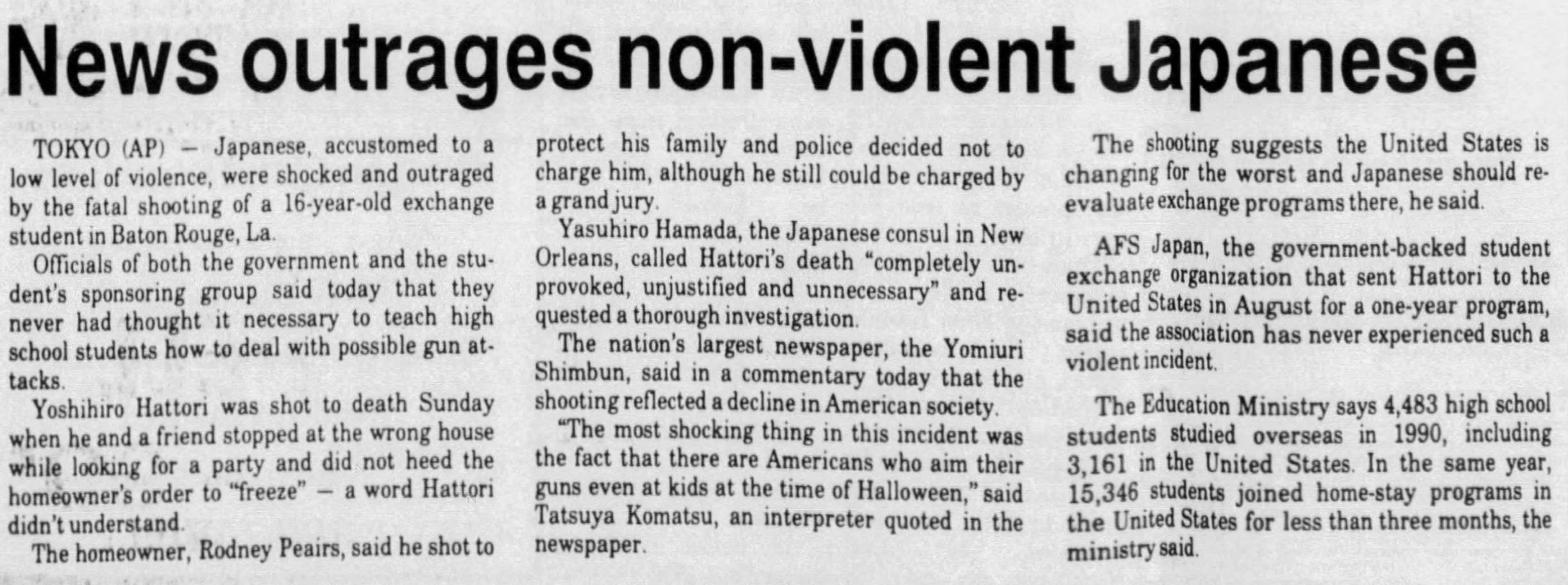
That Peairs fired the shot was never in dispute; the question was whether he was legally justified. After initial questioning by Baton Rouge police, Rodney Peairs was released without charges. They determined he was within his rights against what they viewed as a trespasser.
The decision drew immediate criticism. After protests from Louisiana Governor Edwin Edwards and the Japanese consul in New Orleans, authorities reconsidered, and in November 1992, Rodney Peairs was charged with manslaughter. Peairs maintained he believed he was protecting his family.
As the case moved toward trial, both sides prepared to present very different explanations of what happened that evening during the brief encounter outside the Peairs residence.
Trial of Rodney Peairs
Rodney Peairs's trial began in May 1993 in Baton Rouge. The prosecution, led by District Attorney Doug Moreau, argued the shooting was not self-defense but a tragic overreaction: Peairs was a 6-foot-2 armed adult; Yoshihiro, an unarmed, roughly 130-pound 16-year-old who had never entered the house, threatened no one, and had simply come to the wrong address.
According to the prosecution, Yoshihiro approached the home only because he and Webb Haymaker had mistaken the Peairs residence for the Halloween party they were trying to attend. The prosecution argued that even if Yoshihiro’s movement toward the carport had been unexpected, Peairs was not justified in using deadly force against a teenager who had not threatened him, had not entered the house, and had not shown any intention of harming anyone.
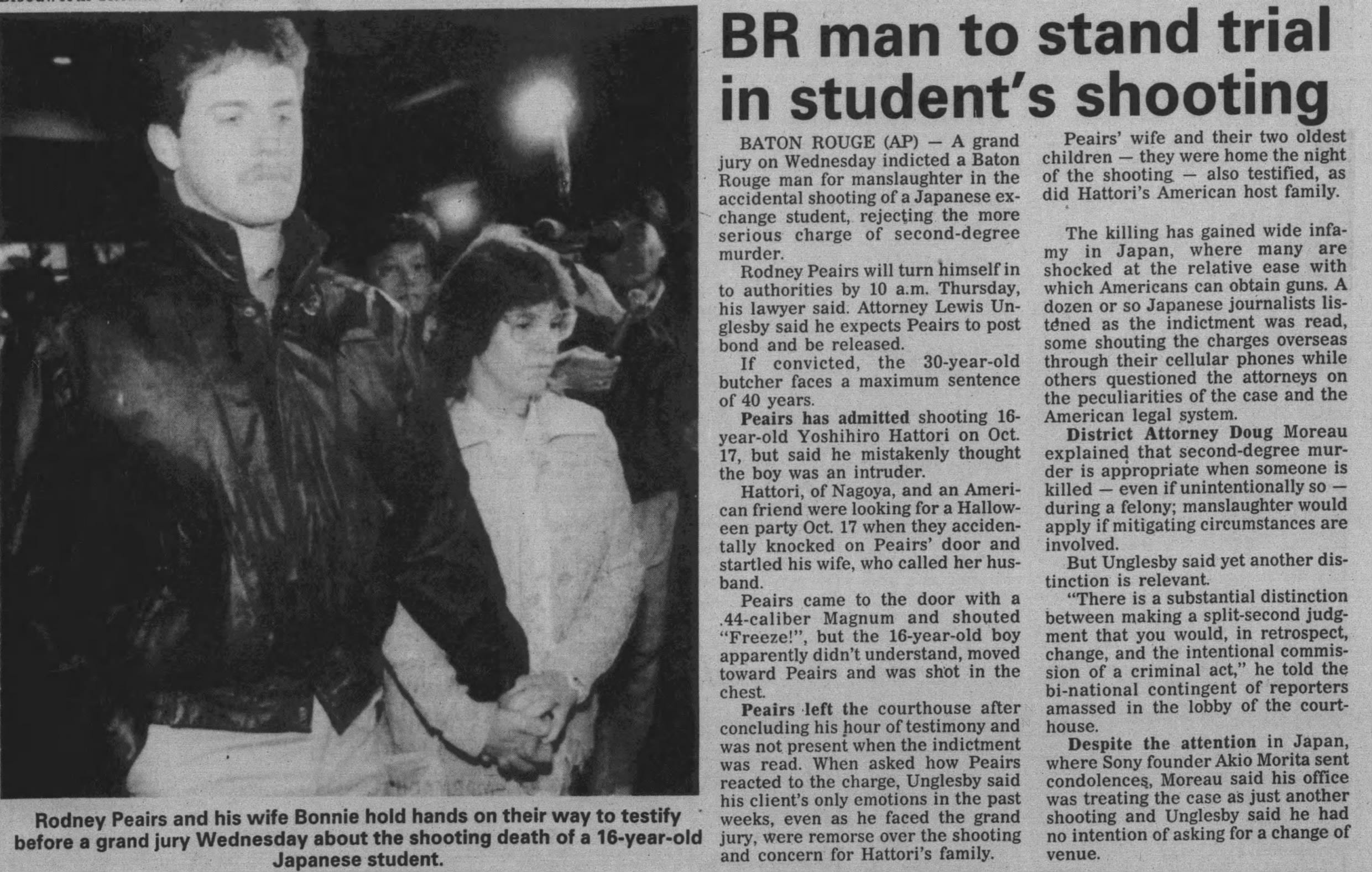
In contrast, the defense argued Peairs reacted to what he believed was an immediate threat, amplified by his wife's panic. Bonnie Peairs testified about the moment she saw Yoshihiro approach:
“He was coming real fast towards me. I had never had somebody come at me like that before. I was terrified.”
She described Rodney retrieving a handgun with a laser sight from a bedroom suitcase, and added:
“There was no thinking involved. I wish I could have thought. If I could have just thought.”
Rodney Peairs testified that Yoshihiro’s movements frightened him:
“It was a person, coming from behind the car, moving real fast. At that point, I pointed the gun and hollered, ‘Freeze!’ The person kept coming toward me, moving very erratically… I remember him laughing. I was scared to death. This person was not gonna stop, he was gonna do harm to me.”
The defense argued that Rodney Peairs did not have time to carefully analyze the situation and that he acted based on what he believed was a dangerous threat to himself and his family.
Peairs testified that he fired when Yoshihiro was about five feet away, and told the court, "I'm very sorry that any of this ever happened." The prosecution countered that Yoshihiro was unarmed, in costume, and carrying a camera, and that his limited English and poor eyesight that night may have kept him from understanding the command. A police detective who interviewed Peairs after the shooting also testified that Peairs had told him: "Boy, I messed up; I made a mistake."
Verdict
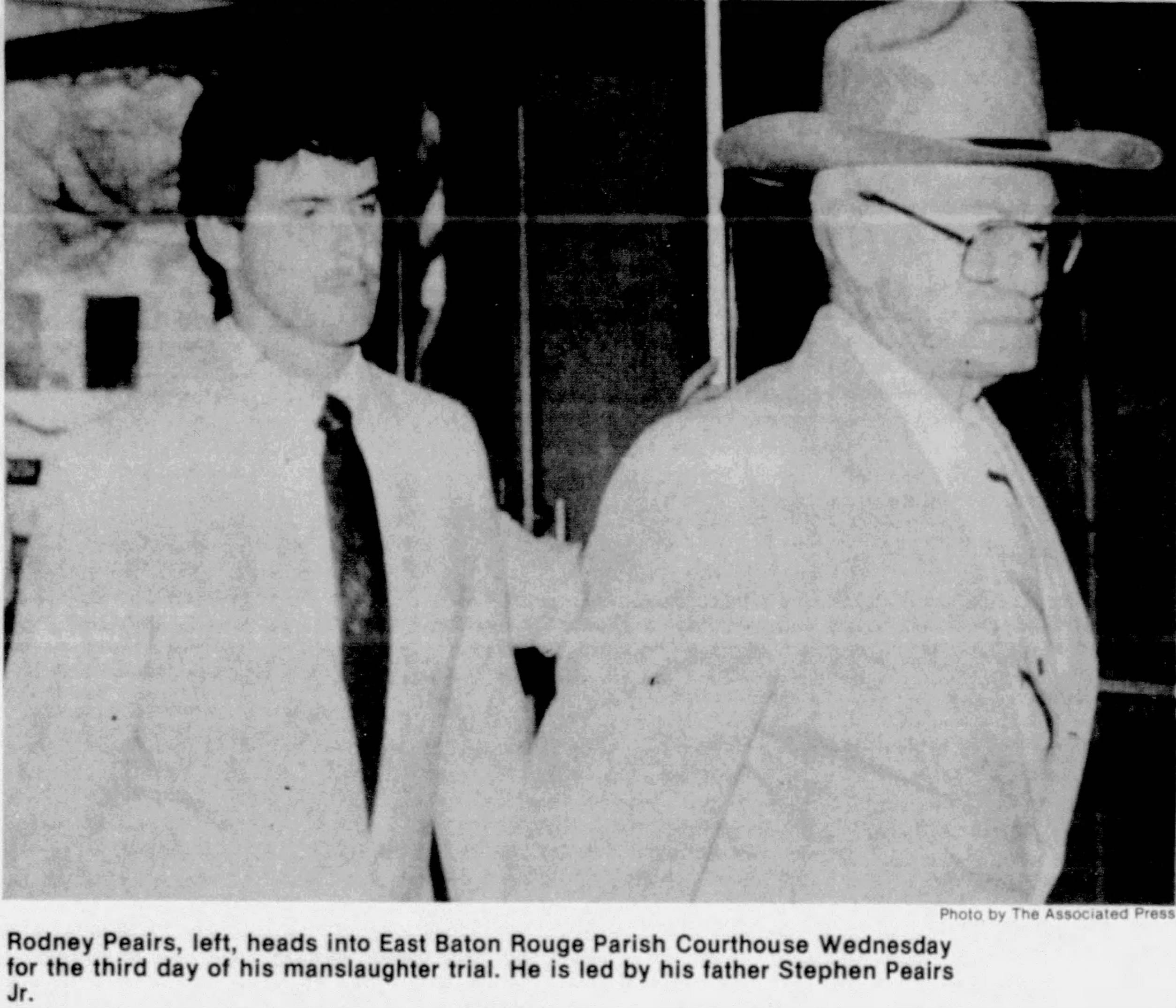
After a seven-day trial, the jury reached a verdict on May 23, 1993. After about three hours of deliberation, they found Ronald Peairs not guilty of manslaughter. Some courtroom spectators applauded. For Yoshihiro's family and many who had followed the case, the acquittal was devastating and bewildering.
Though the trial was finished, the debate over Yoshihiro Hattori’s death was far from over.
Civil Trial
In September 1994, Yoshihiro’s parents filed a wrongful death lawsuit against Rodney Peairs and his wife, Bonnie, seeking accountability for the loss of their son through the civil court system.
Unlike a criminal trial, where prosecutors must prove guilt beyond a reasonable doubt, a civil case operates under a different standard of proof. The question was not whether Rodney Peairs had committed a crime, but whether he had acted negligently and whether his actions contributed to Yoshihiro’s death.
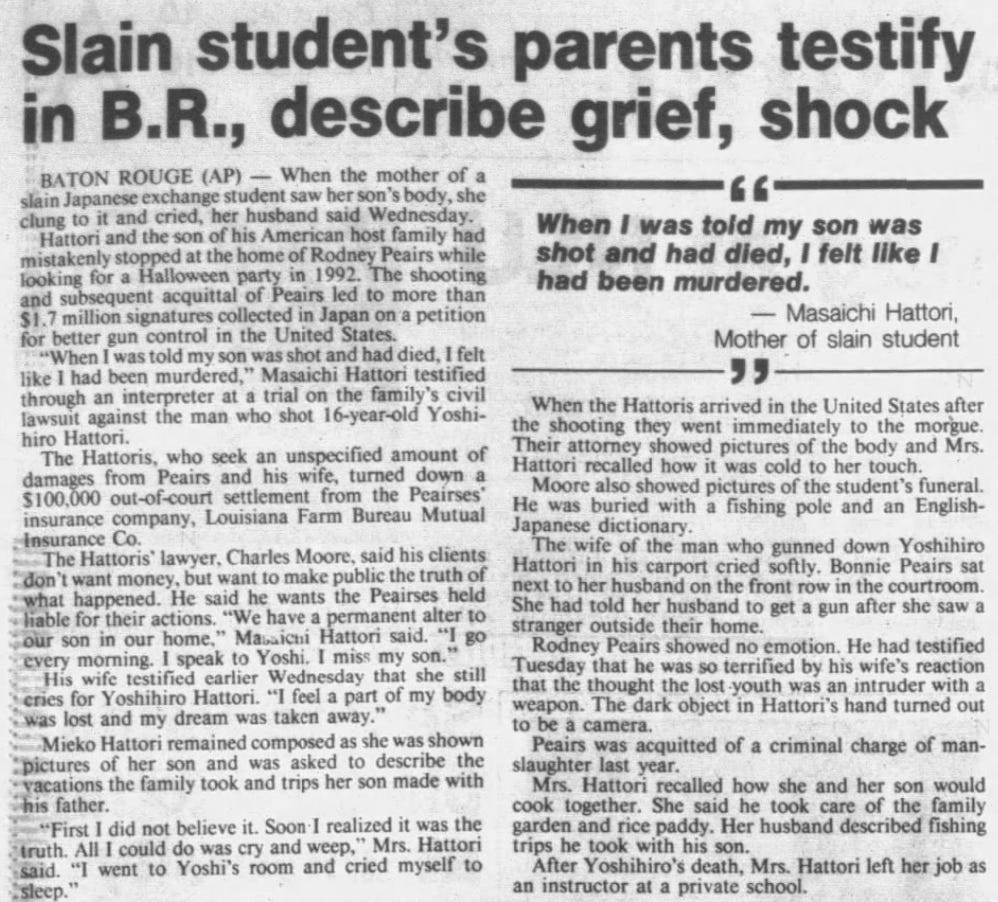
The Hattori family’s attorneys argued that Rodney and Bonnie Peairs had acted unreasonably during the encounter. They argued the situation could have been handled differently.
Rather than confronting the teenagers with a firearm, a safer response would have been to stay inside the home and contact police. They claimed that Peairs, who was much larger than the unarmed Yoshihiro, could have physically restrained him if he believed there was a threat.
The court found Rodney Peairs liable for Yoshihiro's death and awarded his family $650,000 in damages ($653,077.85 with interest and costs).4 Peairs's homeowner's insurer paid its $100,000 policy limit, leaving Peairs responsible for the remaining $550,000.
The Louisiana Court of Appeal upheld the judgment in October 1995, and the Louisiana Supreme Court declined further review in January 1996. By 2022, reporting indicated, the Hattori family had received only about $100,000.
Fight for Change
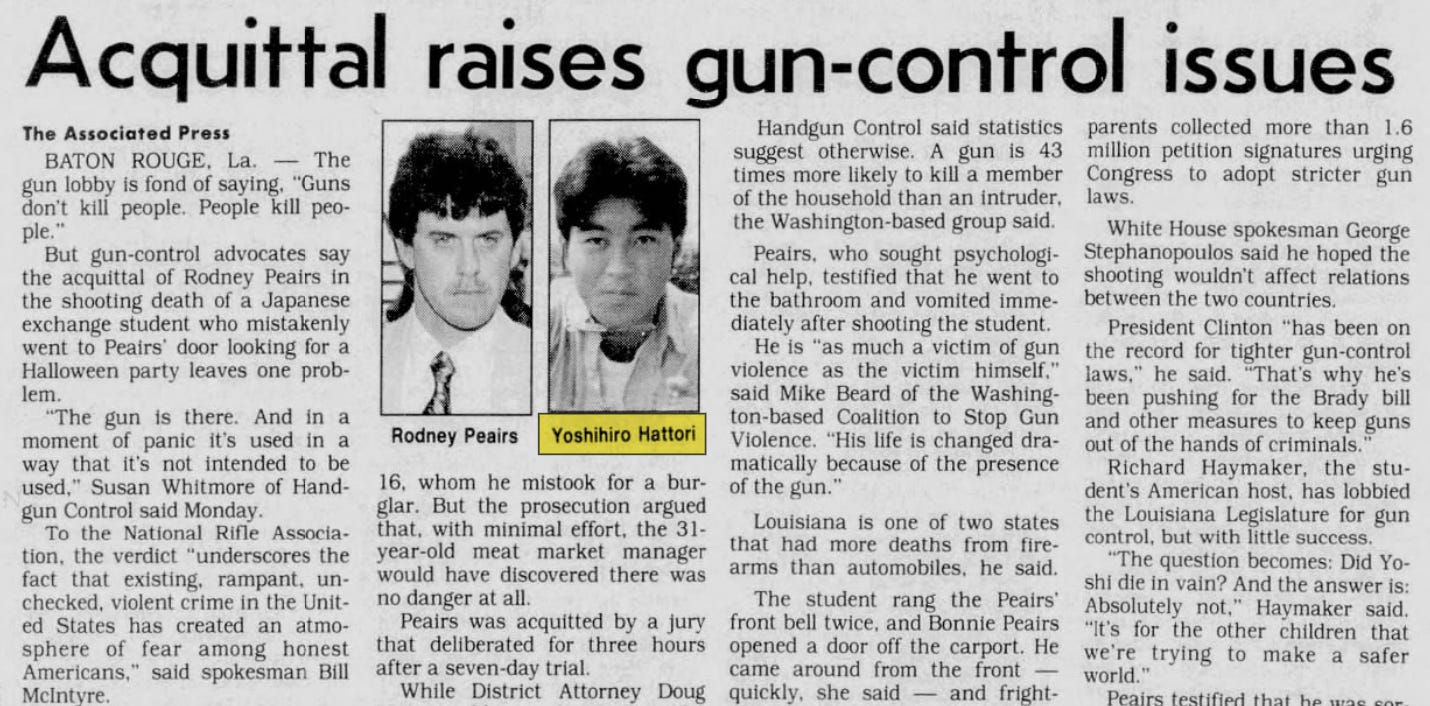
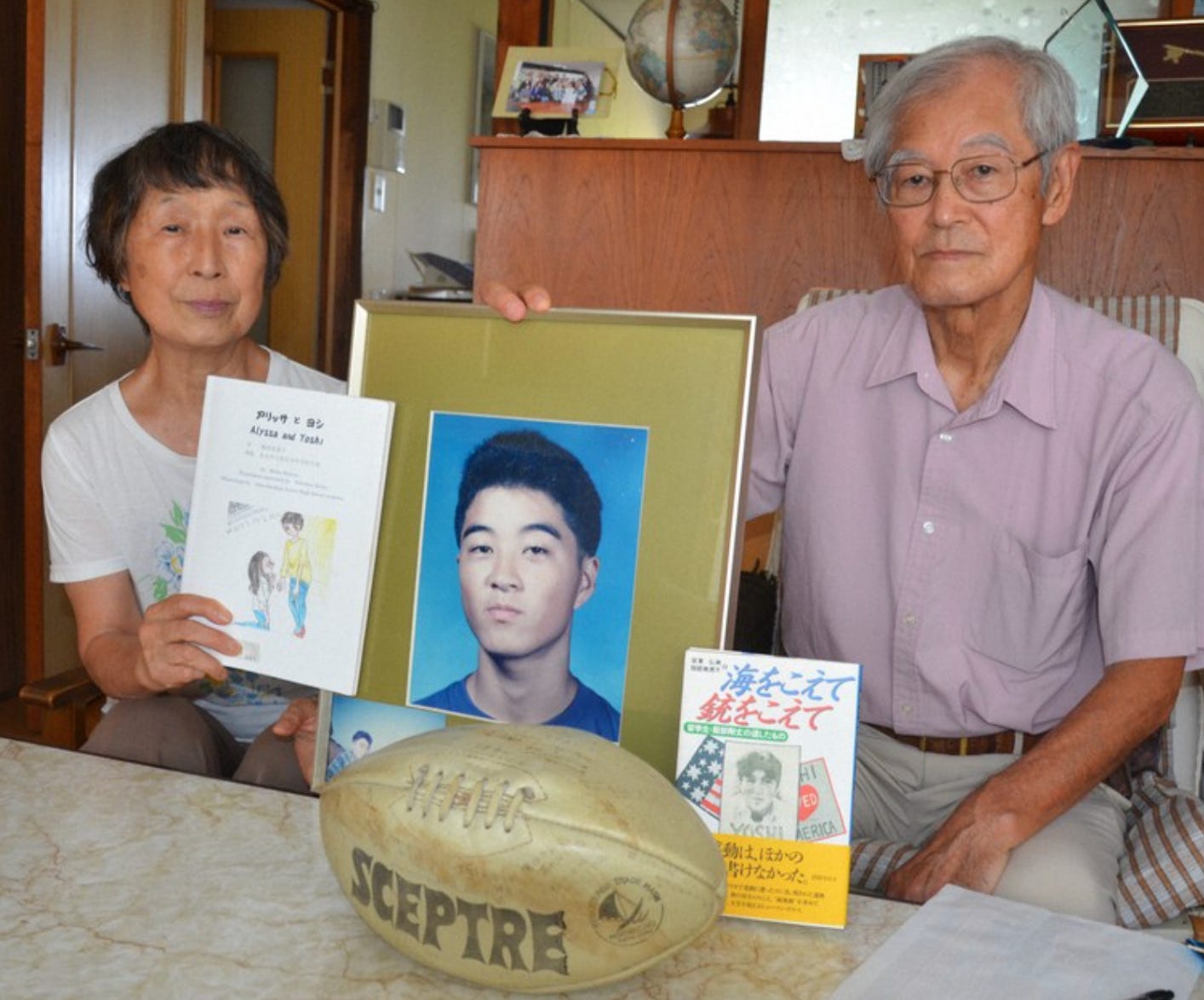
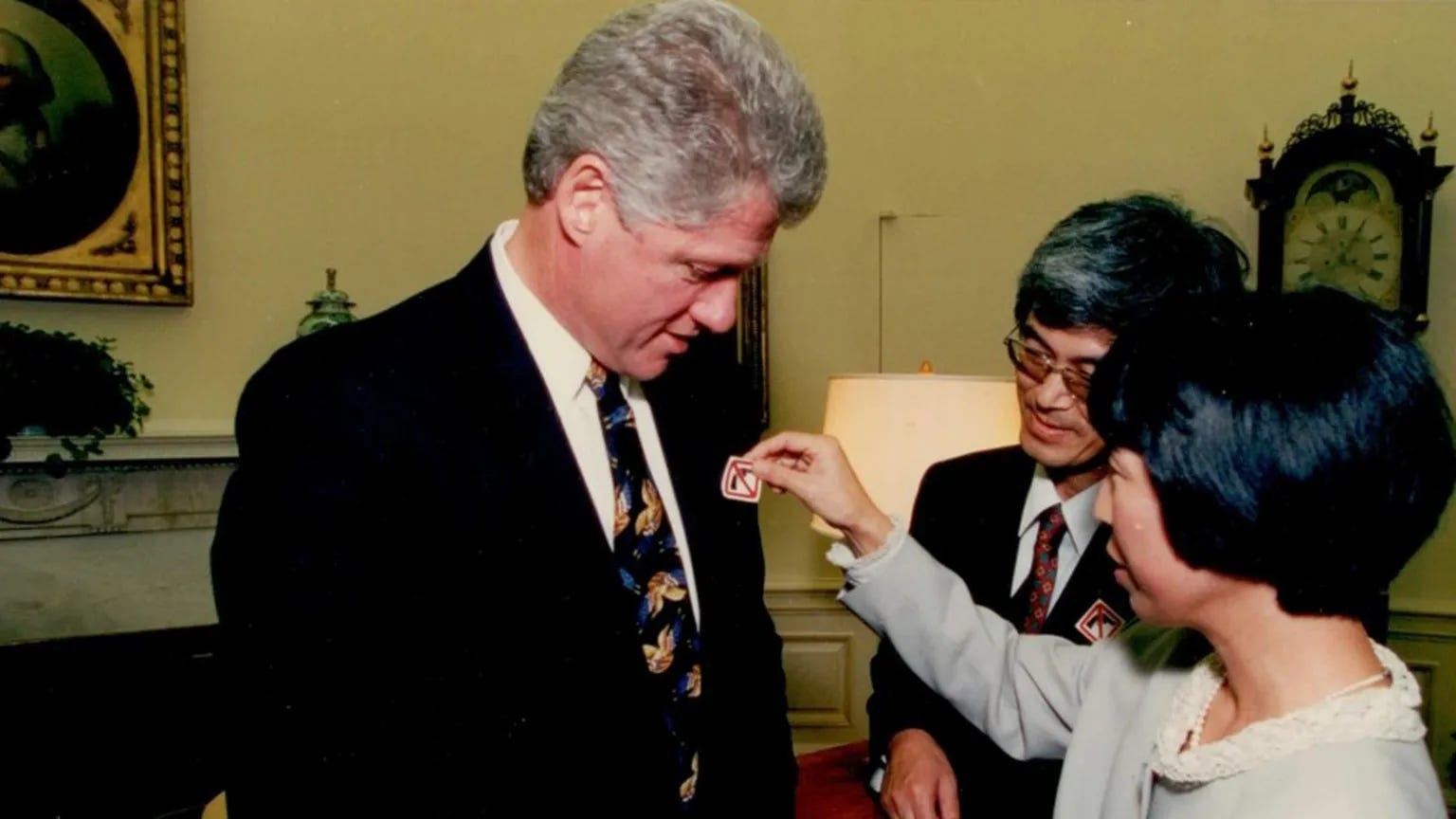
Yoshihiro's parents chose to use their grief to enact change. In November 1993, they met President Bill Clinton at the White House and presented a petition signed by roughly 1.7 million Japanese citizens calling for stronger U.S. gun controls; a separate petition of about 120,000 Americans went to Congress.
The Hattoris and the Haymakers backed the Brady Bill, which required background checks and a waiting period for handgun purchases. President Clinton signed the bill into law as the Brady Handgun Violence Prevention Act on November 30, 1993.
Walter Mondale, then the U.S. ambassador to Japan, said Yoshihiro's death had a significant effect on the public debate over the law.
Aftermath
The verdicts ended the legal proceedings but not the consequences. Rodney Peairs told reporters he would never own a gun again; later accounts said he lost his home and his job as a supermarket butcher and was living in a trailer park.
Yoshihiro's family and his American host family worked to preserve his memory. Through the civil settlement, his parents established charitable funds in his name and created the Yoshi Foundation, an exchange program that sends American high school students to Japan.
Richard Haymaker endowed two scholarships: the Yoshihiro Hattori Memorial Scholarship, for students from Japan, and the Yoshihiro Hattori Memorial Fund for Off-Campus Study, for students wishing to study there.
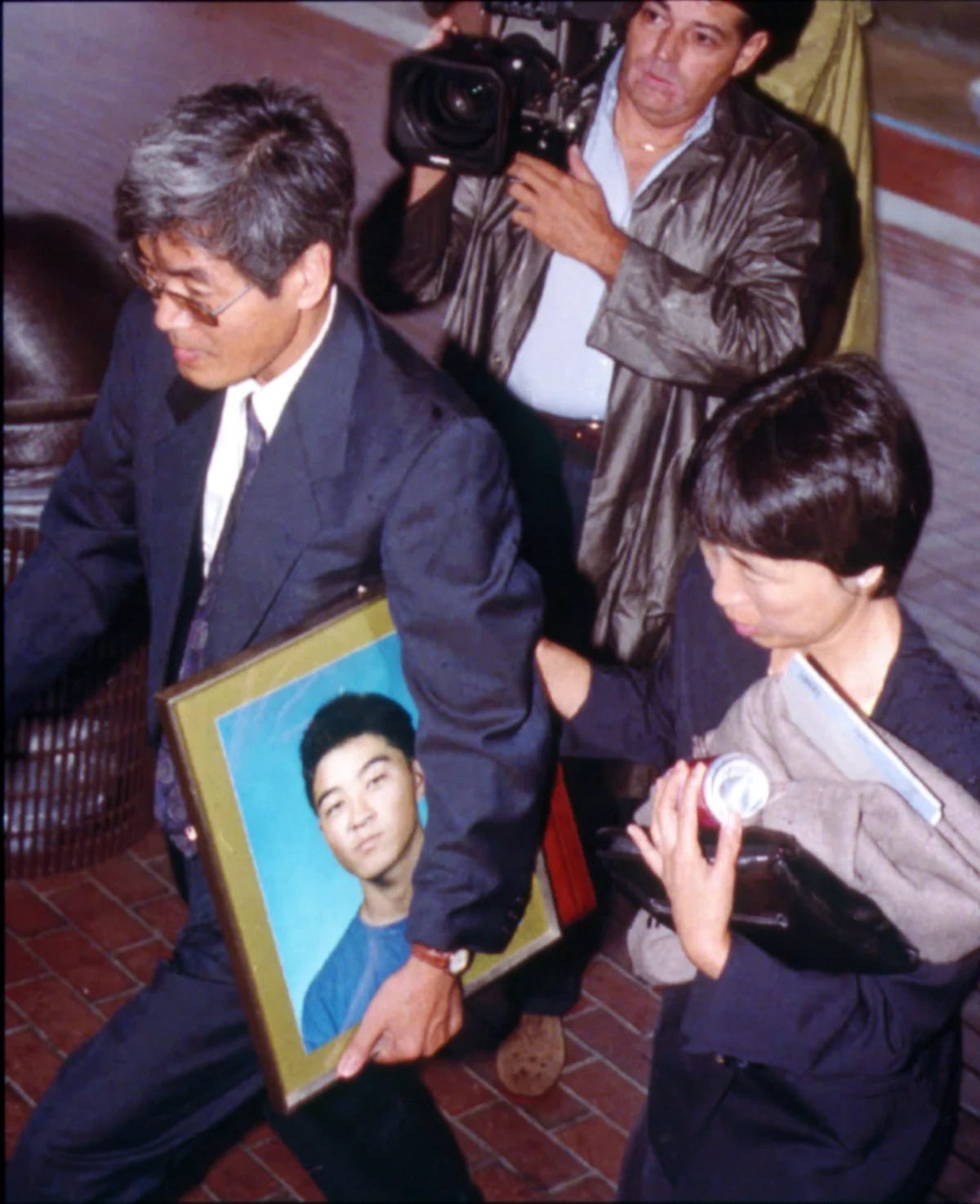
The Hattori and Haymaker families also continued advocating for changes related to gun laws and public safety for many years after Yoshihiro’s death. Their efforts went beyond the immediate aftermath of the case, as they continued sharing Yoshihiro’s story to raise awareness and encourage discussion about preventing similar tragedies. In March 2018, after the Parkland shooting in Florida, Yoshihiro's parents took part in the March for Our Lives movement.
More than thirty years later, Yoshihiro Hattori's name remains tied to a tragedy that began with a simple mistake. He was a teenager who crossed the world with curiosity and hope and lost his life in a tragic misunderstanding. Through scholarships, exchange programs, and continued advocacy, his family and friends ensured that his life represented more than the circumstances of his death.
"How Could It Happen Here?" The Baltimore Sun, November 12, 1992. https://www.baltimoresun.com/news/bs-xpm-1992-11-12-1992317053-story.html
"Killing of Yoshihiro Hattori." Wikipedia. Accessed October 2026. https://en.wikipedia.org/wiki/Killing_of_Yoshihiro_Hattori
"25 Years On, Slain Japanese Exchange Student Recalled by Friends." Japan Today, October 2017. https://japantoday.com/category/features/kuchikomi/25-years-on-slain-japanese-exchange-student-recalled-by-friends
Court of Appeal of Louisiana, First Circuit. "Hattori v. Peairs, 662 So. 2d 509." 1995. https://www.studicata.com/case-briefs/case/hattori-v-peairs