


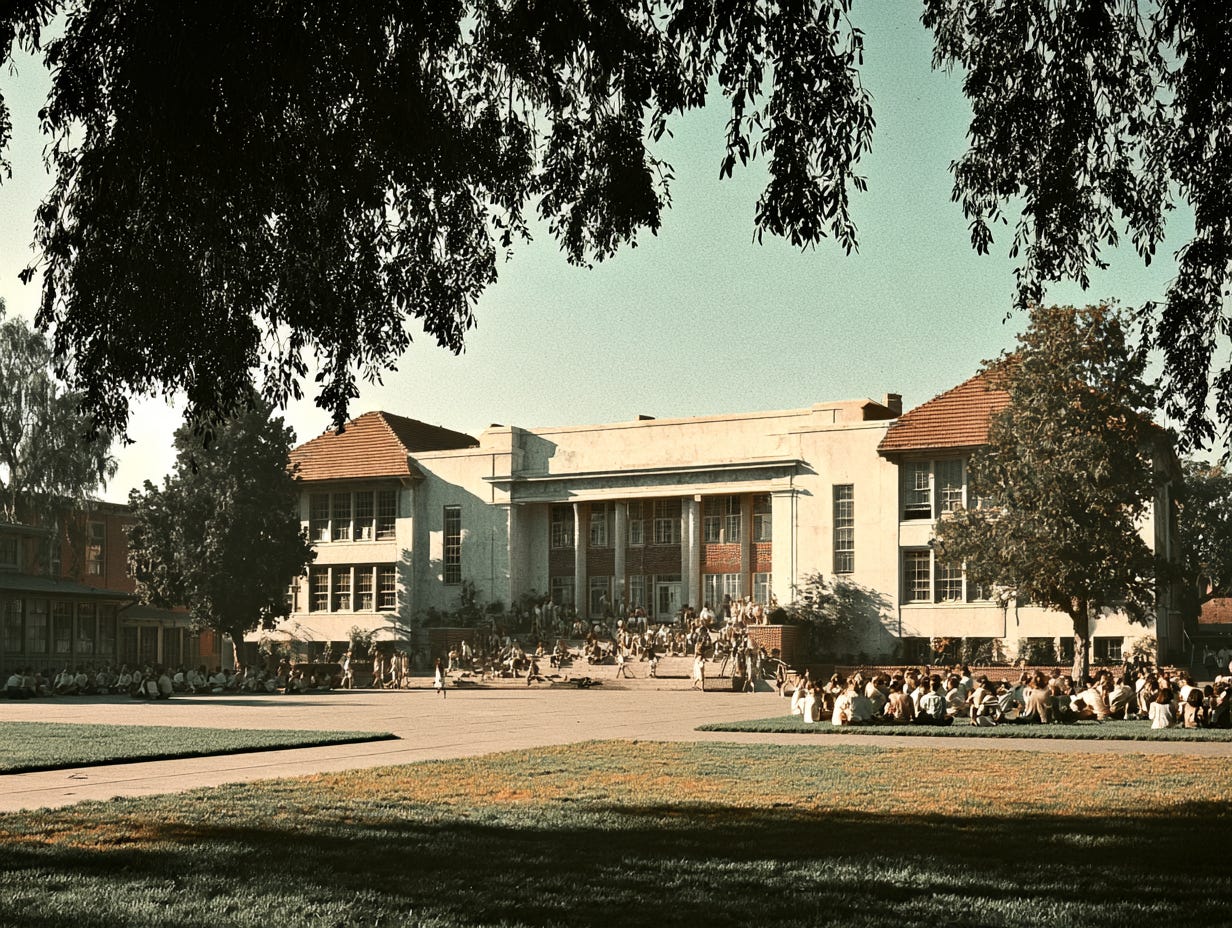
Background
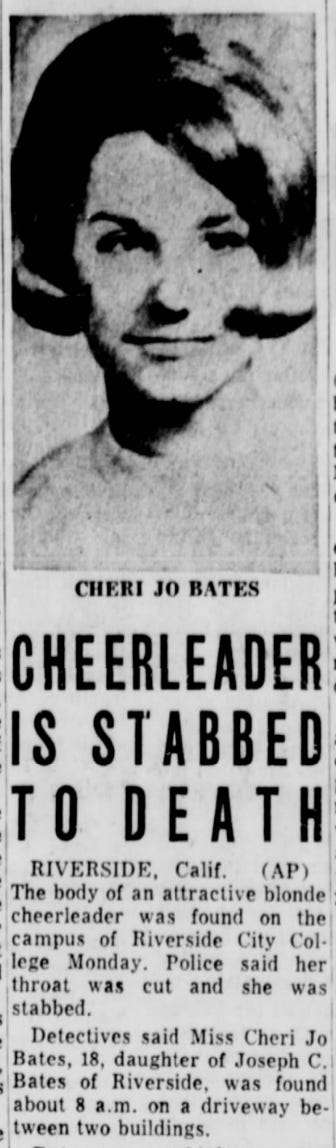
On the evening of October 30, 1966, 18-year-old student Cheri Jo Bates went to the Riverside City College library to study. She never made it home. On Halloween day, her body was found not far from her parked car, having suffered multiple stab wounds during an intense fight with her attacker. Nearly six decades later, her murder remains unsolved.1
Over the years, different theories have emerged as to the identity of her killer. Some have even speculated that she may have been the first victim of the Zodiac Killer. What truly happened that night may never be known, and Cheri Jo’s murderer may well have taken that secret to the grave.
Cheri Jo Bates
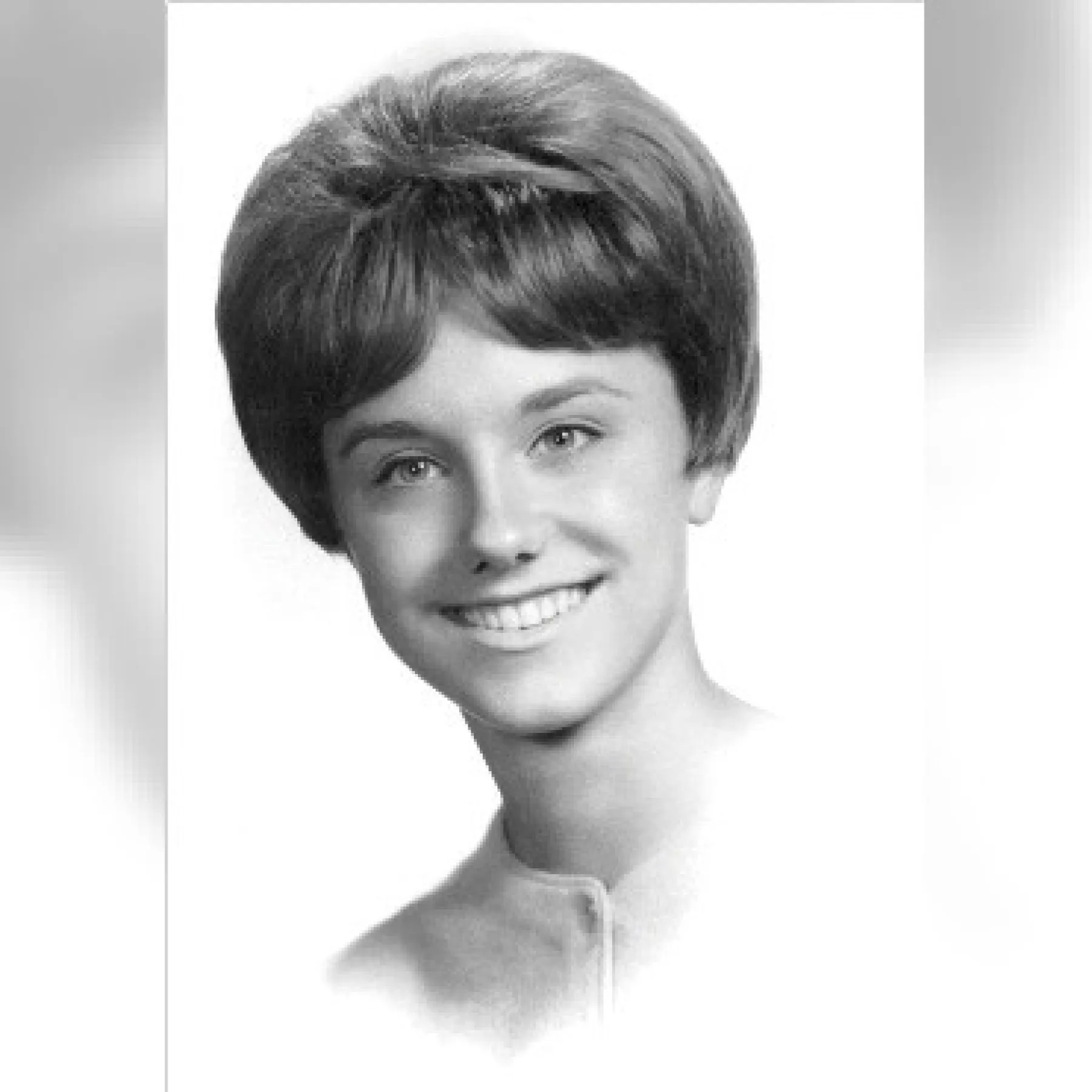
Cheri Josephine Bates was born in Omaha, Nebraska, on February 4, 1948, the daughter of Joseph and Irene Bates, and the younger sister of Michael. The family moved to California in 1957, when Cheri Jo was nine. She was described as a sweet and outgoing young girl who was well liked.
While attending Ramona High School in Riverside, Cheri Jo was an honor student, a varsity cheerleader, and an active member of student government. She was ambitious and driven and hoped to become a flight attendant. After her parents’ divorce, Cheri Jo moved in with her father. Her mother stayed nearby, and her older brother, Michael, enlisted in the U.S. Navy.
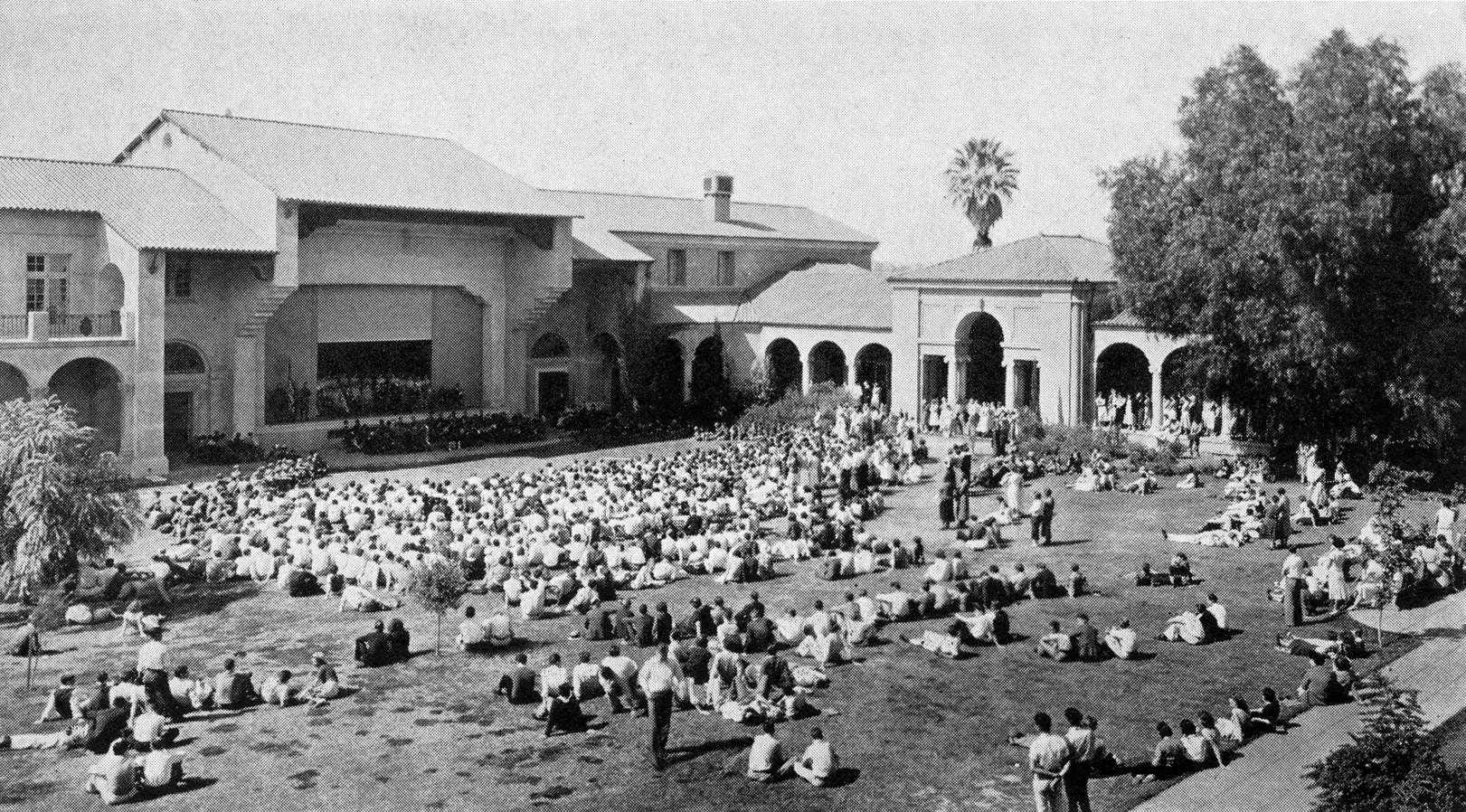
After graduation, Cheri Jo enrolled in college courses at Riverside City College. While attending college, she worked part-time at Riverside National Bank and saved enough to buy herself a lime-green 1960 Volkswagen Beetle, her first adult purchase, and one she was very proud of.
October 30, 1966
On the morning of October 30, 1966, Cheri Jo attended Mass with her father at St. Catherine of Alexandria. After the service, she and her father went out for breakfast. That afternoon, Cheri Jo planned to go to the college library to study. After a friend, Stephanie Guttman, declined her invitation to join, Cheri Jo went to the library alone between 4:30 and 5 p.m. She had left a note on her fridge to let her father know where she was.
Multiple eyewitnesses placed Cheri Jo in the campus library until it closed at 9 p.m. that night. Back at home, Joseph sat up waiting for his daughter to return. When hours passed with no sign of Cheri Jo, Joseph became increasingly worried.
With still no sign of her, Joseph called Cheri Jo’s friend Stephanie to see if she might be there, but Stephanie provided no additional information beyond what he knew from the note Cheri Jo left behind – she had gone to the library and planned to study there until closing, then return home.
Early that morning, Joseph filed a missing person report with the Riverside Police Department. However, before the investigation could even begin, they received the horrific news. At approximately 6:30 a.m., the campus groundskeeper, Cleophus Martin, found Cheri Jo’s body.
Crime Scene
Cheri Jo lay face down on a gravel path between two unoccupied houses off Terracina Drive, near the library’s parking lot. She was still wearing her long-sleeve yellow blouse and red capri pants. None of her clothing had been removed, but they were soaked in blood. Cheri Jo had suffered numerous stab wounds to the chest and left shoulder, along with several deep gashes to her face and neck. Her handbag sat undisturbed beside her, indicating this was not a robbery.
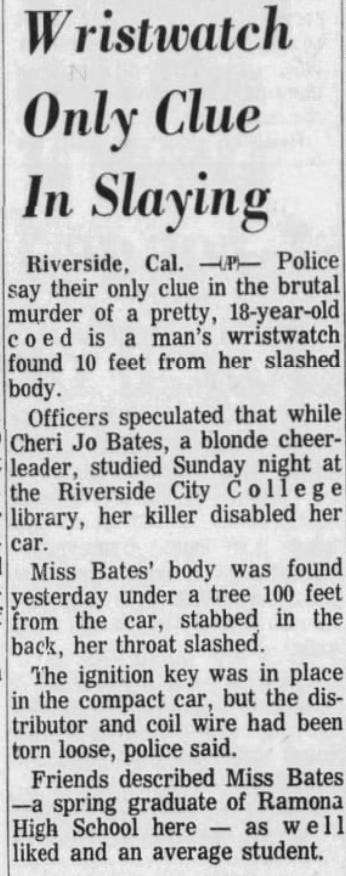
Not far from Cheri Jo’s body, investigators found a cheap watch splattered with paint and a footprint made by a particular type of shoe only sold in military outlets. Despite her small 5 ft 3 in frame, Cheri Jo was athletic, and evidence showed she fought back against her attacker. Residue under her fingernails revealed Cheri Jo had deeply scratched her assailant, and the state of the watch indicated she may have ripped it off his arm.
Cheri Jo’s Beetle was parked approximately 75 yards east of her body, her library books still lying in the front seat. The ignition key was in place, but the ignition wiring and distributor had been pulled loose. Windows on both sides of the front seat were partially rolled down, and smudged handprints and fingerprints were found on the car that investigators believed likely belonged to her murderer.
The autopsy revealed that Cheri Jo’s stab wounds had been caused by a knife approximately three-and-a-half inches in length. The cuts to her neck had severed her jugular and larynx, and the force was so brutal that she had nearly been decapitated.
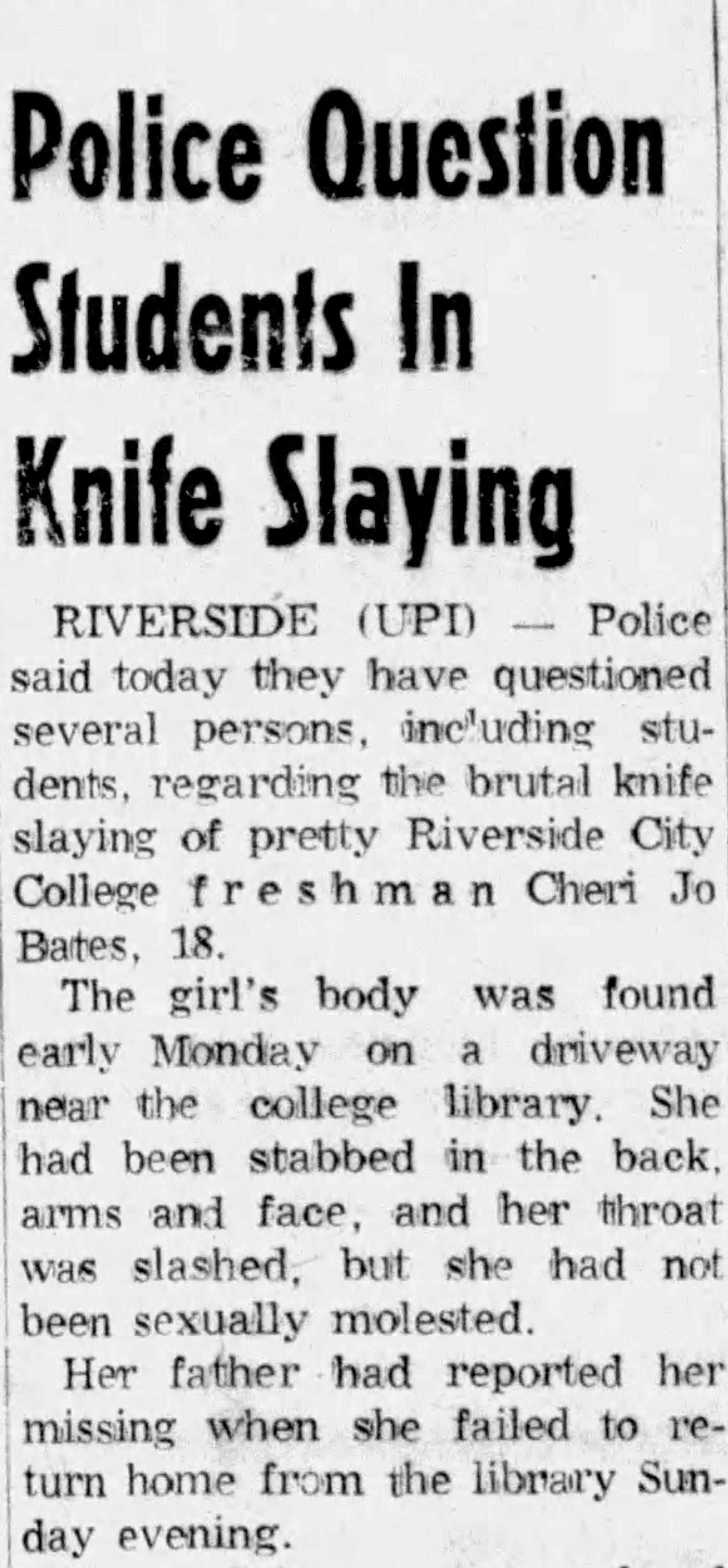
There was no evidence of sexual assault, but further examination of her skull revealed she had been repeatedly kicked in the head. Forensic examiners found skin and brown hair beneath her fingernails. Additional evidence at the scene revealed Cheri Jo had managed to draw blood from her attacker, as trails were found leading away from the crime scene to Terracina Drive, where he presumably ran to after the murder.
Investigation
Within the first twenty-four hours after Cheri Jo’s murder, authorities had interviewed at least 75 people. Many of these witnesses were RCC students, several of whom were able to place Cheri Jo at the library that night. One female student reported seeing a young man, approximately 19 or 20 years old and roughly 5 ft 11 in, lurking across the street from where Cheri Jo’s car was parked and staring at her car near the library’s closing time.
Two separate individuals testified to hearing a woman scream briefly in the direction of Terracina Drive. Another witness reported seeing Cheri Jo’s lime-green Beetle heading toward the RCC campus shortly after 6 p.m., with a bronze 1965 or 1966 Oldsmobile following close behind. Authorities also interviewed military personnel at March Air Force Base due to the unique shoeprint found at the scene.
By November 6th, investigators had managed to rule out all but two people known to be on the RCC campus that night. From the witness statements and autopsy results, authorities placed Cheri Jo’s time of death at approximately 10:15 p.m.
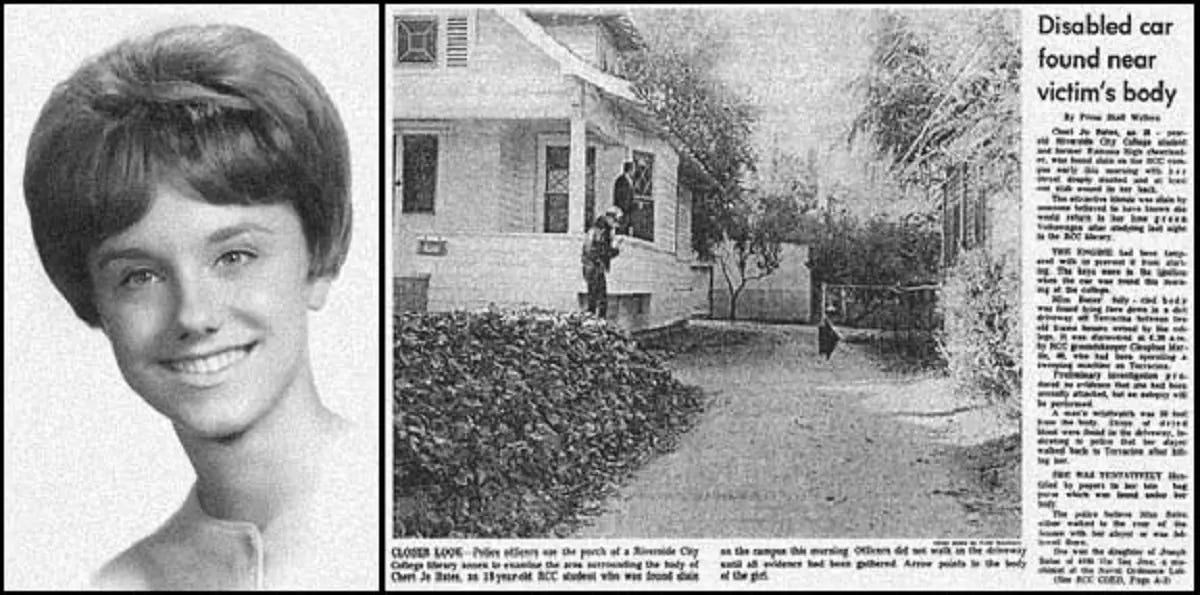
The working theory was that the killer disabled her car, waited, and offered “help” when it wouldn’t start — drawing her away from the lit parking lot before attacking her. The killer may have brandished a weapon or otherwise threatened Cheri Jo after she rolled her windows down, and brought her to a more secluded and dimly lit area before attacking her. With no sexual assault and nothing taken, investigators were hard-pressed to come up with a motive or explanation for the brutal killing.
With the help of 62 RCC students, two librarians, and one custodian, RPD staged a re-enactment of Cheri Jo’s evening in the library. All participants who owned a vehicle were asked to park as close as possible to where they’d parked on the night of the murder, and they were instructed to sit or stand where they’d been inside the library, even as far as wearing the same clothes.
This re-enactment did bring forward more eyewitnesses, but it did not produce any leads that police could use to find Cheri Jo’s killer. Some students remembered seeing a tan-gray Studebaker near the RCC campus that evening, but for whatever reason, police never traced the vehicle to determine its owner.
Cryptic Letters
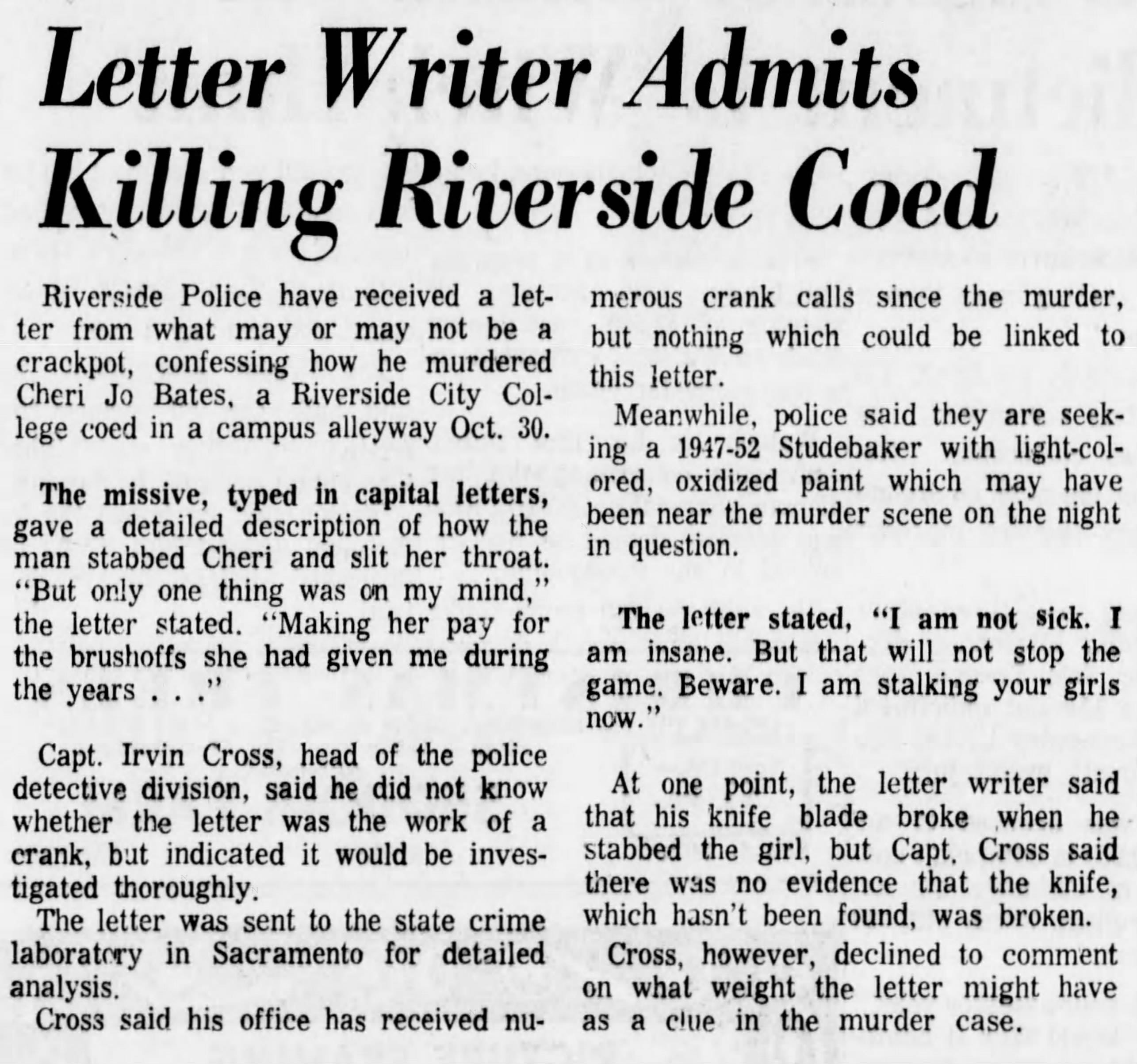
On November 29th, just shy of one month after the murder of Cheri Jo Bates, two letters were sent to the RPD and the Riverside Press-Enterprise. The identical letters described how the killer had tampered with Cheri Jo’s car before watching from a distance as she repeatedly tried to start the engine until the battery died. He then approached her, offering help, stating that his vehicle was just down the street.2
The two then walked away from the library parking lot a short way before he said, “It’s about time.” According to the letter, Cheri Jo replied, “About time for what?” and he responded, “About time for you to die.” The author claims to have then covered Cheri Jo’s mouth with his hand and pressed a knife up to her neck, walking her over to the dimly lit area where the murder occurred.
The author of these letters claimed that he knew Cheri Jo and insinuated that her killing had been an act of revenge for what he perceived as her brushing off his advances for years. Because many details in the letters, such as tampering with the car, had not been released to the public, authorities initially believed the letters were authentic.
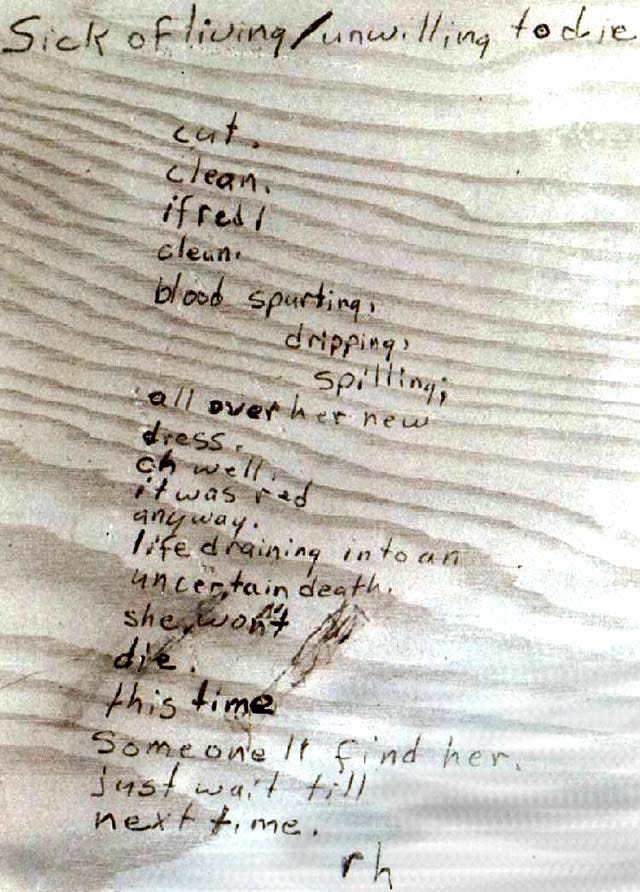
Six months after Cheri Jo’s death, a custodian at RCC discovered a poem of sorts scratched into the underside of a folding desk in the school library. The poem contained multiple graphic allusions to assaulting young women with a knife. Strangely, the language and handwriting resembled what was later seen in the infamous Zodiac letters.
The poem appeared to have been signed with the lowercase initials “r h” at the end. The discovery was made while the desk was in storage, but at the time of the murder, it had been out on the library floor. This poem was retained by investigators as potential circumstantial evidence.
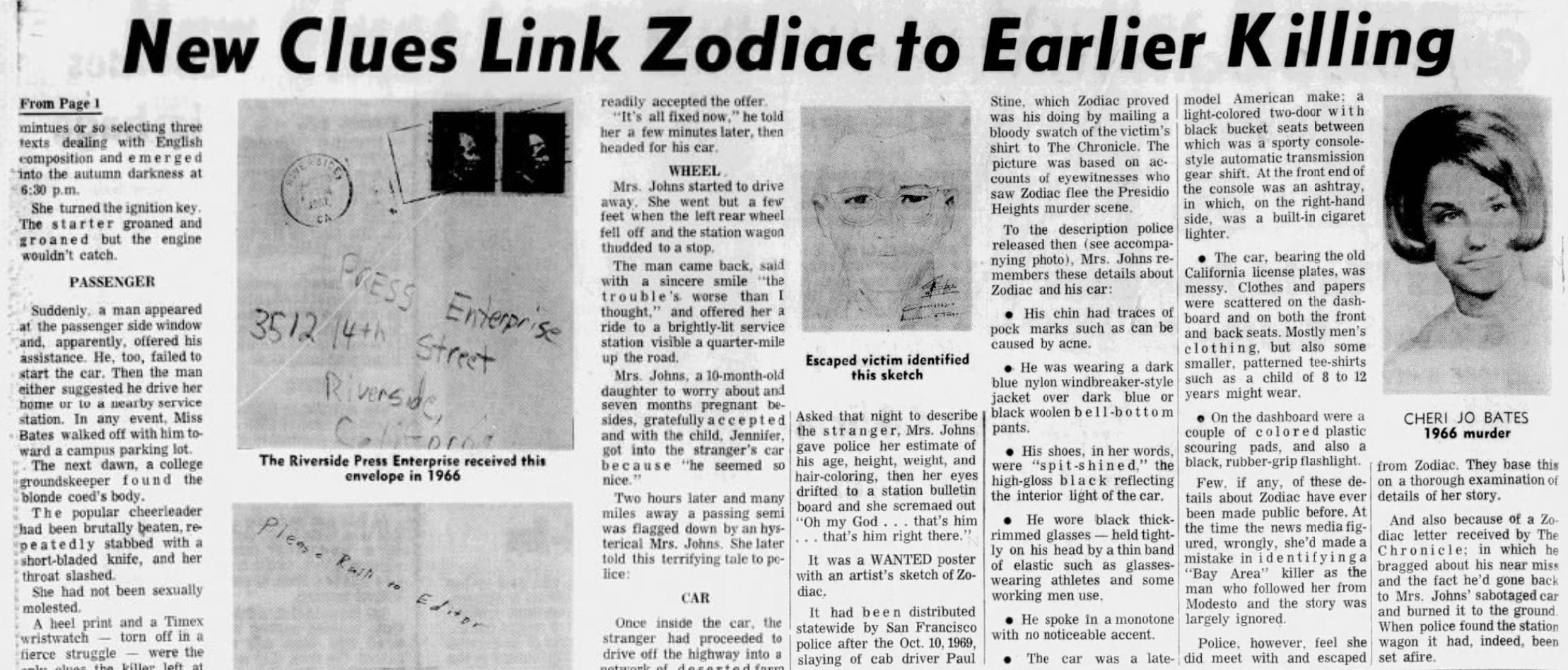
Then, on April 30th, 1967, the Press-Enterprise ran a follow-up story about Cheri Jo’s case. The very next day, RPD and Joseph Bates received handwritten letters that read, “Bates had to die. There will be more.”
Authorities did not believe these letters to be genuine, especially considering the timing, but each was signed with a number or letter, either a “2” or a “Z”, that was impossible to discern. Despite what appeared to be a signature, police felt confident that these letters were a cruel hoax and not communication from the actual murderer.
Zodiac Connection?
In time, some came to believe that Cheri Jo Bates may have been one of the first, or perhaps the very first, victims of the Zodiac Killer.
Famous Zodiac journalist Paul Avery became aware of the potential connection in late 1970. According to Avery, handwriting analysis expert Sherwood Morrill believed the letters sent to the Press-Enterprise and Joseph Bates, and the poem scratched under the desk, were “unquestionably” written by the same person who wrote the infamous Zodiac letters years later.
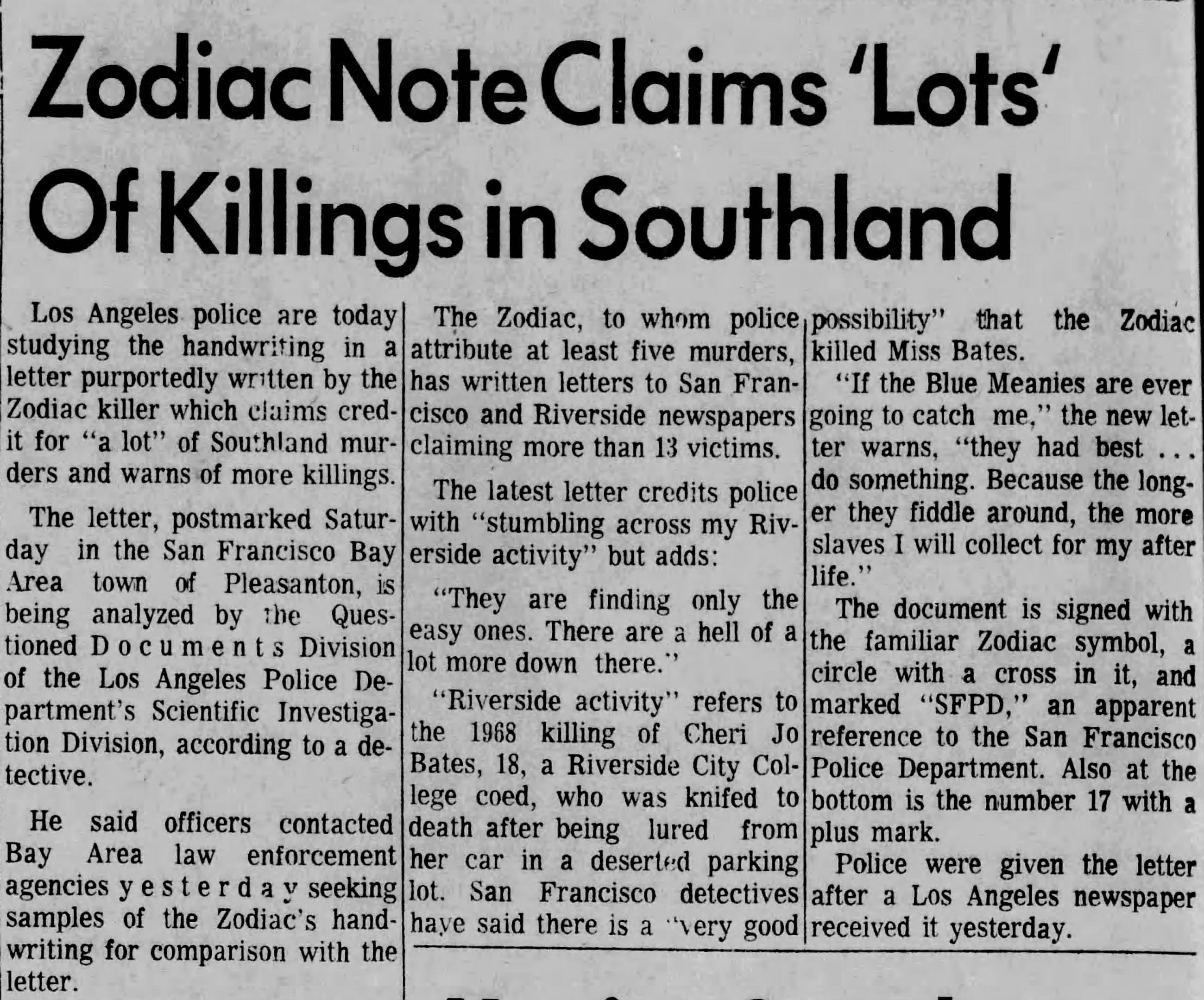
Then, in March 1971, a letter sent to the Los Angeles Times claiming to be from the Zodiac seemed to claim responsibility for Cheri Jo’s murder, citing his “Riverside activity” and how police had only found the “easy” ones. But this link has always been contested: a 1978 postal-laboratory analysis concluded the Zodiac did not write the Bates material, and Riverside police say there is no evidence tying the murder to the Zodiac, believing instead that the killer was local to Riverside County.3
Meanwhile, Steve Hodel became certain that his father, George Hodel, killed Cheri Jo Bates. Many take Hodel’s certainty with heavy skepticism, as he also claimed his father was the Zodiac Killer, the Lipstick Killer, and the murderer of the Black Dahlia.
Current Status of the Case
In August of 2021, the RPD released an update on the letters. Using DNA evidence left on the letters, authorities identified the author in 2020. The author had contacted investigators in 2016, admitting responsibility for the hoax letters and expressing regret for sending them, explaining that he’d been a troubled teenager and wrote the letters to seek attention.
A few months later, in October 2021, a group of retired police officers, intelligence officers and journalists came forward claiming they’d solved the case. According to the group, Cheri Jo’s murder was linked to the Zodiac, and they identified the Zodiac Killer as Gary Francis Poste.
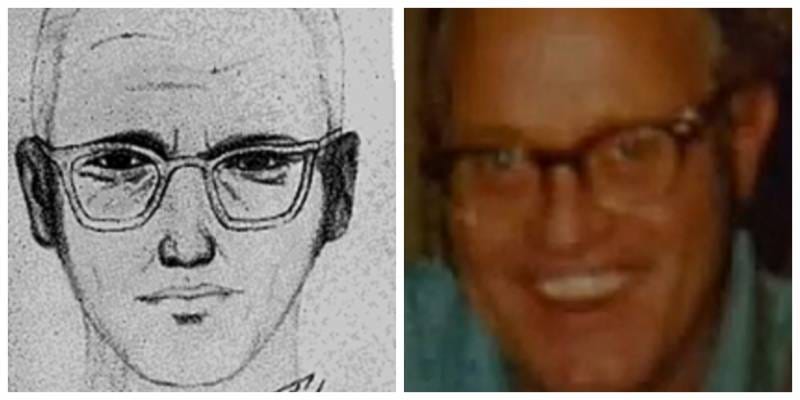
Their evidence was circumstantial but potentially compelling: Poste was a painter, which could explain the paint on the watch, and he had been receiving treatment for a gunshot wound at March Air Force Base around the time of Cheri Jo’s death, perhaps explaining the unique shoeprint. Poste also had brown hair, and evidence under Cheri Jo’s fingernails proved her assailant had brown hair. Despite this, the RPD was skeptical and did not treat it as a credible lead.
To this day, Cheri Jo Bates’ case remains unsolved. The RPD maintains she was not a victim of the Zodiac Killer. Detective Jim Simons has stated there is still one person of interest in the case, but DNA testing of evidence left at the scene does not match this individual. Investigators agree that Cheri Jo likely knew her killer, and many believe the RPD knows who committed the murder but lacks the evidence to prove it in a court of law.
As the 60th anniversary of Cheri Jo’s death approaches, investigators continue to search for answers that may never come. A 1982 police report identified a suspect, but no arrest was made, and the individual’s name has never been released to the public.4 Riverside Police Chief Larry Gonzalez has made it clear that the case remains active and that authorities are using advances in forensic science and DNA technology to pursue every possible lead.

Closing Thoughts
Ken Welty, a former Ramona High classmate of Cheri Jo, has offered a $100,000 reward for information leading to the arrest of her killer. Cheri Jo’s family established a scholarship fund, The Cheri Jo Bates Memorial Endowed Scholarship, for incoming RCC students to honor her legacy.
Anyone with information about the case is encouraged to contact the RPD at [email protected].
“Murder of Cheri Jo Bates.” Wikipedia. Wikimedia Foundation. https://en.wikipedia.org/wiki/Murder_of_Cheri_Jo_Bates
Butterfield, Michael. “Cheri Jo Bates and the Zodiac: Unsolved Crimes and Unanswered Questions.” https://zodiackillerfacts.com/blog/cheri-jo-bates-and-the-zodiac-unsolved-crimes-and-unanswered-questions/
“Cold Case Unit.” Riverside Police Department. https://riversideca.gov/rpd/about-contact/operations/investigations-division/cold-case-unit
McMillan, Rob. “Cold Case Killing of Cheri Jo Bates Continues to Haunt Riverside 6 Decades Later.” ABC7 Los Angeles, June. https://abc7.com/post/killed-cheri-jo-bates-cold-case-continues-haunt-riverside-6-decades-later/19382520/