



Background
Between 1982 and 1994, several women and girls in and around the Kansas City metro area fell victim to a vicious serial killer. After disappearing, their bodies were later found floating in the Missouri River, often partially dismembered. The strange pattern of severing the victims' legs led authorities to link the killings across more than a decade.
The unknown murderer, who came to be known as the Missouri River Killer, was never caught. To this day, the case remains unsolved, though many believe the killer died a free man.
A Chilling Pattern
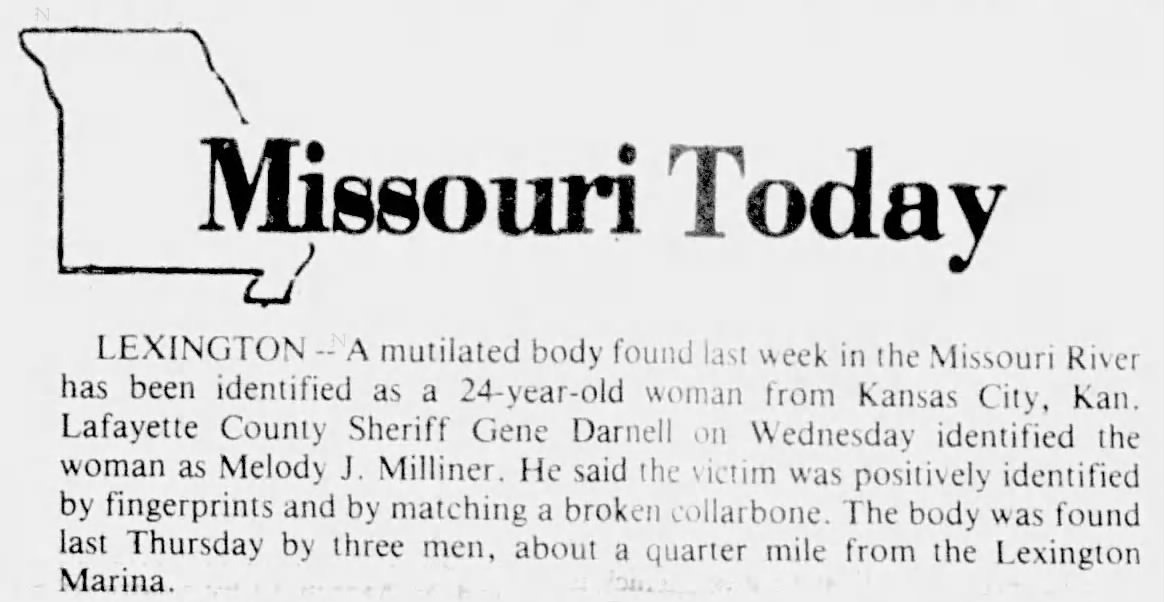
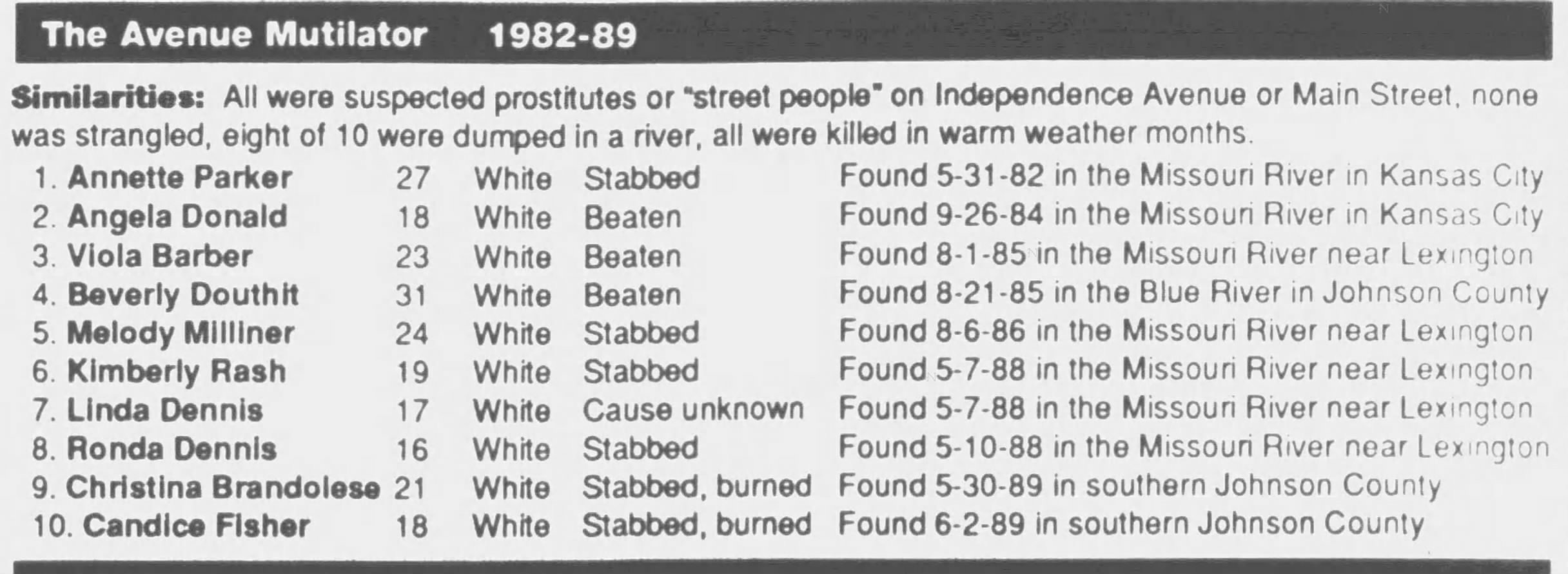
On August 6th, 1986, the body of 24-year-old Melody Jo Milliner was found floating in the Missouri River.1 A resident of Kansas City, Melody had been working as a prostitute to support herself and her 2-year-old daughter, and she could often be found near Independence Avenue.
Police initially theorized she may have met her killer while working on the street. Her father owned a farm in Kansas that Melody often visited, and according to him, she was, or had been, assisting police with an ongoing investigation prior to her death. The autopsy revealed she had died from multiple stab wounds.
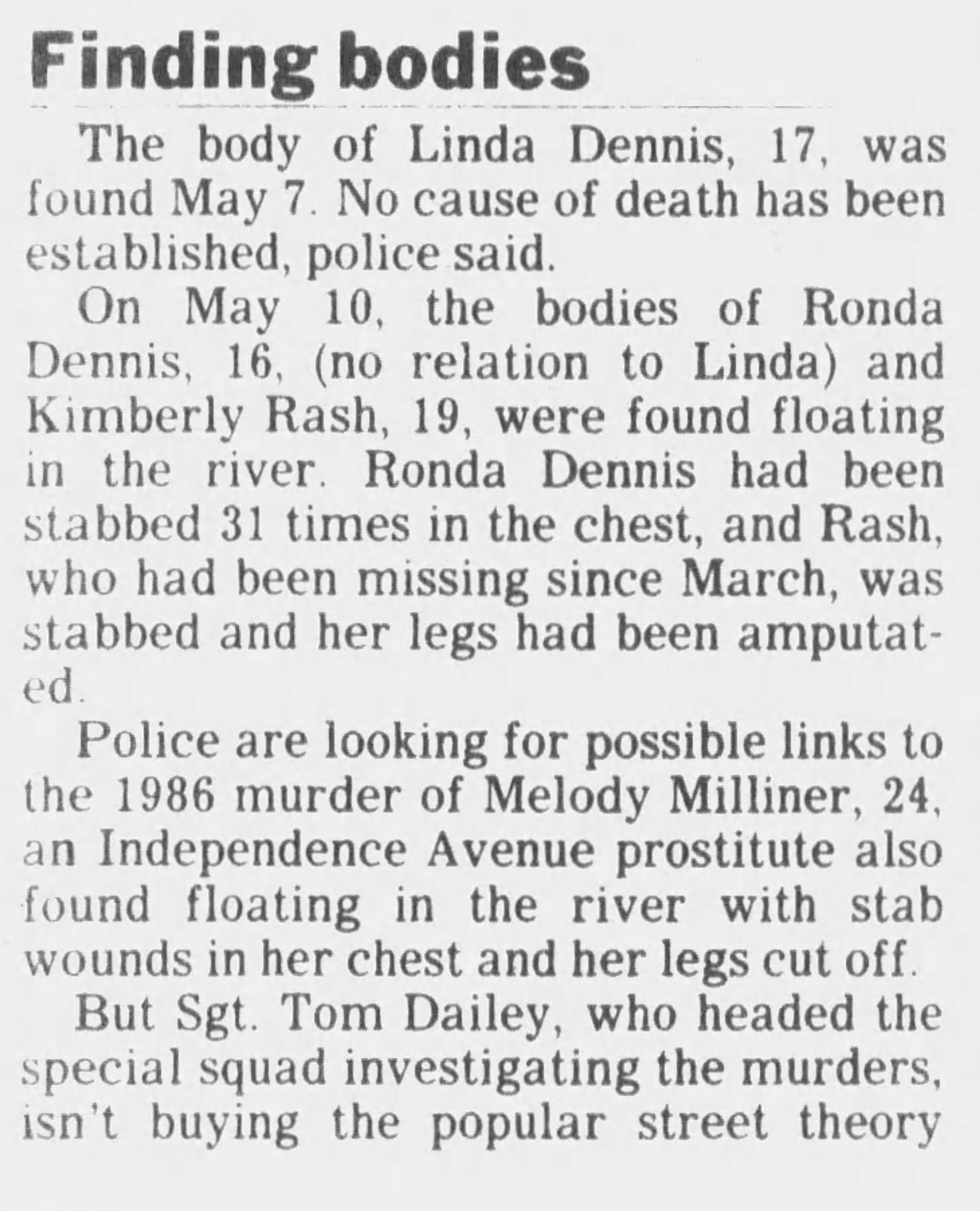
Less than two years later, on May 7th, 1988, the body of Linda Dennis was found on the north side of the river. Also a native of Kansas City, Linda was only 17. Authorities could not determine a cause of death due to the advanced state of decomposition, but her body was found entangled in driftwood in a manner that suggested foul play. Linda had previously been arrested on a prostitution charge that was later dropped; though she may still have been working, police could not develop solid leads.
The next discovery came only three days later, when a fisherman found the body of 19-year-old Kimberly Rash, who had gone missing little more than a month earlier. Like Melody, Kimberly had worked as a prostitute in Kansas City, though not in the same areas, and like Melody, she had died of multiple stab wounds (more than 31).
The links between these cases could no longer be ignored.
The very same day, 16-year-old Rhonda Dennis was found floating in the river. She had also been stabbed, precisely 31 times, and her clothes had been removed. Unlike some earlier victims, Rhonda had no known history of prostitution; the one potential link was that she lived on Independence Avenue, the same street where Melody usually worked. A pattern was emerging.
A Disturbing M.O.
Beyond the other similarities, one bizarre detail recurred among the recovered bodies. In the cases of Melody and Kimberly, both of their legs had been amputated. Two bodies turning up within two years of each other, in the same river, each one with both legs removed, this detail all but eliminated the possibility of coincidence.
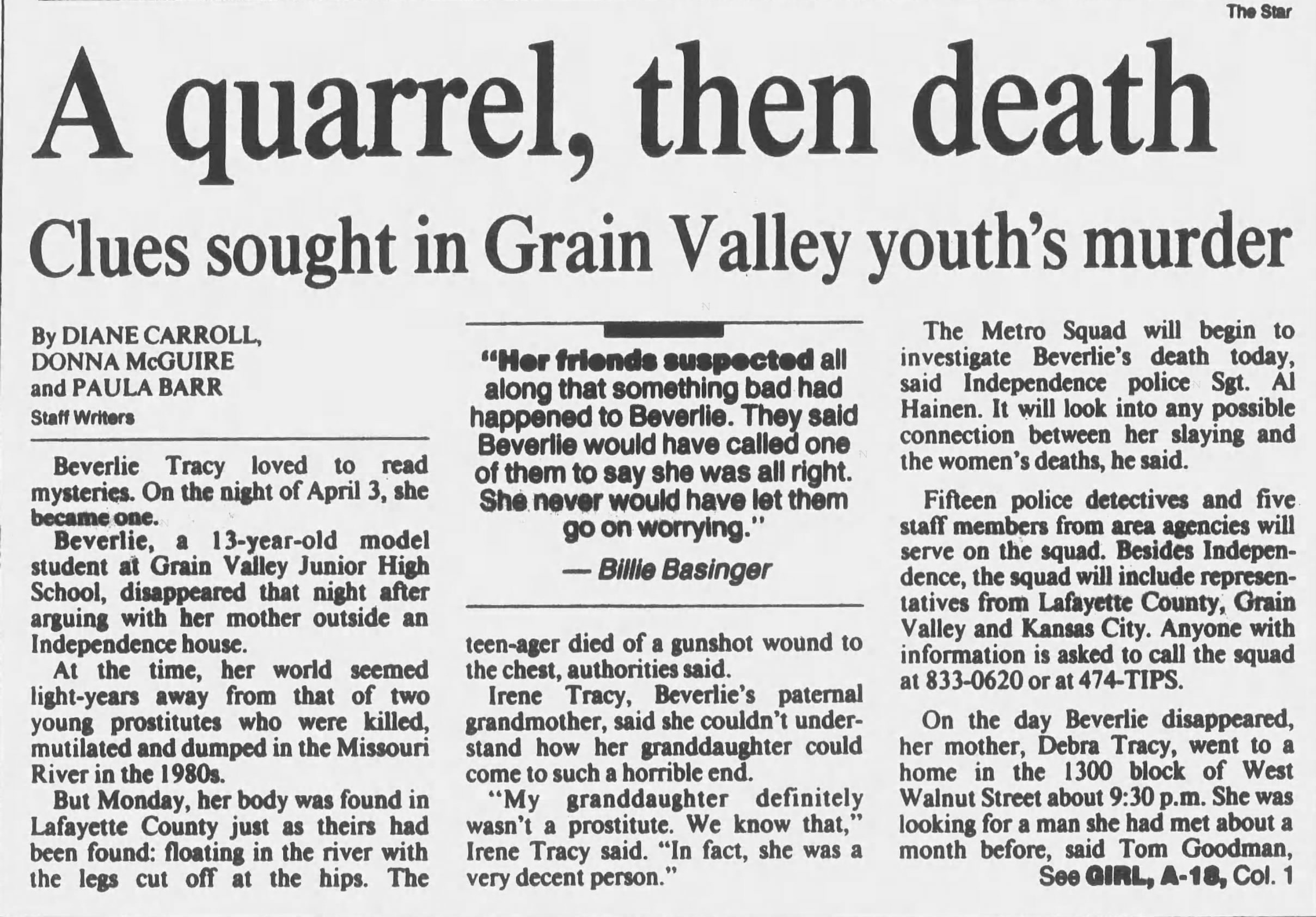
When 13-year-old Beverlie Tracy's body was found floating in the river on April 15th, 1991, eleven days after she was reported missing, police suspected the same offender. Although Beverlie had died of gunshot wounds to the chest rather than stab wounds, both of her legs had been amputated.
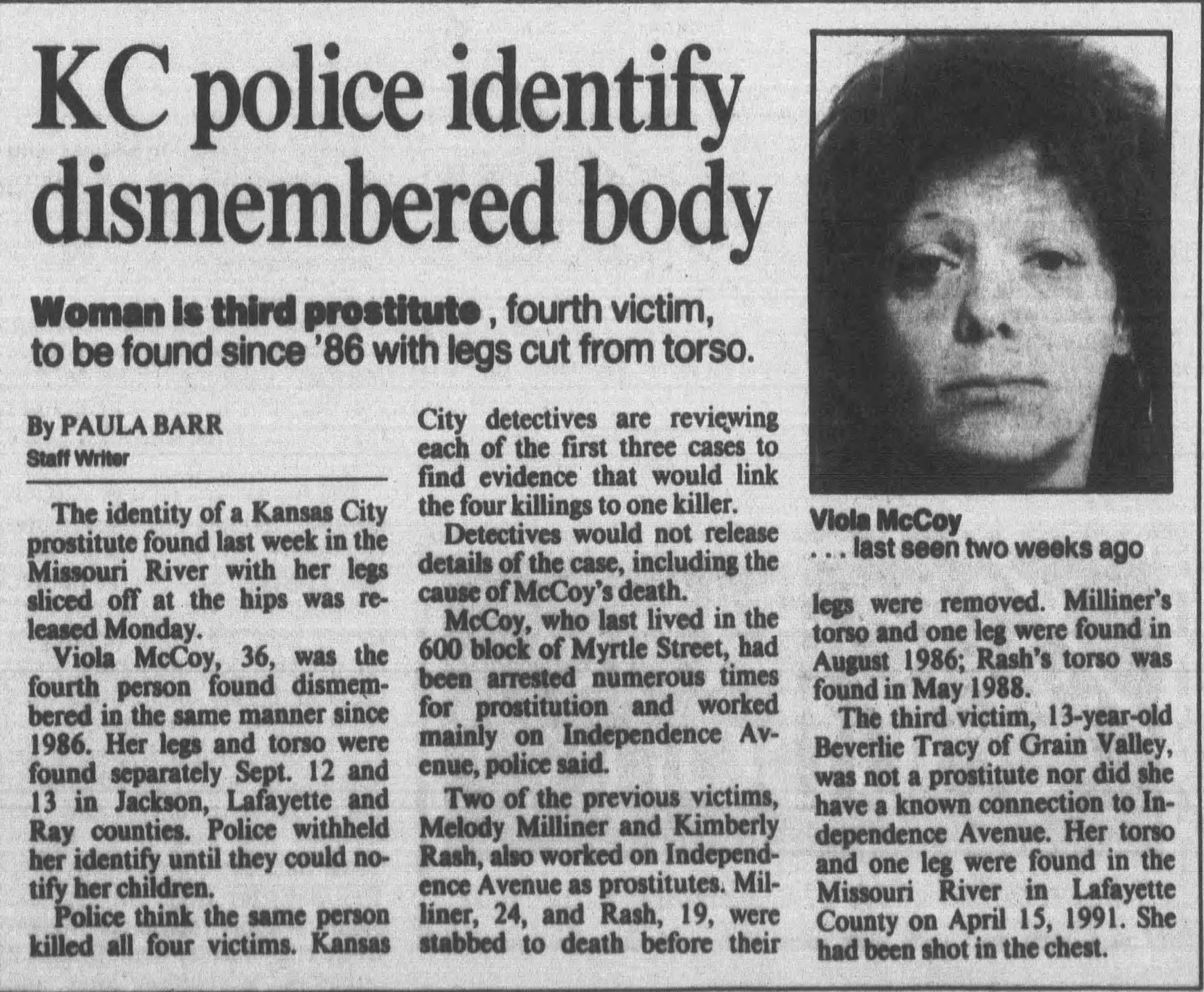
Three years later, on September 12th, 1994, the gruesome M.O. resurfaced. No body was found at first — only a severed leg. The following day, the torso of 36-year-old Viola McCoy was recovered.
Viola had last been seen on September 8th after reportedly running off following an argument with her boyfriend, and she had a history of drug abuse. Whatever the circumstances, the amputation of her legs suggested her case was related to the others.
The recurring pattern prompted police to re-examine older unsolved cases, and in doing so they may have identified the killer's first victim. Annette K. Parker, 27, had been found floating in the Missouri River on May 31st, 1982. She had been stabbed 13 times in the chest and had a rope tied around her neck.
Unlike the later victims, Annette was not from Kansas City but from Omaha, Nebraska, and had been missing a little over a week when two fishermen found her. Because of the similarity in M.O., police came to believe Annette was the earliest victim of the Missouri River Killer.
Suspects
In 1988, following the discovery of Linda, Kimberly, and Rhonda, the FBI joined a special unit with officers from Ray County and the Kansas City Police Department. Within a month, however, the task force was disbanded, and the FBI withdrew. As Ray County Sheriff Tom Harmon told the Columbia Daily Tribune in June 1988, investigators “just couldn’t put anything together.”2
However, authorities promised to pursue any new leads.
In August 1992, police thought they had a suspect: a local Kansas City doctor previously charged with drugging and sexually assaulting two female patients during house calls. Speculation ran wild after Grain Valley Police Chief Skip Hedges claimed the doctor's office was located near Independence Avenue, implying a link to the area where Melody worked and Beverlie lived.
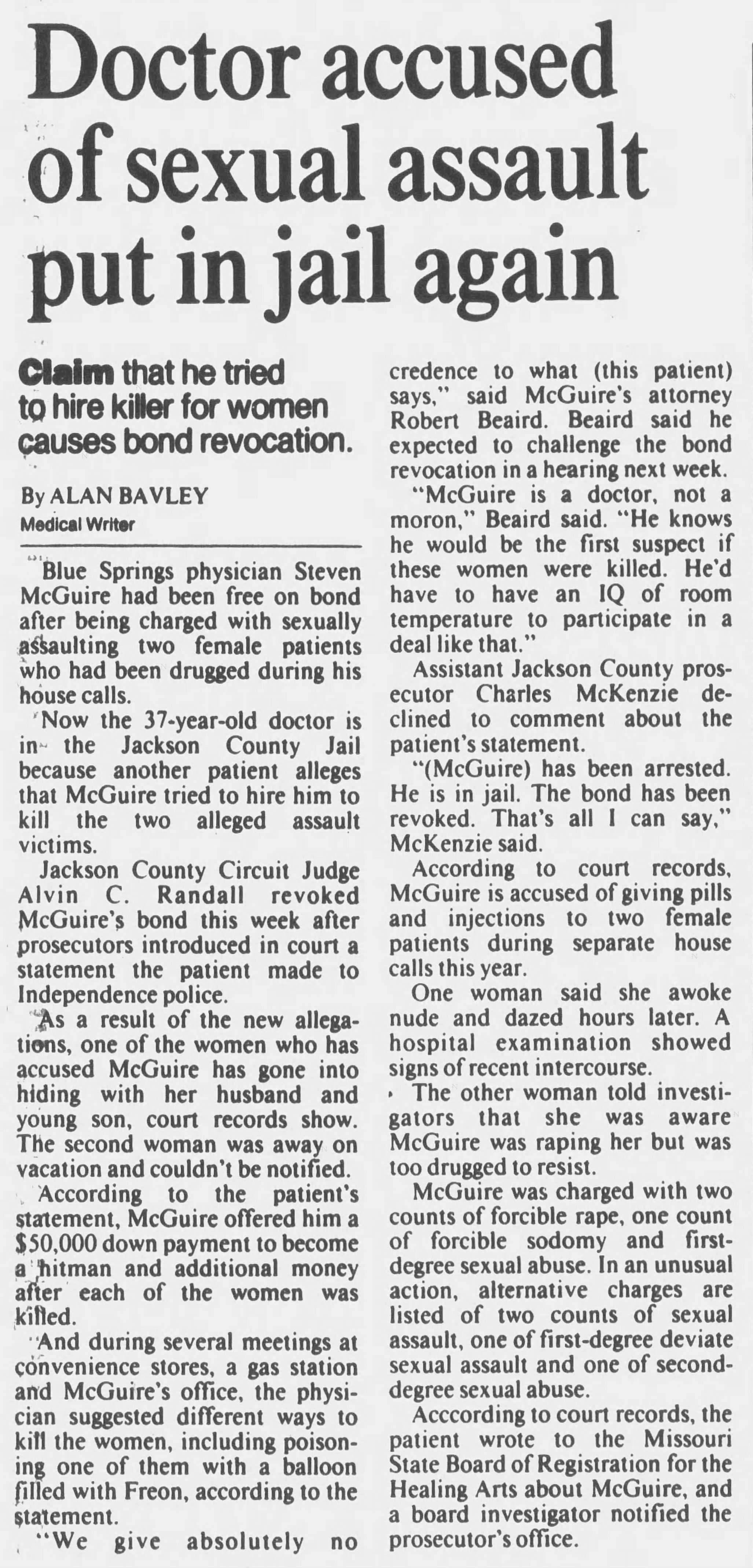
That claim about the office location proved false, and no evidence tied the doctor to the murders. His attorney, Robert Beaird, called the investigation ludicrous, saying he "wouldn't be surprised if next week we hear a report that ties [his client] to the Kennedy assassination."3
During the investigation, police focused on a man named Gregory Breeden. A Kansas City supply clerk who had served in the U.S. Navy from 1965 to 1968, Breeden had initially been looked at in relation to Annette Parker's death. He claimed the two were engaged and was released without charge. He would nonetheless become the primary suspect in Parker's death and the six other killings authorities attributed to the same offender.

On November 2nd, 1994, Kansas City Police raided Breeden's home in the middle of the night. He was arrested on check-forgery charges, but during the search, authorities recovered 19 knives as well as clothing that resembled the type Melody Milliner had been wearing when she disappeared.
In 1996, while Breeden was serving a 10-year sentence for check fraud, he was indicted for Viola McCoy's murder. Even still, bodies continued to surface in the river during his incarceration, though investigators at the time considered them unrelated.
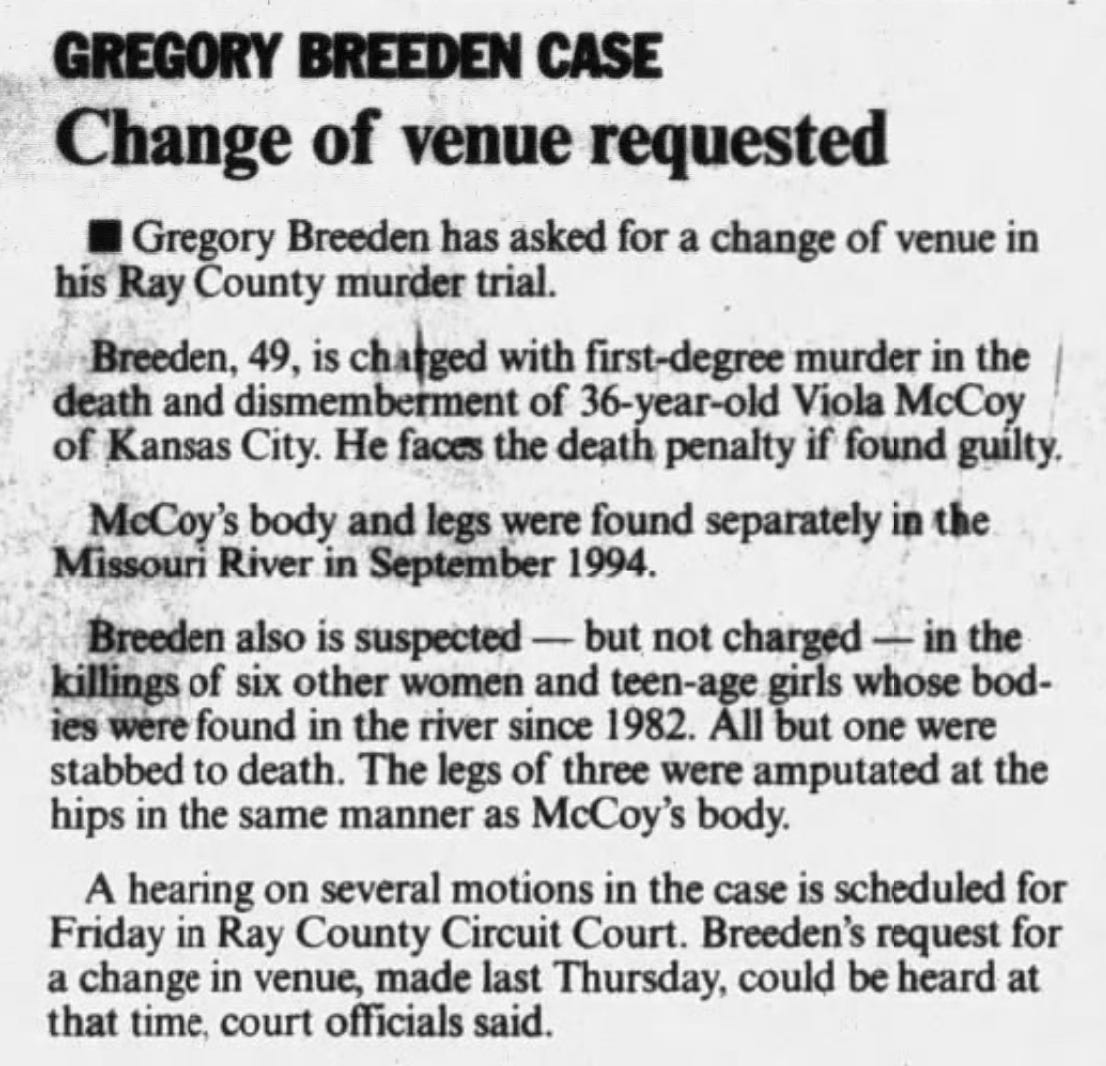
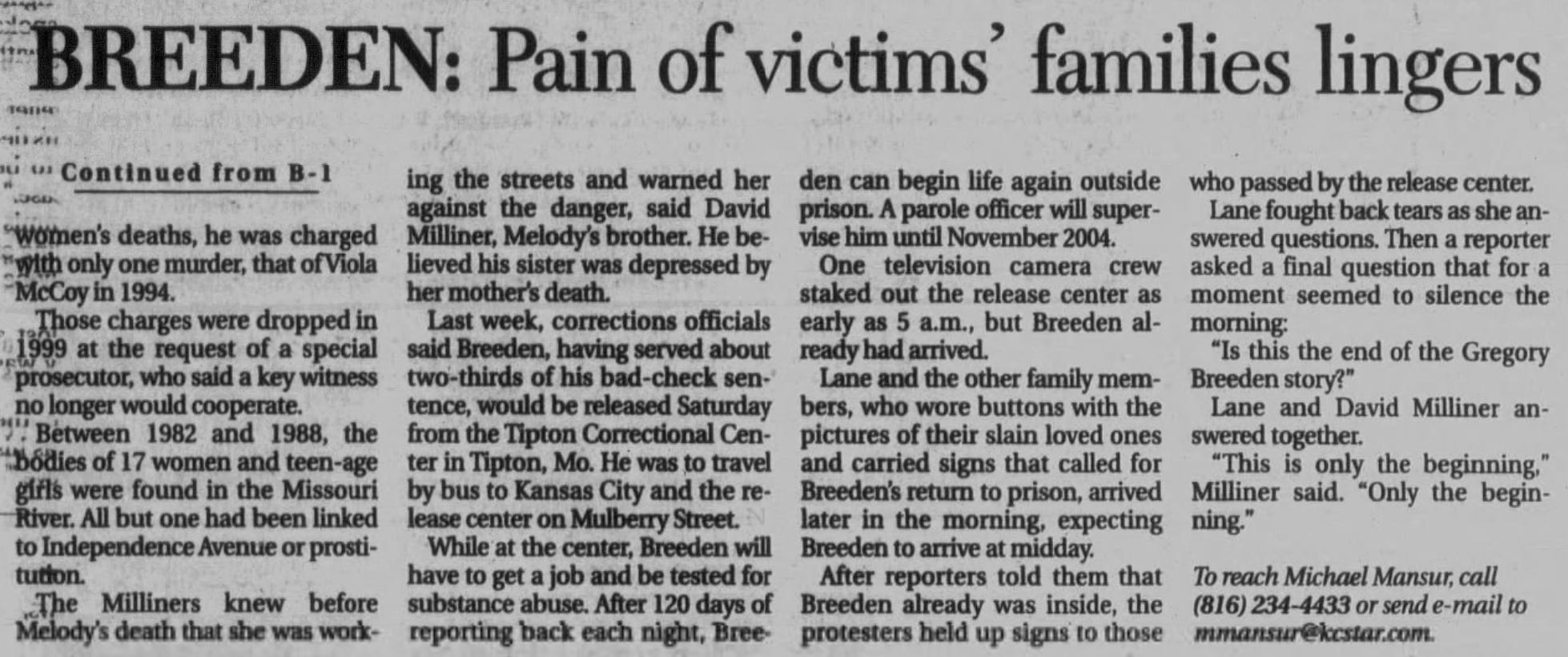
On April 1st, 1999, the murder charge was dropped due to a lack of evidence after a jailhouse informant refused to cooperate. After his release, Breeden maintained his innocence, admitting he knew some of the women from the Independence Avenue area but denying any involvement in their deaths.
In May 2014, Breeden was found dead in his Bates County motel room, believed to have been dead for as long as a week; his death was ruled natural.4 As the last primary suspect, his passing was a blow to victims’ families still searching for answers.
Closing Thoughts
With the death of the primary suspect and the absence of any significant new leads, investigators had little to go on. The case remains open, and anyone with information is encouraged to come forward. However long ago it may seem, the families of these women still hope for the closure they deserve.
"Missouri Today.” Lake Sun Leader, August 14, 1986, p. 3. https://www.newspapers.com/image/
"Squad Investigating Bodies in River Disbands." Columbia Daily Tribune, June 2, 1988, p. 11. https://www.newspapers.com/image/1020085115/
Barr, Paula. "Possible Links between Slaying, Doctor under Arrest Are Doubted." Kansas City Star, August 21, 1992, p. 30. https://www.newspapers.com/image/682336900/
Breit, Peggy. "Former Suspect in Missouri Murder Spree Found Dead." KMBC, 2014. https://www.kmbc.com/article/former-suspect-in-missouri-murder-spree-found-dead/3682546
Yet, most of the immense violence committed by humankind is against largely defenseless animals — mostly for food but also trophy hunting, perceived medicinal uses, and gratuitous body wear — their blood literally shed and bodies eaten, or wasted, in mind-boggling quantity by our fundamentally predatory omnivore species.
It even leaves me wondering whether the metaphorical Tree of Knowledge’s forbidden fruit of Eden eaten by the Biblical Adam and Eve was actually God’s four-legged creation. I'm not a vegetarian (let alone a vegan), but I can still see that act really angering the Almighty — a lot more than the couple’s eating non-sentient, non-living, non-bloody fruit.
As strange or lame as it sounds, when I do eat meat (however relatively little) I distract my thoughts from what I’m actually eating — indeed once living, moving, bloody animal flesh — which, for me at least, is one (perhaps small) step below cannibalism. ... My continued meat-eating is due mostly to weakness, but I intend to toughen up on this matter.
Also, maybe animal growing, slaughtering and/or eating is as bad for one's spirit as it can be for one's body, not to mention the natural environment.
For example, during my youth, I spent many commercial fishing seasons on my (now deceased) father's boat, and often enough the deck would be covered by dead fish sliding around in a pool of their own thick blood-reddened slime. I now wonder whether such sights, and cleaning them from his boat a few hours later, may have had some negative psychological, if not also spiritual, effect on him (or similarly on other people tasked with the slaughter of food animals/creatures)?
Along with our ‘intelligence’ comes a proportionate reprehensible potential for evil behavior, e.g. malice for malice’s sake. But with animals, especially our four-legged friends, there definitely is a beautiful absence of undesirable distinctly-human traits.
While animals can react violently, it is typically due to reactive distrust/dislike or necessity/sustenance. But leave it to us humans, with our greater ‘thinking’ capacity, to commit a spiteful act, even if only because we can.